

Last Updated: August 2026
If you finance a vehicle, your state may not legally require “full coverage,” but your loan agreement will usually require insurance that protects the lender’s collateral. In practice, that commonly means maintaining collision and comprehensive coverage in addition to the liability and other coverage required by state law.
Quick answer: Read the insurance section of your loan contract before changing coverage. Most financed vehicles must keep collision and comprehensive coverage until the loan is paid off. If coverage is canceled or lapses, the lender may buy force-placed insurance and charge you for it. That coverage may protect the lender and vehicle without providing the protection you expect for yourself.
Compare equivalent coverage and confirm the lender’s requirements before changing your policy.
Why Financed Cars Usually Need More Than Liability Insurance
Liability insurance generally helps pay for injuries or property damage you cause to other people, up to the policy limits. It normally does not repair or replace your own vehicle after an at-fault collision, theft, fire, vandalism, flood, hail, or similar loss.
A lender has a financial interest in the vehicle until the loan is satisfied. If the car is badly damaged or stolen, the borrower still owes the loan balance. Requiring collision and comprehensive coverage reduces the lender’s risk that its collateral disappears while the debt remains unpaid.
The NAIC explains that collision and comprehensive are generally not required by state law, but a lender may require them on a financed or leased vehicle. State-required insurance and contract-required insurance are therefore two different layers.
What “Full Coverage” Usually Means
“Full coverage” is a common phrase, not one standardized insurance policy. It usually refers to a policy combining liability coverage with collision and comprehensive coverage. Depending on the state and policy, it may also include uninsured or underinsured motorist coverage, medical payments, personal injury protection, rental reimbursement, roadside assistance, or other options.
| Coverage | What It Generally Addresses | Why It Matters on a Financed Car |
|---|---|---|
| Liability | Injury or property damage you cause to others | Helps meet state requirements but does not protect the financed vehicle itself |
| Collision | Damage to your car from a collision or rollover, subject to terms and deductible | Protects the lender’s collateral after many crash losses |
| Comprehensive | Covered non-collision losses such as theft, fire, weather, or vandalism | Protects the vehicle from covered losses outside a collision |
| GAP product | May cover some difference between vehicle value and qualifying loan balance after a covered total loss | Does not replace collision, comprehensive, or liability coverage |
Review Full Coverage vs. Liability Insurance for a more detailed comparison.
Decision Module 1: What Coverage Must You Keep?
- Check state law: Maintain the liability and other coverage required where the vehicle is registered.
- Read the loan contract: Identify required physical-damage coverage, maximum deductibles, loss-payee wording, and proof requirements.
- Check the current policy: Verify that the financed vehicle, lender, coverage, and effective dates are correct.
- Ask before changing: Confirm uncertain requirements with the lender or loan servicer in writing.
The ordinary state minimum may be lower than the loan agreement requires. Use Minimum Car Insurance Requirements by State as a starting point, then follow the loan contract.
What Happens If You Do Not Maintain the Required Coverage?
Insurers may notify a listed lender when a policy is canceled, expires, or changes in a way that affects its interest. The lender or servicer may then ask for proof of replacement coverage. If the problem is not resolved, the loan contract may allow additional action.
- The lender may purchase force-placed or collateral-protection coverage.
- The cost may be charged to the borrower or added to the amount due.
- The borrower may still lack liability, medical, personal-property, rental, or other expected protection.
- The lapse or failure to meet contract terms may create default-related consequences allowed by the agreement and applicable law.
- If a loss occurs while coverage is missing, the borrower may remain responsible for the loan and uninsured losses.
Repossession is not an automatic result of every insurance problem. Consequences depend on the contract, notices, lender actions, payment status, and applicable law. Respond promptly instead of assuming the issue will correct itself.
What Is Force-Placed Insurance?
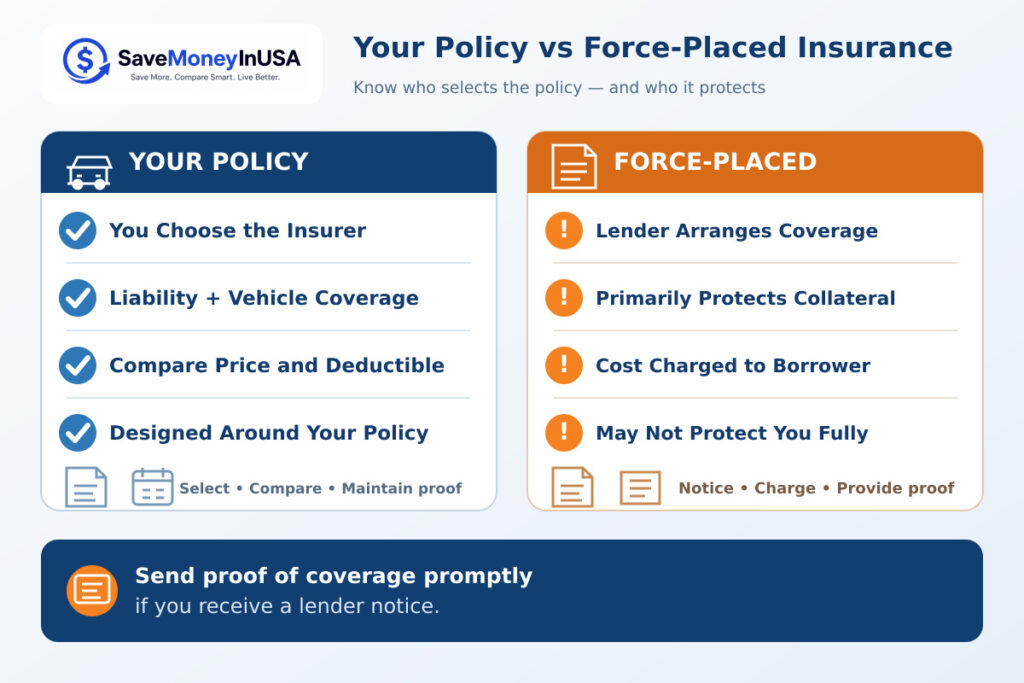
Force-placed insurance is coverage obtained by a lender when the borrower does not maintain the insurance required by the vehicle loan. The CFPB explains that this coverage protects the lender and vehicle, but not necessarily the borrower. The lender charges the borrower for the coverage.
| Feature | Your Auto Policy | Force-Placed Coverage |
|---|---|---|
| Who selects it? | You select an insurer and policy | The lender or servicer arranges it under the contract |
| Primary protection | Coverage is structured for the insured and vehicle | Primarily protects the lender’s interest and collateral |
| Liability protection | May include required liability coverage | May not provide the liability protection you need |
| Cost control | You can compare insurers and options | You may have limited control and still be charged |
| How to end it | Replace or cancel according to policy and contract terms | Provide acceptable proof and request cancellation or correction |
If force-placed coverage appears incorrectly, contact the servicer immediately. Send proof showing the insurer, vehicle, required coverage, policy number, and effective dates. Request written confirmation that the lender received the proof and ask whether charges will be canceled or adjusted for any overlapping period. Keep copies of every notice and communication.
Decision Module 2: How Should You Respond to an Insurance Notice?
- Coverage is active: Send the declarations page or other requested proof promptly and verify receipt.
- Coverage information is wrong: Ask the insurer to correct the vehicle, lender, loss payee, or effective dates.
- Policy actually lapsed: Seek reinstatement or replacement coverage immediately without driving uninsured.
- Force-placed charge continues: Request an itemized explanation and follow the servicer’s dispute process.
- Problem remains unresolved: Consider contacting the state insurance department, CFPB, or qualified legal help as appropriate.
How Deductibles Affect a Financed-Car Policy
Collision and comprehensive coverage usually have deductibles. Raising a deductible may lower the premium, but the lender may limit how high it can be. A deductible that satisfies the loan agreement can still be financially unsafe if you could not pay it after a claim.
Request quotes at permitted deductible levels while keeping every other input unchanged. Compare the added out-of-pocket risk with the annual premium difference. See Car Insurance Deductible Explained before making the change.
How to Lower the Cost Without Violating the Loan Agreement
Compare Equivalent Policies
Use the same drivers, vehicle, liability limits, collision and comprehensive coverage, deductibles, and optional benefits. Record the amount due today, full policy-term premium, installment fees, and included discounts. Follow the quote comparison guide to avoid comparing unequal protection.
Ask About Eligible Discounts
Possible discounts may involve multiple vehicles, multiple policies, vehicle safety equipment, low mileage, approved driving programs, automatic payment, or paperless billing. Availability and savings vary. Confirm what is already included and what is required to keep each discount.
Remove Only Truly Optional Add-Ons
Rental reimbursement, roadside assistance, or other add-ons may be optional, but evaluate the retained risk before removing them. Do not confuse an optional benefit with lender-required collision or comprehensive coverage.
Review Billing Options
Compare monthly and paid-in-full totals, including installment fees. Choose a schedule you can maintain without weakening emergency savings or risking a lapse.
For additional premium-reduction strategies, see How to Save Money on Car Insurance in the USA. You can also browse the Car Insurance Guides Resource Center for related financing, GAP, coverage, deductible, payment, and state-specific topics.
Does GAP Replace Full Coverage?
No. GAP is generally an optional product intended to cover some or all of the difference between the qualifying loan balance and the insurer’s vehicle-value payment after a covered theft or total loss. It does not replace liability, collision, or comprehensive coverage, and restrictions or exclusions may apply.
The CFPB advises consumers to compare the price and terms because GAP may be sold by a dealer, lender, or insurer and financing the cost can increase the loan balance and total interest. Read What Is GAP Insurance and Do You Need It? before purchasing or canceling it.
When Can You Remove Collision and Comprehensive?
Do not remove required coverage merely because the balance is low or the vehicle is older. Wait until the loan is satisfied and the lender confirms that its interest has ended. Then reassess the vehicle’s value, deductible, premium, savings, replacement needs, and ability to absorb a loss.
Even after payoff, collision and comprehensive may still be worthwhile. The decision becomes yours rather than the lender’s. Compare the car’s current value, the annual premium, your deductible, and how much financial loss you could absorb before removing either coverage.
Common Mistakes With Insurance on a Financed Car
- Assuming the state minimum automatically satisfies the loan contract
- Canceling collision or comprehensive before the loan is paid
- Ignoring a lender’s request for proof when coverage is actually active
- Assuming force-placed insurance provides normal personal auto coverage
- Choosing a deductible above the lender’s limit or personal budget
- Treating GAP as a replacement for collision and comprehensive
- Canceling an old policy before the replacement policy is active
Frequently Asked Questions
Is full coverage required by law on a financed car?
Collision and comprehensive are generally lender requirements rather than ordinary state-law requirements. State liability and other mandatory coverages still apply. Read both the law and loan agreement.
Will the lender know if my insurance is canceled?
The lender may receive notice because it is listed on the policy as having an interest in the vehicle. It may also request updated proof. Do not assume cancellation will remain unnoticed.
Can a lender add insurance without my permission?
The loan contract commonly allows the lender to obtain coverage when required insurance is missing and charge the borrower. Exact rights, notices, and procedures depend on the agreement and applicable law.
Does financing itself increase my insurance rate?
The loan requirement can increase the amount of coverage you buy compared with liability only. The actual premium depends on the vehicle, driver, coverage, location, deductible, insurer, and approved rating factors.
What should I do if force-placed coverage is incorrect?
Contact the servicer, provide complete proof for the disputed period, verify receipt, request cancellation or correction, and keep written records. Escalate through available complaint or legal channels if the issue remains unresolved.
Final Takeaway
A financed car usually needs collision and comprehensive coverage because the loan agreement protects the lender’s collateral. Liability-only insurance generally does not satisfy that requirement. Before changing coverage, read the contract, confirm permitted deductibles, compare equivalent quotes, and keep proof current. Preventing a lapse is usually safer and less costly than allowing force-placed insurance to take over.
Sources
- National Association of Insurance Commissioners — Auto Insurance
- National Association of Insurance Commissioners — A Consumer’s Guide to Auto Insurance
- Consumer Financial Protection Bureau — Auto Insurance Options When Financing a Car
- Consumer Financial Protection Bureau — What Is Force-Placed Insurance?
- Consumer Financial Protection Bureau — What Is GAP Insurance?
About the Author
The SaveMoneyInUSA Editorial Team researches car insurance costs, coverage options, state requirements, discounts, and quote-comparison considerations for drivers in the United States.
Learn more about our Editorial Team.
Disclaimer
SaveMoneyInUSA is an independent informational website and is not an insurance company, broker, lender, dealer, or agent.
Some links may be affiliate links. We may receive compensation from partners at no additional cost to users.
Insurance premiums, coverage definitions, loan terms, lender requirements, force-placed coverage, GAP terms, and eligibility vary by insurer, lender, contract, state law, and individual circumstances.
This content is provided for educational purposes only and should not be considered insurance, legal, or financial advice.