

Last Updated: August 2026
A car insurance deductible is the portion of a covered vehicle-damage claim that you are responsible for paying. The deductible you select can affect both your insurance premium and the amount you may need to cover after an accident, theft, storm, or other covered loss.
Choosing a deductible should not be based only on the lowest monthly premium. A higher deductible may reduce the cost of collision or comprehensive coverage, but it also increases your financial responsibility when you use that coverage.
Quick answer: A car insurance deductible is the amount of an eligible covered loss that remains your responsibility under a coverage that includes one. Deductibles most commonly apply to collision and comprehensive coverage. A higher deductible may reduce the premium for that coverage, but it also increases your share after a covered loss. Choose an amount you could realistically pay from available savings. A deductible generally applies to each relevant claim rather than once per year.

Before comparing deductible options, review your current declarations page or coverage summary. Collision and comprehensive coverage may have separate deductible amounts, and the rules can vary by policy and state.
What Is a Car Insurance Deductible?
A car insurance deductible is the amount of an eligible covered loss that remains your responsibility before or as part of the insurer’s claim payment. The exact process depends on the type of claim, the repair arrangement, the policy terms, and how the insurer issues payment.
For example, suppose your vehicle has $3,000 of covered collision damage and your collision deductible is $500. Subject to the policy and approved claim amount:
- Your responsibility would generally be $500.
- The insurer could pay the remaining $2,500 of the approved covered loss.
If the same covered loss were subject to a $1,000 deductible, your responsibility would generally be $1,000 and the insurer could pay the remaining $2,000.
A deductible is not normally an annual spending limit. It generally applies separately to each covered claim for which that deductible is required. Always check the policy because coverage terms and exceptions vary.
Which Car Insurance Coverages Usually Have a Deductible?
Deductibles are most commonly associated with coverage for physical damage to your own vehicle. They do not necessarily apply to every section of an auto insurance policy.
Collision coverage
Collision coverage generally helps pay for eligible damage to your vehicle caused by a collision with another vehicle or object, or by the vehicle overturning, subject to the policy terms.
Collision coverage usually has a deductible. Common choices may include $250, $500, $1,000, or another amount offered by the insurer.
Comprehensive coverage
Comprehensive coverage, sometimes described as other-than-collision coverage, generally helps cover certain non-collision losses. Depending on the policy, these may include theft, vandalism, fire, hail, falling objects, flood, or contact with an animal.
Comprehensive coverage also commonly has a deductible. Your comprehensive deductible does not have to be the same as your collision deductible if the insurer offers different choices.
Other coverage that may have a deductible
Some policies or states may apply deductibles to other types of coverage, such as certain uninsured motorist property-damage, personal injury protection, glass, or special endorsement claims. Other policies may offer reduced or waived deductibles for specified losses.
Because these rules vary, do not assume that a deductible does or does not apply based only on the coverage name. Review the declarations page, policy language, and endorsements or ask the insurer for clarification.
Liability insurance
Auto liability coverage generally does not use a deductible in the same way collision and comprehensive coverage do. Liability insurance helps pay eligible costs when you are legally responsible for injury or property damage to another party, up to the applicable limits and subject to the policy terms.
For a broader explanation of these coverage categories, see our guide to full coverage versus liability insurance.
When Do You Pay a Car Insurance Deductible?
A deductible generally applies when you make an eligible claim under a coverage that includes one. How the amount is handled can vary.
When the vehicle is repaired
If a repair shop completes covered work, the insurer may pay its approved portion to you, the repair facility, or both. You may then be responsible for paying the deductible or the remaining balance to the repair shop.
When the insurer pays you directly
The insurer may subtract the deductible from the approved claim payment and issue the remaining amount to you. In that situation, you may not literally send the deductible to the insurance company, but the deductible still reduces the amount you receive.
When another driver caused the accident
If another driver is responsible and you successfully make a property-damage claim against that driver’s insurer, your own collision deductible may not apply to the other insurer’s payment.
However, you might decide to use your own collision coverage while responsibility is being investigated or while waiting for the other insurer. In that situation, your own collision deductible may initially apply. Your insurer may later attempt to recover its payment and your deductible from the responsible party, but recovery and timing are not guaranteed.
Important: Do not assume that you never pay a deductible when another driver appears responsible. The deductible may depend on which insurance coverage handles the claim and whether the other party’s responsibility and coverage have been confirmed.
Car Insurance Deductible Examples
The examples below illustrate basic deductible calculations. They are not actual insurance quotes or guarantees of claim payment.
| Approved Covered Loss | Deductible | Your Share | Possible Insurer Payment |
|---|---|---|---|
| $3,000 | $500 | $500 | $2,500 |
| $3,000 | $1,000 | $1,000 | $2,000 |
| $700 | $1,000 | Up to $700 | $0 |
These simplified examples assume that the loss is covered and the stated amount is approved. Actual payments can be affected by policy limits, exclusions, depreciation, repair estimates, betterment, prior damage, ownership interests, and other claim factors.
What If the Damage Is Less Than Your Deductible?
If the approved covered damage is less than the applicable deductible, the insurer will generally not make a payment under that coverage.
For example, if covered damage is estimated at $700 and your deductible is $1,000, the loss does not exceed the deductible. You would generally be responsible for the repair cost.
This does not necessarily mean that you should avoid contacting the insurer after every incident. Policy notice requirements, damage to other people, hidden damage, injuries, lender requirements, and uncertainty about the total repair cost may affect what you should do.
If you are unsure, ask the insurer about its reporting requirements before deciding how to proceed.
How Does a Deductible Work After a Total Loss?
If the insurer determines that a covered vehicle is a total loss, the claim is generally based on the vehicle’s covered value under the policy rather than the cost of completing repairs. The applicable deductible is usually subtracted from the approved settlement.
For example, if an insurer determines that a covered total-loss settlement is $12,000 and a $1,000 deductible applies, the payment before other permitted adjustments could be $11,000.
If the vehicle is financed, the lender may have an interest in the claim payment. The settlement may be paid partly or entirely to the lender, depending on the loan balance, title, policy, and state rules. A deductible does not disappear simply because the vehicle is totaled.
Can Collision and Comprehensive Have Different Deductibles?
Yes. Many insurers allow drivers to choose different deductible amounts for collision and comprehensive coverage.
For example, a driver might select:
- A $1,000 collision deductible
- A $500 comprehensive deductible
This arrangement may be considered when the driver wants a lower collision premium but prefers a smaller out-of-pocket amount for theft, glass, weather, or other comprehensive losses.
The available choices and price differences depend on the insurer. Ask for the premium under several combinations rather than assuming that both deductibles must be identical.
How Deductibles Affect Car Insurance Premiums
A higher collision or comprehensive deductible will generally reduce the premium for that coverage because you agree to absorb a larger portion of a covered loss. A lower deductible will generally cost more because the insurer may begin paying at a lower claim amount.
The premium difference is not the same for every driver, vehicle, insurer, or deductible level. Raising a deductible by $500 does not mean that every policy will produce the same amount of savings.
Before changing the deductible, ask for the actual price difference. Then compare the premium savings with the additional amount you would have to pay after a claim.
This article focuses on how deductibles work. For a more detailed cost comparison, see car insurance deductible versus premium.
How to Choose the Right Car Insurance Deductible
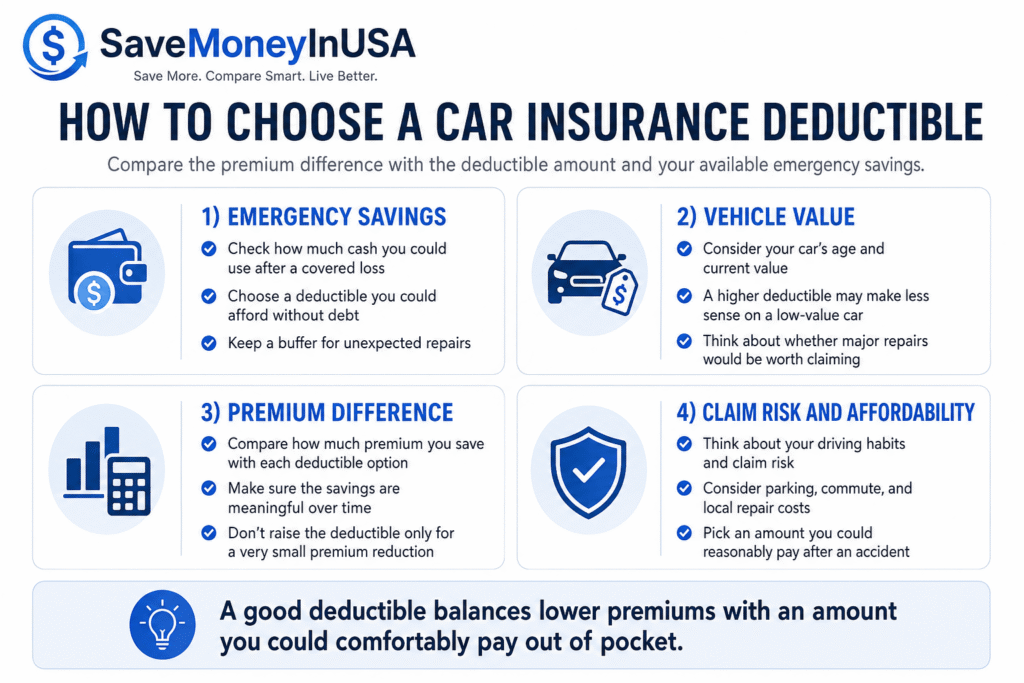
There is no single deductible that is correct for every driver. Use the following factors to evaluate the available choices.
1. Check your emergency savings
Start with the amount of cash you could access after an unexpected loss. The deductible should not force you to miss rent, debt payments, utilities, medical expenses, or other essential obligations.
If paying a $1,000 or $2,000 deductible would prevent you from repairing the vehicle, the lower premium may not justify the added financial risk.
2. Compare the actual premium difference
Ask the insurer to quote several deductible levels while keeping all other coverage information the same. Record the six-month or annual premium difference rather than looking only at the monthly payment.
For example, compare how much you would save by increasing a deductible from $500 to $1,000 with the additional $500 you would assume after a covered claim. The comparison should use your real quotes, not a general online estimate.
3. Consider the vehicle’s value
Consider the current value of the vehicle and the most the insurer might reasonably pay after a covered total loss. A very high deductible may reduce the practical value of physical-damage coverage on a low-value vehicle.
However, an older vehicle is not automatically inexpensive or easy for you to replace. Your transportation needs and available replacement funds matter as much as the vehicle’s market value.
4. Review the loan or lease agreement
A lender or leasing company may require collision and comprehensive coverage and may restrict the deductible amounts you can select. Choosing a deductible above the permitted amount could violate the finance or lease agreement.
Review the contract before making a change. Do not rely solely on the fact that an insurance website allows you to select a particular amount.
5. Think about your dependence on the vehicle
If you depend on the vehicle for commuting, caregiving, medical appointments, or earning income, consider how an unaffordable deductible could delay repairs.
A driver with a second household vehicle or flexible transportation may be able to accept more out-of-pocket risk than someone who has no practical alternative.
6. Evaluate risks relevant to each coverage
Collision and comprehensive cover different types of losses. Consider traffic exposure, theft, vandalism, hail, flooding, falling objects, wildlife, and where the vehicle is normally parked.
This does not predict whether a claim will occur. It helps you decide whether separate collision and comprehensive deductible amounts may fit your circumstances.
Deductible decision rule: Choose an amount that you could reasonably pay after an unexpected claim. Then confirm that the premium savings are meaningful enough to justify taking on the additional out-of-pocket risk.
Car Insurance Deductible Decision Checklist
Before selecting or changing a deductible, answer these questions:
- How much could I pay immediately after an accident or other covered loss?
- Would paying the deductible interfere with essential monthly expenses?
- What is the premium at each available deductible level?
- How much would I actually save over six months or one year?
- What is the vehicle’s approximate current value?
- Could I replace or repair the vehicle without insurance proceeds?
- Does a lender or lease agreement limit my deductible choices?
- Do I want different deductibles for collision and comprehensive?
- Has my savings, vehicle value, mileage, or household transportation changed?
Common Car Insurance Deductible Amounts
Insurers may offer several deductible choices. Common options for collision or comprehensive coverage can include:
- $100
- $250
- $500
- $1,000
- $1,500
- $2,000
Not every insurer offers every amount. Very low or high deductible choices may be unavailable for certain vehicles, coverages, states, lenders, leases, or underwriting situations.
Do not assume that $500 or $1,000 is automatically the best choice because it is common. The appropriate amount depends on your available savings and the real premium difference on your policy.
Higher vs. Lower Car Insurance Deductibles
The choice between a higher and lower deductible depends on your available savings, the actual premium difference, your dependence on the vehicle, lender requirements, and how much out-of-pocket risk you are prepared to accept.
| Consideration | A Higher Deductible May Fit When | A Lower Deductible May Fit When |
|---|---|---|
| Emergency savings | You could pay the deductible without missing essential expenses | A larger unexpected expense would be difficult to manage |
| Premium difference | The premium reduction is meaningful compared with the additional risk | The additional premium is affordable and the price difference is relatively small |
| Dependence on the vehicle | You have another practical transportation option while repairs are completed | You rely heavily on the vehicle and could not easily delay repairs |
| Loan or lease | The lender or lease permits the higher amount | The agreement requires a lower maximum deductible |
| Out-of-pocket risk | You are prepared to absorb more of each eligible covered loss | You prefer a smaller and more manageable share after a covered claim |
A higher deductible does not guarantee long-term savings because the result depends on the premium difference, how long you keep the policy, and whether claims occur. A lower deductible does not increase the policy limit or guarantee that a loss is covered; it only changes your share of eligible claims to which the deductible applies.
Common Deductible Mistakes to Avoid
Selecting the highest deductible only to lower the premium
Reducing the premium is not helpful if you cannot afford to use the coverage after a loss. Base the choice on accessible savings, not an amount you hope to save later.
Comparing deductibles without comparing identical coverage
When requesting quotes, keep liability limits, optional coverages, drivers, vehicles, and other policy details the same. Otherwise, the price difference may not be caused by the deductible alone.
See our guide on how to compare car insurance quotes correctly.
Assuming collision and comprehensive must use the same amount
Ask whether different deductible combinations are available. Separate amounts may provide a better balance for your budget and risk concerns.
Ignoring lender or lease requirements
Confirm the maximum permitted deductible before changing physical-damage coverage on a financed or leased vehicle.
Assuming the deductible is paid only once each year
A deductible generally applies to each covered claim that is subject to it. It is not normally an annual total like a health insurance deductible.
Waiting until after damage occurs to request a lower deductible
A policy change applies according to its approved effective date. You cannot generally lower a deductible after a loss and use the new amount for damage that occurred before the change became effective.
Failing to review the deductible as circumstances change
Review your selection when your savings, vehicle value, loan status, household transportation, or insurance premium changes.
For additional cost-saving methods that do not automatically require reducing coverage, read how to lower your car insurance premium.
Frequently Asked Questions About Car Insurance Deductibles
What is the best car insurance deductible?
There is no single best amount. A suitable deductible is one you could reasonably pay after an unexpected covered loss while still receiving a worthwhile premium for the coverage.
Is a $1,000 car insurance deductible too high?
A $1,000 deductible may be manageable for a driver with sufficient emergency savings, but it may be too high for someone who could not pay that amount quickly. Compare the actual premium difference and check lender or lease requirements before selecting it.
Do I pay a deductible if I am not at fault?
It depends on which coverage handles the claim. A claim paid directly by the responsible driver’s insurer may not involve your own collision deductible. If you use your own collision coverage, your deductible may initially apply even if you believe another driver caused the accident.
Do I pay a deductible for liability insurance?
Standard personal auto liability coverage generally does not have the same type of deductible commonly used for collision and comprehensive coverage. Review your policy for any special terms or endorsements.
Do I pay the deductible directly to the insurance company?
Not necessarily. The insurer may subtract the deductible from its claim payment, or you may pay your portion to the repair facility. The process depends on how the claim and repair payment are handled.
Can I change my car insurance deductible?
You can generally ask the insurer to change a deductible, subject to available options, underwriting approval, lender or lease requirements, and the effective date of the policy change. The new deductible does not normally apply retroactively to an earlier loss.
Does a higher deductible always lower the premium?
A higher deductible will generally reduce the premium for the affected physical-damage coverage, but the amount of the reduction varies. Ask for an actual quote before deciding whether the additional out-of-pocket risk is worthwhile.
What happens if I cannot afford my deductible?
The insurer’s covered payment is generally still calculated after applying the deductible. If you cannot pay your share, a repair shop may not release or complete the vehicle, depending on the arrangement. This is why the deductible should be supported by available savings rather than future income you may not have when a loss occurs.
Final Thoughts on Choosing a Car Insurance Deductible
A car insurance deductible determines how much of an eligible covered loss remains your responsibility. Collision and comprehensive commonly have deductibles, and the two coverages may allow different amounts.
Before selecting a deductible, compare the actual premium difference, review your available savings, check the vehicle’s value, and confirm any lender or lease restrictions. The lowest premium is not automatically the best option if the deductible would be difficult to pay after an accident or other covered loss.
Choose an amount that balances policy cost with a realistic ability to repair or replace your vehicle when you need the coverage.
Sources
- National Association of Insurance Commissioners — A Consumer’s Guide to Auto Insurance
- National Association of Insurance Commissioners — A Shopping Tool for Auto Insurance
- National Association of Insurance Commissioners — Tips for Saving on Auto Insurance
- California Department of Insurance — Automobile Insurance Guide
- California Department of Insurance — Shopping for Automobile Insurance
- Texas Department of Insurance — What to Know About Deductibles
- Texas Department of Insurance — Auto Insurance Guide
Deductibles, available amounts, coverage terms, claim procedures, premium effects, and lender requirements vary by insurer, policy, vehicle, and state. Review your current policy and confirm details with a licensed insurer or insurance professional before changing coverage.
About the Author
The SaveMoneyInUSA Editorial Team researches car insurance costs, coverage options, state requirements, and quote comparison considerations for drivers in the United States.
Learn more about our Editorial Team.
Disclaimer
SaveMoneyInUSA is an independent informational website and is not an insurance company, broker, or agent.
Some links may be affiliate links. We may receive compensation from partners at no additional cost to users.
Insurance rates, coverage options, and eligibility vary by provider and individual circumstances.
This content is provided for educational purposes only and should not be considered insurance, legal, or financial advice.