

Last Updated: August 2026

Choosing a car insurance deductible is a trade-off. A higher deductible can reduce your premium, but it also increases what you may have to pay after a covered collision or comprehensive claim. A lower deductible costs more upfront through the premium but reduces the immediate out-of-pocket burden of a covered loss.
Quick answer: Neither option always saves more. Compare the premium difference, the deductible difference, your available emergency savings, the value of your vehicle, and how long you expect to keep the policy. A practical choice is a deductible you could comfortably pay without borrowing or delaying essential repairs.
Compare the same coverage limits with several deductible options before deciding.
Deductible vs Premium: The Key Difference
| Term | What It Means | When You Pay |
|---|---|---|
| Premium | The price charged to keep the policy active | According to your billing schedule, such as monthly or paid in full |
| Deductible | The amount you are responsible for on a covered claim before the applicable coverage pays the remaining covered loss, up to policy limits | When a covered loss subject to that deductible occurs |
Premiums are paid whether or not you file a claim. A deductible is generally paid only when a covered claim subject to that deductible occurs. Deductibles commonly apply separately to collision and comprehensive coverage; liability coverage does not normally use the same type of deductible.
For a more detailed explanation, read Car Insurance Deductible Explained.
When requesting prices for different deductible options, keep the drivers, vehicles, liability limits, optional coverages, and policy term the same. Follow our step-by-step car insurance quote comparison guide, or use the Car Insurance Guides Resource Center to find related coverage and cost topics.
How a Higher Deductible Can Lower Your Premium
With a higher deductible, you agree to absorb a larger portion of a covered vehicle-damage loss. The insurer therefore takes on less of the smaller-loss risk, which generally lowers the premium for the affected coverage.
The amount saved is not fixed. It varies by insurer, vehicle, location, coverage, claims history, deductible choices, and other permitted rating factors. Ask for quotes using identical drivers, vehicles, limits, and optional coverages, changing only the deductible. Otherwise, the comparison will not isolate the deductible’s effect.
Use the Break-Even Period to Compare Options
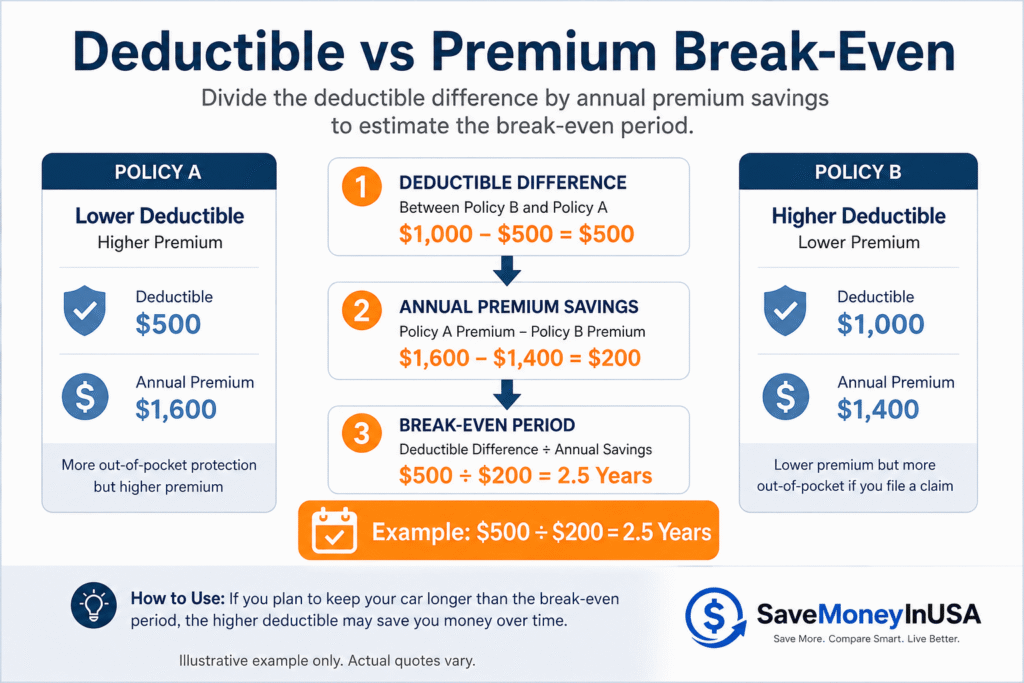
A break-even calculation shows how long the annual premium savings would need to accumulate before equaling the additional deductible risk.
Break-even period = Difference in deductibles ÷ Annual premium savings
Hypothetical Example
| Option | Collision Deductible | Annual Premium |
|---|---|---|
| A | $500 | $1,800 |
| B | $1,000 | $1,600 |
- Additional deductible risk with Option B: $500
- Annual premium savings with Option B: $200
- Break-even period: $500 ÷ $200 = 2.5 years
This example does not predict an actual quote. It shows the calculation method. If no applicable claim occurs during those 2.5 years and the premium difference remains the same, the accumulated savings would equal the additional $500 deductible exposure. A claim before then could change the result.
How Different Claim Scenarios Change the Result
The break-even calculation is only a starting point. The actual financial result depends on how long you keep the policy, whether the premium difference changes at renewal, and whether you have a covered claim subject to the deductible.
Using the same hypothetical options—$500 versus $1,000 collision deductibles and $200 in annual premium savings—the following table shows how several simplified situations could compare.
| Scenario | Premium Savings | Additional Deductible Cost | Simplified Result |
|---|---|---|---|
| No applicable claim for 1 year | $200 | $0 | Higher deductible is $200 ahead |
| No applicable claim for 3 years | $600 | $0 | Higher deductible is $600 ahead |
| One applicable claim after 1 year | $200 | $500 | Higher deductible is $300 behind |
| One applicable claim after 3 years | $600 | $500 | Higher deductible is $100 ahead |
These examples are illustrations, not predictions or insurance quotes. They assume that the premium difference remains $200 per year and that only one deductible applies. Renewal prices, claim circumstances, policy changes, multiple losses, and other costs could produce a different result.
What the Break-Even Calculation Does Not Tell You
A break-even period does not predict whether an accident, theft, storm, or other covered loss will occur. It also does not guarantee that the premium difference between two deductible options will remain unchanged.
Insurers can revise premiums at renewal because of approved rate changes, repair costs, claim trends, vehicle changes, driving history, mileage, location, discounts, and other permitted factors. A deductible option that saves $200 this year may produce a different price difference next year.
The calculation also does not measure the practical consequences of temporarily losing access to your vehicle. If an unaffordable deductible delays repairs, you might face rental, rideshare, missed-work, or alternative transportation costs. Those expenses may matter even though they are not part of the deductible itself.
Use the formula as a comparison tool, not as a forecast. The deductible still needs to fit your current cash reserves and transportation needs.
Compare More Than the Monthly Payment
A lower monthly bill can look attractive, but the monthly difference alone does not show the full trade-off. Compare the total premium for the full policy term, installment fees, collision deductible, comprehensive deductible, coverage limits, exclusions, and optional benefits.
- No applicable claim: The higher-deductible option may cost less if the premium savings continue.
- One covered claim: Compare the accumulated premium savings with the additional deductible paid.
- Multiple covered claims: A deductible may apply to each separate loss, so repeated claims can make a higher deductible more expensive.
When a Higher Deductible May Make Sense
- You can pay the full deductible immediately from savings.
- The annual premium reduction is meaningful compared with the deductible increase.
- You understand that a deductible can apply to each covered loss.
- You are comfortable retaining more financial risk.
- The deductible is not unreasonably high compared with the vehicle’s value.
A higher deductible should not depend on being able to use a credit card or loan after an accident. If paying it would delay essential repairs or create expensive debt, the apparent premium savings may not be worthwhile.
When a Lower Deductible May Make Sense
- A large unexpected repair expense would be difficult to manage.
- The premium difference between deductible choices is relatively small.
- You prefer more predictable out-of-pocket costs after a covered loss.
- Your vehicle is important for work and delayed repairs would create additional problems.
Collision and Comprehensive Deductibles May Differ
Do not assume one deductible applies to every part of the policy. Collision and comprehensive coverage may have different deductible options. For example, a driver might choose a $1,000 collision deductible and a $500 comprehensive deductible if theft, weather, glass, or animal-related losses are a different concern than collision losses.
Availability varies by insurer and state. Review the declarations page and ask how the deductible applies to glass claims, total losses, uninsured motorist property damage, and any deductible waivers.
Financed and Leased Cars: Check the Contract
Lenders and leasing companies commonly require collision and comprehensive coverage. They may also limit how high the deductible can be. Before changing it, check the finance or lease agreement and confirm the proposed deductible is allowed.
Learn more in Do I Need Full Coverage If My Car Is Financed? and Full Coverage vs Liability Insurance.
Common Deductible Choices
Common options include $250, $500, and $1,000, although insurers may offer other amounts. A common amount is not automatically the right amount. The useful comparison is what each option changes in your actual premium and whether you can cover the deductible.
How Vehicle Value Changes the Decision
The value of the vehicle affects how useful collision and comprehensive coverage may be. After a covered total loss, the insurer generally bases the settlement on the vehicle’s covered value under the policy, subject to the deductible and other permitted adjustments.
For example, a $1,000 deductible represents a much larger share of a vehicle worth $4,000 than of a vehicle worth $30,000. A very high deductible can reduce the practical value of physical-damage coverage on a lower-value car because smaller losses may not exceed the deductible by much.
However, vehicle value should not be the only consideration. An older car may still be essential for commuting, caregiving, or earning income. If you could not afford to replace or repair it, keeping collision or comprehensive coverage with an affordable deductible may still be reasonable.
Compare the vehicle’s approximate current value, the annual cost of the applicable coverage, the available deductible choices, and your ability to replace the vehicle without insurance proceeds.
Mistakes to Avoid
- Choosing only by monthly price: Compare the full-term premium and any installment fees.
- Using different coverage in each quote: Keep limits and optional coverages the same.
- Assuming every claim has the same deductible: Review each coverage separately.
- Selecting a deductible you cannot fund: Premium savings do not help if repairs must be delayed.
- Ignoring vehicle value: Consider whether collision and comprehensive still make sense on an older, lower-value vehicle.
For additional ways to reduce costs without weakening important protection, see How to Lower Car Insurance Premiums and How to Save Money on Car Insurance.
Review Your Deductible at Every Renewal
The deductible that worked when you bought the policy may not remain appropriate. Your savings, vehicle value, annual mileage, loan balance, household transportation, and premium can change over time.
At each renewal, request the price for at least two deductible options while keeping the other coverage terms the same. Recalculate the annual savings and break-even period instead of assuming that last year’s comparison still applies.
Consider reviewing the deductible sooner if you pay off the vehicle, replace the car, move, add a household driver, experience a major change in savings, or become more dependent on the vehicle for work or family responsibilities.
Five-Step Deductible Decision Checklist
- Request the same policy with at least two deductible options.
- Calculate the full-year premium difference.
- Calculate the additional deductible exposure and break-even period.
- Confirm you can pay the higher deductible from available savings.
- Check lender requirements and review collision and comprehensive separately.
Frequently Asked Questions
Does a higher deductible always lower the premium?
It generally lowers the premium for the affected coverage, but the amount varies. Compare actual quotes rather than assuming a standard percentage.
Do I pay a deductible if I cause damage to another person’s car?
Auto liability coverage generally does not use the collision or comprehensive deductible described in this guide. Policy terms and state rules vary, so review your policy.
Is a $500 or $1,000 deductible better?
Neither is universally better. Compare the annual premium savings, calculate the break-even period, and choose an amount you could pay immediately after a loss.
Can I change my deductible later?
Insurers generally allow policy changes, but the new deductible applies prospectively and may require underwriting or lender compliance. It cannot normally be changed after a loss to affect that claim.
Final Takeaway
A higher deductible can produce meaningful premium savings, but it transfers more claim cost to you. A lower deductible reduces that immediate burden but costs more whether or not a claim occurs. Compare identical coverage, calculate the break-even period, and select a deductible that your budget can support today—not one that depends on future borrowing.
Sources
- National Association of Insurance Commissioners — A Consumer’s Guide to Auto Insurance
- NAIC — Best Practices for Buying Auto Insurance
- California Department of Insurance — Automobile Insurance Guide
About the Author
The SaveMoneyInUSA Editorial Team researches car insurance costs, coverage options, state requirements, discounts, and quote-comparison considerations for drivers in the United States.
Learn more about our Editorial Team and Editorial Guidelines.
Disclaimer
SaveMoneyInUSA is an independent informational website and is not an insurance company, broker, or agent.
Some links may be affiliate links. We may receive compensation from partners at no additional cost to users.
Insurance premiums, deductibles, fees, coverage options, policy terms, lender requirements, and eligibility vary by insurer, state law, vehicle, policy, and individual circumstances.
This content is provided for educational purposes only and should not be considered insurance, legal, or financial advice.