

Last Updated: August 2026
Paying your car insurance premium in full can reduce your total policy cost, but it is not automatically the best choice for every driver. The savings depend on the insurer, your state, available discounts, installment fees, policy length, and how much cash you need to pay upfront.
Some insurance companies offer a paid-in-full discount. Others mainly help you save by removing monthly installment or service fees. If paying upfront would drain your emergency fund or force you to carry expensive credit card debt, the discount may not be worth it.
This guide explains how paying in full works, where the savings come from, how to compare payment plans correctly, and when monthly payments may be the smarter financial choice.
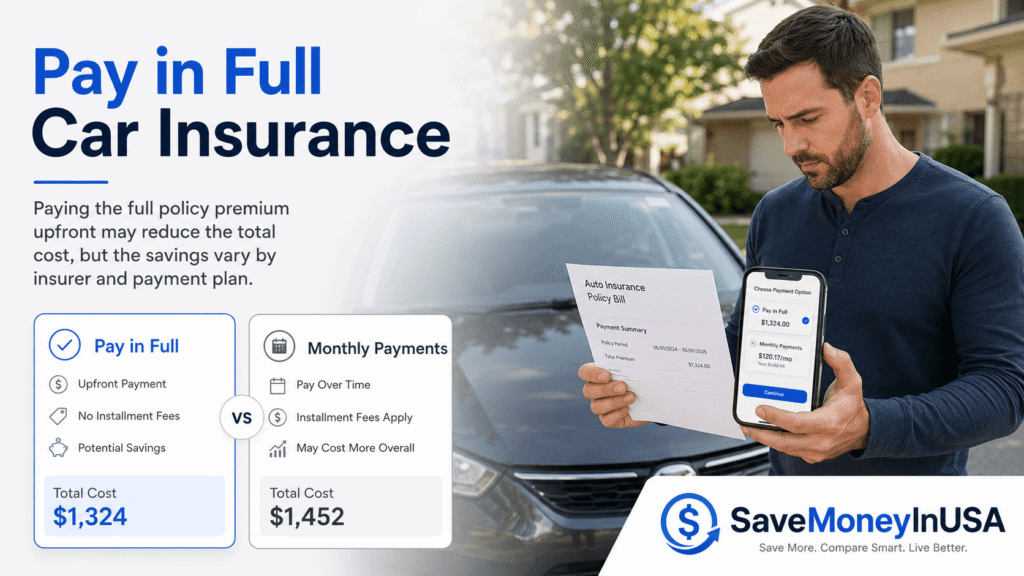
Compare the same coverage limits and deductibles so you can see the real price difference—not just the advertised monthly payment.
What Does Paying Car Insurance in Full Mean?
Paying car insurance in full means paying the entire premium for a policy term in one payment instead of dividing it into installments. Many personal auto insurance policies run for six months, although some insurers offer 12-month terms.
For example, if your six-month premium is $900, paying in full means paying the complete $900 near the beginning of the policy. With a monthly plan, you may make a down payment followed by several installments.
A Down Payment Is Not the Same as Paying in Full
A car insurance down payment is usually the first amount required to activate an installment plan. It covers only part of the policy-term premium. Paying in full means paying the complete premium for the entire policy term at once.
A lower amount due today can improve short-term cash flow, but it does not necessarily reduce the total policy cost. Compare the initial payment, all remaining installments, and every fee. Our guide to no down payment car insurance explains why a small first payment should not be confused with free or cheaper coverage.
The coverage itself does not necessarily change because of the payment schedule. The main differences are:
- How much you pay upfront
- Whether installment or service fees apply
- Whether a paid-in-full or automatic-payment discount is available
- How the payments affect your monthly cash flow
- The risk of missing a future payment
Is It Cheaper to Pay Car Insurance in Full?
Paying in full is often cheaper, but the amount saved varies. Some insurers offer a direct discount for paying the policy premium upfront. Others charge installment fees when a policyholder selects monthly or multi-payment billing.
However, you should not assume that every company offers the same discount. Availability may vary by insurer, state, policy type, payment method, and other eligibility rules.
The only reliable way to calculate your savings is to compare the insurer’s actual total amounts:
- Ask for the total amount due if you pay the policy in full.
- Add the down payment and every scheduled installment under the monthly plan.
- Include all installment, service, card-processing, or billing fees.
- Subtract the pay-in-full total from the installment-plan total.
Do not compare only the first payment or the advertised monthly amount. A low first payment does not necessarily mean a lower total premium.
Where Do Pay-in-Full Savings Come From?
1. Paid-in-Full Discounts
Some insurers reduce the premium when you pay the entire policy term upfront. The discount may appear on your quote, declarations page, billing schedule, or list of policy discounts.
Because the discount is not universal, ask the insurer or agent whether it is available in your state and whether it can be combined with other payment-related discounts.
2. Avoided Installment Fees
A monthly plan may include a fee for each installment. Even a relatively small charge can add up when it is applied several times during a six- or 12-month policy.
Paying in full generally eliminates those future installment charges. Check the complete billing schedule because the fee may not be included in the base premium shown on the initial quote.
3. Different Automatic-Payment Options
If paying in full is not practical, automatic payments may provide a middle ground. Some insurers offer a discount or reduced installment fees when payments are automatically withdrawn from a bank account.
Ask whether the insurer treats automatic bank withdrawals differently from recurring debit or credit card payments. Payment-method rules can vary.
Pay-in-Full Savings Example
The following is a hypothetical example to show how the calculation works. It is not an industry average or a guaranteed discount.
| Cost Item | Pay in Full | Installment Plan |
|---|---|---|
| Base six-month premium | $900 | $900 |
| Paid-in-full discount | −$45 | $0 |
| Installment fees | $0 | $25 |
| Total policy cost | $855 | $925 |
In this example, paying in full saves $70 over the six-month term. Your result could be smaller, larger, or zero depending on the quote and payment plans offered.
Before selecting a plan, ask the insurer to show both totals in writing. If you are comparing companies, keep the drivers, vehicles, coverage limits, deductibles, and optional coverages the same.
Pay in Full vs Monthly Car Insurance
The better option depends on more than the discount. Consider the total price, upfront payment, financial flexibility, and risk of missing an installment.
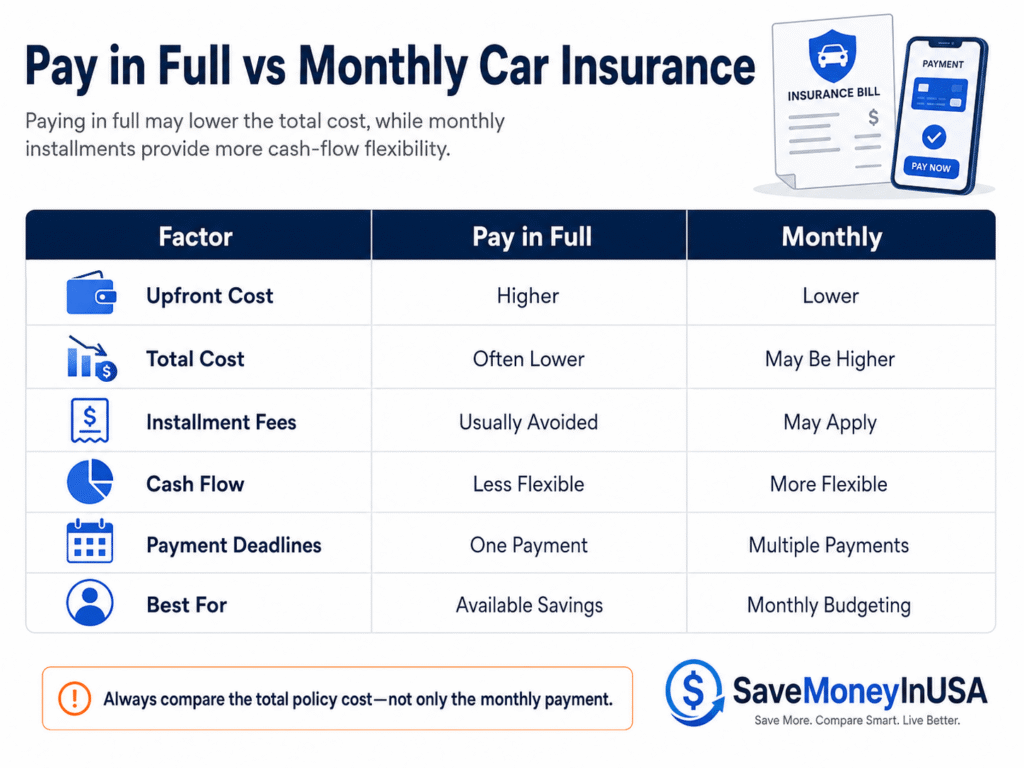
| Factor | Pay in Full | Monthly Installments |
|---|---|---|
| Upfront payment | Highest | Lower |
| Total policy cost | May be lower when a discount or avoided fees apply | May be higher because of installment or service fees |
| Cash-flow flexibility | Lower during the payment month | Higher because payments are spread out |
| Future payment deadlines | None during the paid policy term | Several scheduled due dates |
| Main financial risk | Using too much emergency cash or borrowing at high interest | Missing a payment or paying more in total fees |
| Often fits drivers who | Have sufficient savings after paying the premium | Need predictable payments and stronger short-term liquidity |
These are general differences, not guarantees. The actual discount, fees, payment schedules, and eligibility rules depend on the insurer, state, and policy.
The Key Trade-Off
The choice comes down to a simple trade-off: paying in full may reduce the total policy cost, while monthly installments protect your short-term cash flow.
- Choose pay in full when the confirmed savings are meaningful and the payment will not weaken your emergency fund.
- Choose monthly installments when paying upfront would make essential expenses harder to manage or force you to carry high-interest debt.
- Before deciding, compare the total amount paid over the complete policy term, including every installment or processing fee.
When Paying in Full Makes Sense
Paying the full premium may be a good choice when all or most of the following apply:
- You can pay the premium without using money needed for rent, food, utilities, debt payments, or other essential expenses.
- You will still have an adequate emergency fund after making the payment.
- The insurer confirms that paying in full reduces the total policy cost.
- You want to eliminate future payment deadlines during the policy term.
- You are unlikely to carry high-interest debt to finance the payment.
- You expect to keep continuous coverage for the full term.
A driver who already has the money set aside may benefit from the discount and simpler billing. Paying upfront can also reduce the chance of an accidental coverage lapse caused by a missed installment.
When Monthly Payments May Be Better
Monthly payments can be the more responsible option when preserving cash matters more than receiving a modest discount.
Consider installments if:
- Paying in full would leave you without emergency savings.
- You would need to carry a balance on a high-interest credit card.
- Your income is irregular or your budget is temporarily tight.
- The insurer offers little or no savings for paying upfront.
- An automatic-payment plan significantly reduces the installment fees.
- You have more urgent high-interest debt or essential expenses.
Choosing installments does not mean you are making a bad decision. The goal is to select the payment plan with the best overall effect on your finances—not simply the plan with the lowest insurance total.
Should You Use Savings or a Credit Card to Pay in Full?
Using available cash can make sense if the payment does not weaken your emergency fund. Using a credit card requires more caution.
Suppose paying in full saves $70, but you put the $855 premium on a credit card and carry the balance at a high annual percentage rate. The interest could quickly exceed the insurance savings.
A credit card may still be convenient if you:
- Can pay the statement balance in full by the due date
- Confirm that the insurer does not add a card-processing fee
- Do not need to carry the balance from month to month
Do not borrow at a high interest rate merely to obtain a small paid-in-full discount. Compare the insurance savings with the full financing cost before deciding.
What Happens If You Cancel After Paying in Full?
Paying upfront generally does not prevent you from canceling or switching insurers during the policy term. If you cancel after paying in advance, you may receive a refund for the unused portion of the premium.
However, the exact refund depends on the insurer, state rules, effective cancellation date, policy terms, and whether a cancellation fee or other adjustment applies.
Before switching:
- Confirm the start date of the replacement policy.
- Ask the current insurer for an estimated refund and any cancellation charge.
- Do not cancel the old policy until the new coverage is active.
- Keep written confirmation of the cancellation and refund.
Avoiding a coverage gap is more important than receiving the refund a few days earlier. Even a short lapse can create legal, registration, lender, and future insurance-pricing problems.
How to Compare Car Insurance Payment Plans Correctly
Use the following checklist before choosing between full payment and installments:
- Confirm the policy term: Determine whether the quote covers six or 12 months.
- Compare total premiums: Do not rely only on the monthly payment.
- Identify every fee: Look for installment, service, processing, late-payment, and returned-payment fees.
- Check the discount: Ask whether the quote includes a paid-in-full discount.
- Ask about autopay: Determine whether automatic bank withdrawals reduce fees or qualify for another discount.
- Use identical coverage: Compare the same liability limits, deductibles, and optional coverages.
- Review cancellation rules: Ask how unused premium would be refunded if you switch.
- Protect your cash flow: Make sure the upfront payment will not create a larger financial problem.
Our step-by-step guide to comparing car insurance quotes explains how to keep coverage details consistent when evaluating different companies.
Other Ways to Lower Your Car Insurance Cost
The payment schedule is only one part of your insurance cost. A different insurer may save you more than a paid-in-full discount from your current company.
Consider these additional steps:
- Compare quotes from several insurers using equivalent coverage.
- Confirm every discount for which you may qualify.
- Review your annual mileage, drivers, address, and vehicle information for accuracy.
- Consider a higher deductible only if you could afford it after a claim.
- Bundle policies when the combined total is genuinely lower.
- Avoid coverage lapses and maintain a safe driving record.
See our guides to the best cheap car insurance companies and ways to lower your car insurance premium for more cost-saving ideas.
For a broader review process, use our pillar guide on how to save money on car insurance in the USA. It combines quote comparison, discounts, deductibles, coverage reviews, payment choices, and renewal checks in one workflow.
In states where insurers are permitted to use credit information, credit-based insurance scores may also affect pricing. Learn more about how credit score affects car insurance rates.
Frequently Asked Questions
Is it always cheaper to pay car insurance in full?
No. Paying in full is often cheaper when the insurer offers a discount or charges fees for installments, but savings are not guaranteed. Compare the actual total cost of every available payment plan.
How much can I save by paying car insurance in full?
The amount varies by insurer, state, policy, and payment method. Ask for the full-payment total and the sum of all installment payments and fees. The difference between those amounts is your actual potential saving.
Does paying car insurance monthly build credit?
Car insurance payments generally are not reported to the major credit bureaus as regular credit-account payments. However, unpaid insurance debt that is sent to collections could potentially affect your credit history.
Can I switch car insurance after paying in full?
Yes. Paying in full generally does not prevent you from switching insurers. You may receive a refund for unused premium, subject to the policy terms, state rules, cancellation date, and possible fees.
Is autopay cheaper than regular monthly payments?
It can be. Some insurers offer an automatic-payment discount or reduce installment fees for certain payment methods. Ask the insurer to compare the total cost of regular installments, autopay, and paying in full.
Should I pay in full if I have credit card debt?
Not necessarily. If paying upfront would prevent you from reducing high-interest debt or require you to carry a new credit card balance, the interest cost could be greater than the insurance savings.
Final Verdict: Should You Pay Car Insurance in Full?
Paying in full can be a good way to lower your total car insurance cost when it unlocks a discount, eliminates installment fees, and does not damage your emergency savings or create high-interest debt.
Monthly payments may be better when cash-flow flexibility is more valuable or when the insurer offers little difference between the payment plans.
Before deciding, compare these three numbers:
- The total amount required to pay in full
- The total of all installment payments and fees
- The cost of using or borrowing the money needed to pay upfront
The best payment plan is the one that lowers your overall cost without creating a larger financial risk.
Sources
- GEICO — Auto Insurance Payment Methods and Plans
- Progressive — Car Insurance Payment Options and Paying Upfront
- Progressive — Car Insurance Refunds After Cancellation
- GEICO — Auto Policy Payment and Automatic-Payment FAQs
- National Association of Insurance Commissioners — Consumer’s Guide to Auto Insurance
About the Author
The SaveMoneyInUSA Editorial Team researches car insurance costs, coverage options, state requirements, discounts, and quote-comparison considerations for drivers in the United States.
Learn more about our Editorial Team.
Disclaimer
SaveMoneyInUSA is an independent informational website and is not an insurance company, broker, or agent.
Some links may be affiliate links. We may receive compensation from partners at no additional cost to users.
Insurance rates, discounts, fees, payment plans, refunds, coverage options, and eligibility vary by insurer, state, policy, and individual circumstances.
This content is provided for educational purposes only and should not be considered insurance, legal, or financial advice.