

Last Updated: August 2026
Finding cheap car insurance for bad credit can be difficult because insurers may consider credit-based insurance information when state law allows. But a weaker credit history does not tell you which company will offer your lowest price. Insurers use different rating models, discounts, underwriting rules, and payment plans, so comparable quotes can vary substantially for the same driver.
Quick answer: Start by comparing several quotes with identical drivers, vehicles, coverage limits, and deductibles. Review the total policy premium—not only the monthly payment—and verify how your state regulates credit-based insurance scoring. The best company is the one that offers the right coverage at the lowest total cost for your actual profile, not the company that ranks first on a generic list.
Compare the same coverage across multiple options and review the full policy cost before deciding.
How Bad Credit Can Affect Car Insurance
Where permitted, an insurer may use a credit-based insurance score as one factor in underwriting or rating. This is not necessarily the same score a lender uses for a credit card or mortgage. Insurance scoring models use information from a consumer credit report to estimate insurance risk, and the formula can differ by insurer.
Credit is only one possible factor. Your driving record, location, vehicle, mileage, coverage, deductibles, insurance history, household drivers, and available discounts may also influence the quote. That is why two people with similar consumer credit scores may not receive similar premiums.
State rules matter. Some states prohibit or restrict the use of credit information in personal auto insurance, while other states permit it under specific consumer protections. California private-passenger auto pricing follows its own approved rating rules, so drivers should not assume that credit affects a California quote. Read How Credit Score Affects Car Insurance Rates for a fuller explanation.
Credit Score vs. Credit-Based Insurance Score
| Item | Consumer Credit Score | Credit-Based Insurance Score |
|---|---|---|
| Primary purpose | Helps estimate credit repayment risk | Helps estimate insurance loss or claim risk |
| Typical user | Lenders and other permitted users | Insurers where state law permits |
| Based on | Information in credit reports | Credit-report information processed through an insurance model |
| Same number? | No universal score applies everywhere | Not necessarily the same as a lending score |
| Only pricing factor? | Not applicable | No; other insurance rating factors also matter |
Checking your own credit report does not reduce your credit score. Review the reports for accounts you do not recognize, incorrect late payments, duplicate debts, or outdated information. The Consumer Financial Protection Bureau directs consumers to AnnualCreditReport.com for federally authorized free reports.
Can You Still Find Affordable Coverage With Poor Credit?
Yes, but “affordable” must include both price and protection. A policy can appear cheap because it has very low liability limits, excludes useful optional coverage, or uses a deductible you could not afford after a claim. The objective is not simply to obtain the smallest monthly number. It is to find the lowest sustainable cost for coverage that meets state, lender, and personal-risk needs.
There is also no universally cheapest insurer for drivers with bad credit. A national company may be competitive for one applicant and expensive for another. A regional insurer may offer a better price in one state but not operate elsewhere. The only reliable comparison is a set of current written quotes based on the same applicant information.
How to Compare the Best Car Insurance Companies for Bad Credit
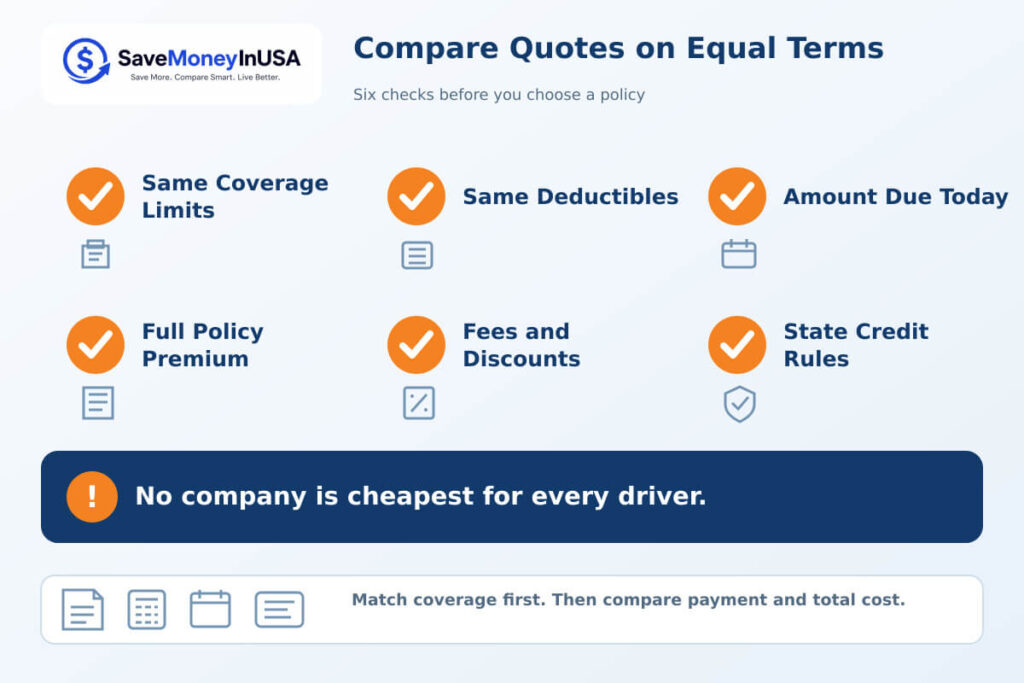
Instead of treating a company ranking as a promise, compare each insurer using the same worksheet. Obtain quotes close together so that your vehicle, address, drivers, coverage choices, and insurance history have not changed between applications.
- Coverage: Match liability limits, uninsured or underinsured motorist coverage, collision, comprehensive, and optional benefits.
- Deductibles: Use the same collision and comprehensive deductibles in every quote.
- Total cost: Record the full six- or twelve-month premium, amount due today, every installment, and all billing fees.
- Discounts: Confirm which discounts are already included and what action is required to keep them.
- Service: Review complaint information, financial-strength information, claims access, and local agent availability when relevant.
- Terms: Check exclusions, cancellation rules, renewal terms, telematics requirements, and consequences of a failed payment.
Use the step-by-step car insurance quote comparison guide to keep the inputs consistent.
Decision Module 1: Minimum Coverage or More Protection?
Minimum state-required coverage may produce the smallest quote, but it can leave a large financial gap after a serious at-fault accident. Before reducing coverage, consider the value of your assets, how much you drive, who uses the vehicle, and whether you could pay damages beyond the policy limit.
| Situation | Option to Evaluate | Main Trade-Off |
|---|---|---|
| Older vehicle with no loan | Liability plus selected optional coverage | Lower premium but less protection for your own vehicle |
| Financed or leased vehicle | Coverage required by the lender or lease | Higher premium but contractual requirements apply |
| Assets or income to protect | Liability limits above the legal minimum | Higher premium with more protection from a major claim |
| Very limited monthly budget | Most protective policy you can keep continuously active | Avoid choosing limits based only on today’s payment |
Confirm your legal baseline in Minimum Car Insurance Requirements by State. State minimums are legal starting points, not personalized recommendations.
Decision Module 2: Should You Raise the Deductible?
A higher collision or comprehensive deductible may reduce the premium, but the savings are useful only if you could pay the higher deductible after a covered loss. Do not create an unaffordable claim expense to solve a premium problem.
- Ask for quotes at two or three deductible levels while keeping every other input unchanged.
- Calculate the annual premium difference between the options.
- Compare the extra deductible with the annual savings.
- Keep the chosen deductible available in emergency savings.
For the break-even method and practical examples, review Deductible vs Premium in Car Insurance.
Ways to Lower Car Insurance Costs With Bad Credit
1. Compare Equivalent Quotes
Quote variation is the strongest reason to shop. Do not compare one insurer’s minimum-coverage quote with another insurer’s higher-limit policy. Matching inputs makes the price difference meaningful.
2. Ask About Every Eligible Discount
Discounts may be available for multiple vehicles, multiple policies, vehicle safety equipment, low mileage, defensive-driving courses, paperless billing, automatic payments, or approved driving programs. Eligibility and savings vary, and some programs require ongoing participation.
3. Review Monthly and Paid-in-Full Costs
Monthly billing may improve cash flow but can include installment fees or miss a paid-in-full discount. Compare the total policy-term cost and keep enough emergency savings before paying a large amount upfront. See Pay in Full Car Insurance: Is It Cheaper?.
4. Consider Usage-Based Insurance Carefully
A telematics or usage-based program may evaluate factors such as mileage, braking, acceleration, time of day, or phone use, depending on the program. Ask what data is collected, how long the monitoring lasts, whether participation can increase as well as decrease the price, and what happens if you stop participating.
5. Correct Credit-Report Errors
If your state and insurer use credit-based insurance information, inaccurate report data could matter. Obtain your reports through the federally authorized source, dispute errors with the reporting company, and keep documentation. Legitimate corrections take time; avoid companies promising an instant credit fix.
6. Avoid a Coverage Lapse
Arrange the new policy before canceling the existing one. A lapse can create legal exposure and may affect future pricing or eligibility. Confirm the new policy’s effective date and proof of insurance before driving.
For a broader cost-reduction plan, see How to Save Money on Car Insurance in the USA. You can also browse the Car Insurance Guides Resource Center for related coverage, payment, driver, financing, and state-specific topics.
A Practical Quote Comparison Example
Assume three insurers quote the same driver, vehicle, liability limits, optional coverage, and deductibles. The numbers below are hypothetical and illustrate the comparison process; they are not current prices from named insurers.
| Comparison Item | Quote A | Quote B | Quote C |
|---|---|---|---|
| Amount due today | $180 | $125 | $210 |
| Six-month total | $1,080 | $1,140 | $1,020 |
| Installment fee | Included | Additional | None when paid in full |
| Coverage and deductibles | Matched | Matched | Matched |
| Main observation | Middle total cost | Lowest initial payment | Lowest six-month total |
Quote B has the smallest first payment but the highest policy-term total. Quote C has the lowest total but requires more money upfront. The right choice depends on whether the driver can afford the initial payment without missing future bills or draining emergency savings.
Common Mistakes to Avoid
- Assuming one company is always cheapest: Rankings cannot predict an individual quote.
- Comparing different coverage: A lower price may simply provide less protection.
- Looking only at monthly payments: Include the amount due today, fees, and full-term premium.
- Choosing an unaffordable deductible: Premium savings do not help if you cannot repair the vehicle after a claim.
- Dropping required coverage: A lender or lease may require collision and comprehensive coverage.
- Paying for guaranteed approval or guaranteed savings: Legitimate prices depend on underwriting information and policy terms.
- Canceling before replacement coverage starts: Prevent an accidental lapse.
Frequently Asked Questions
Does getting an insurance quote hurt my credit score?
Requesting an insurance quote generally does not reduce a consumer credit score. Insurance-related use of credit information differs from applying for a loan. Ask the insurer how it handles consumer-report information if you want confirmation.
Which insurance company is cheapest for bad credit?
No company is consistently cheapest for every driver. State rules, insurer models, driving history, location, vehicle, coverage, discounts, and household information can change the result. Compare current quotes instead of relying on a universal ranking.
Can an insurer deny coverage only because of credit?
Rules vary by state. In most states, insurers cannot use a credit-based insurance score as the sole reason to deny, cancel, or refuse to renew a policy, or to increase a premium. If consumer-report information contributed to an adverse decision, review the notice and request the applicable report so you can check it for errors. Contact your state insurance department for the rules that apply where you live.
Will improving credit immediately lower my premium?
Not necessarily. An insurer may review credit-based information at a new application, renewal, or another time permitted by state law and company procedure. Correct report errors promptly, but do not assume that a score change creates an immediate insurance adjustment.
Should I reduce coverage to make insurance affordable?
Review the risk before removing coverage. Maintain state-required insurance and any lender-required protection. Compare quotes, deductibles, discounts, optional benefits, and payment plans before reducing important liability or physical-damage coverage.
Final Takeaway
Bad credit can affect car insurance pricing where state law allows, but it does not identify your cheapest insurer. Compare several written quotes using identical coverage, review the complete policy-term cost, select a deductible you could actually pay, and verify state-specific credit rules. The best result is an affordable policy you can keep active—not merely the smallest payment shown in an advertisement.
Sources
- National Association of Insurance Commissioners — A Consumer’s Guide to Auto Insurance
- National Association of Insurance Commissioners — A Shopping Tool for Auto Insurance
- National Association of Insurance Commissioners — Credit-Based Insurance Scores
- Federal Trade Commission — Credit-Based Insurance Scores: Impacts on Consumers of Automobile Insurance
- Consumer Financial Protection Bureau — How to Get Free Credit Reports
- California Department of Insurance — Automobile Insurance Guide
About the Author
The SaveMoneyInUSA Editorial Team researches car insurance costs, coverage options, state requirements, discounts, and quote-comparison considerations for drivers in the United States.
Learn more about our Editorial Team.
Disclaimer
SaveMoneyInUSA is an independent informational website and is not an insurance company, broker, or agent.
Some links may be affiliate links. We may receive compensation from partners at no additional cost to users.
Insurance premiums, credit-based insurance scoring practices, coverage options, discounts, and eligibility vary by insurer, state law, policy, and individual circumstances.
This content is provided for educational purposes only and should not be considered insurance, legal, or financial advice.