

Last Updated: October 2026
Comparing car insurance quotes can help drivers find a better combination of price, coverage, deductible, and service. However, quotes are only useful when they are based on the same driver information and the same coverage choices.
Quick Answer: How Should You Compare Car Insurance Quotes?
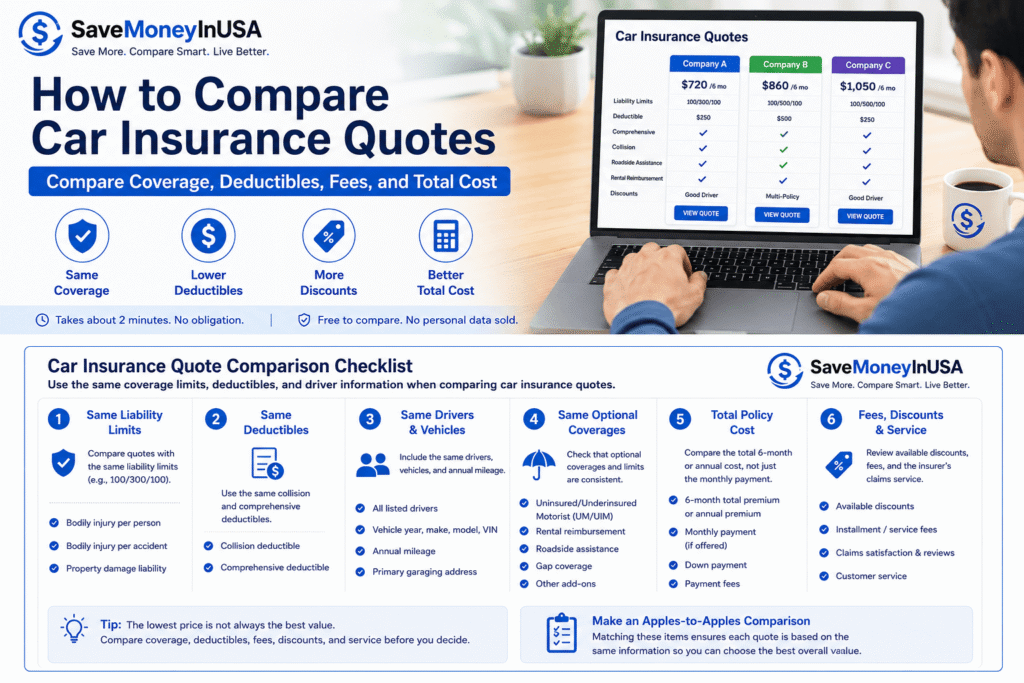
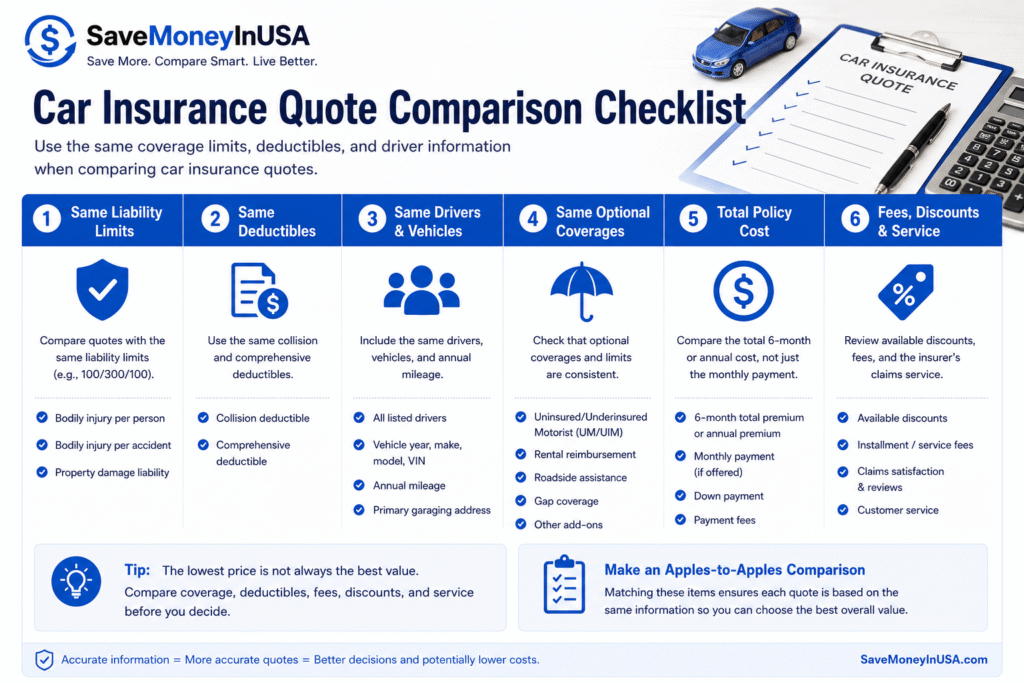
Compare quotes from several insurers using identical liability limits, deductibles, optional coverages, vehicle information, annual mileage, and driver details.
Do not choose a policy based only on the lowest monthly premium. A cheaper quote may include lower liability limits, a higher deductible, fewer optional coverages, or additional payment fees.
The goal is to compare quotes on an apples-to-apples basis and select the policy that offers the best overall value for your situation.
Where Can You Get Car Insurance Quotes to Compare?
To get actual quotes, visit several insurers directly, contact a licensed independent agent, or use an online comparison service that works with participating insurers. Check how many companies each source represents and whether it provides a quote, an estimate, or a referral to an agent. You may need more than one source to compare a broader range of options.
What this site provides: SaveMoneyInUSA offers an educational comparison checklist. It does not generate personalized insurance quotes or show live prices. Use the checklist below when you request quotes from insurers, agents, or comparison services.
Why Comparing Car Insurance Quotes Is So Important
Car insurance prices are not standardized. Each insurer uses its own state-approved rating method and underwriting rules. Two companies can evaluate the same driver and vehicle differently, even when the requested coverage is identical.
Because companies weigh permitted factors differently, comparing several equivalent quotes can reveal a wide range of prices and eligibility decisions. It can also help you determine whether your current insurer still offers competitive value.
Quote comparison is only useful when the inputs match. If one quote has lower liability limits, a higher deductible, fewer optional coverages, or a different payment schedule, the lower price does not represent an equivalent policy.
For a broader savings strategy, see our pillar guide on how to save money on car insurance in the USA. You can also use the Car Insurance Guides Resource Center to find coverage, cost, driver, financing, and state-specific resources.
What Factors Affect Your Car Insurance Quotes?
The factors an insurer may consider depend on state law, the insurer’s approved rating plan, the policy, and the applicant. Common factors can include:
- Driving history: Accidents, claims, violations, and years of experience may affect eligibility and pricing.
- Credit-based insurance information: Some insurers may use it where state law permits. It is not allowed as a private-passenger auto rating factor in every state, including California.
- Garaging location: Territory, traffic patterns, theft experience, weather, repair costs, and claim frequency can affect prices.
- Vehicle: Repair cost, replacement value, safety features, theft experience, performance, and claim history may matter.
- Coverage selections: Liability limits, collision, comprehensive, UM/UIM, medical coverages, and optional benefits affect the quote.
- Deductibles: A higher collision or comprehensive deductible generally lowers the premium for that coverage but increases your share of a covered loss.
- Vehicle use and mileage: Commuting, business use, annual mileage, and the drivers assigned to the vehicle can affect the result.
- Insurance history and discounts: Prior coverage, lapses, household policies, payment method, and available discounts may also matter.
When requesting quotes from multiple insurers, use the same driver information, vehicle details, liability limits, deductibles, and optional coverages. Even small differences can make quotes difficult to compare fairly.
Not sure how deductibles affect a claim and premium? Read our car insurance deductible guide.
What Information Do You Need Before Comparing Quotes?
Before requesting car insurance quotes, gather the same information you plan to provide to every insurer. Consistent information helps ensure that each quote is based on the same level of risk, making the comparison much more meaningful.
You should have:
- Driver’s license information for every listed driver
- Vehicle year, make, model, and VIN
- Current insurance declarations page (if you already have coverage)
- Current liability limits and deductibles
- Estimated annual mileage
- Vehicle usage (commuting, business, or personal)
- Home address where the vehicle is normally garaged
- Driving history, including recent accidents or traffic violations
- Any discounts you may qualify for, such as multi-policy, safe driver, or good student discounts
If you don’t currently have insurance, you can still compare quotes. Just make sure every insurer receives the same driver and vehicle information so the prices are directly comparable.
Tip: Even small differences in annual mileage, deductible amounts, or liability limits can significantly change a quote. Always verify that every quote is based on the same information before comparing prices.
What You Should Compare (Not Just the Price)
Many drivers compare only the monthly premium, but that can lead to misleading conclusions. A lower premium often means the policy includes different coverage or higher out-of-pocket costs.
Before deciding which quote offers the best value, make sure you are comparing:
| What to compare | Why it matters |
|---|---|
| Liability limits | A cheaper quote may provide less protection |
| Collision and comprehensive deductibles | A higher deductible can lower the premium but increase out-of-pocket costs |
| Optional coverages | Match rental reimbursement, roadside assistance, and other selected benefits. Also match UM/UIM and medical coverages where available or required by state law. |
| Total policy cost | Compare the full term cost, not only the monthly payment |
| Fees and payment terms | Monthly installments may include service or installment fees |
| Discounts | Make sure each insurer applied the discounts for which you may qualify |
| Claims and service | Price matters, but claims handling and customer service also affect value |
Using identical coverage limits and deductibles allows you to make a true “apples-to-apples” comparison and choose the policy that offers the best overall value rather than simply the lowest price.
Car Insurance Quote Comparison Example
The figures below are hypothetical examples, not actual insurer prices. Assume the same drivers, vehicle, liability limits, other coverages, and payment method.
| Item | Quote A | Quote B |
|---|---|---|
| Policy term | 6 months | 6 months |
| Total payable for the six-month term, including any installment fees | $900 | $840 |
| Collision deductible | $500 | $1,000 |
| Comprehensive deductible | $500 | $500 |
What the difference means: Quote B costs $60 less over six months, but its collision deductible is $500 higher. These are different coverage choices, so the lower premium alone does not establish better value.
How to make the comparison fair: Ask for Quote B to be recalculated with a $500 collision deductible, keeping everything else unchanged. Then compare the revised total cost.
If you are deliberately considering the higher deductible, assess both the actual premium savings and whether you could afford that deductible after a covered loss. Savings are not guaranteed.
You can ask:
“Please revise this quote using a $500 collision deductible, keeping all other details unchanged. Please confirm the total premium, all fees, and the policy term.”
If the billing schedules differ, compare the amount due today and the total of all installments and fees. Our guide to paying car insurance in full vs. monthly explains how payment choices can affect total policy cost and cash flow.
Not sure which coverage fits your situation? Start with our guide to the best car insurance coverage options, then compare full coverage vs. liability insurance.
Step-by-Step: How to Compare Car Insurance Quotes
- Review your current declarations page or decide which liability limits, deductibles, and optional coverages you want to compare.
- Gather accurate driver, vehicle, garaging, mileage, and insurance-history information.
- Request quotes from several sources, such as insurer websites, licensed agents, or comparison platforms.
- Use the same coverage limits, deductibles, drivers, vehicles, policy term, and payment schedule for every request.
- Record the total policy premium, amount due today, installment fees, discounts, and optional coverage costs.
- Review insurer licensing, complaint information, claims access, service options, and financial considerations that matter to you.
- Before buying, ask the insurer or agent to confirm the final premium, effective date, coverage, exclusions, and payment schedule in writing.
How to Choose the Best Insurance Option
The best option is the policy that provides appropriate protection at a total cost you can manage. Use the following decision framework instead of relying on one number:
- Legal and contract requirements: Does the policy meet state rules and any lender or lease requirements?
- Liability protection: Would the limits reasonably protect your income, savings, and other assets after a serious accident?
- Vehicle risk: If you remove collision or comprehensive coverage, could you afford to repair or replace the vehicle yourself?
- Deductible: Could you pay the selected collision or comprehensive deductible on short notice?
- Total cost: What will you pay for the complete policy term after discounts, installment fees, and optional coverages?
- Service and access: Can you comfortably use the insurer’s claims, billing, document, and customer-service channels?
Risks of Choosing the Cheapest Insurance
Choosing the lowest price without reviewing coverage can lead to serious financial risk in an accident.
A policy with insufficient liability limits may leave you responsible for covered losses that exceed the policy limits after a serious accident. Removing collision or comprehensive coverage can also leave you responsible for repairing or replacing your own vehicle after a loss those coverages would otherwise address.
How Often Should You Compare Insurance Quotes?
You should compare car insurance quotes around each renewal period and whenever your driver, vehicle, location, or coverage needs change.
Consider requesting new quotes if you:
- Notice a significant increase in your renewal premium
- Buy or replace a vehicle
- Move to a different ZIP code
- Add or remove a driver
- Improve your driving record
- Become eligible for new discounts
- Need different coverage limits or deductibles
Comparing quotes does not mean you must switch insurers. It helps confirm whether your current policy still offers competitive pricing and appropriate coverage. Before switching, make sure the new policy is active before canceling the old one.
Compare equivalent coverage, deductibles, policy terms, and payment schedules before choosing:
Quote Sources: What Each Option Offers
No single quote channel is best for every driver. Availability, response time, participating insurers, and the amount of follow-up required can vary.
| Quote Channel | Possible Advantage | What to Check |
|---|---|---|
| Direct insurer website or phone line | Information comes directly from that company | You must contact other insurers separately for a broader comparison |
| Independent insurance agent | May help explain coverage and shop among companies represented by the agency | Ask which insurers the agent can access and whether any fees apply |
| Captive agent | Can explain one insurer’s products, discounts, and underwriting questions | The agent generally represents one insurance group rather than the entire market |
| Online comparison platform | Can reduce repeated data entry and connect you with participating providers | Not every site includes every insurer or provides an immediate final quote; review consent and follow-up terms |
Whichever method you use, confirm that every result uses identical liability limits, deductibles, drivers, vehicles, and optional coverages. An initial estimate may change after the insurer verifies driving history, vehicle information, prior insurance, credit-based insurance information where permitted, or other underwriting details.
If standard-market options are limited, see our guide to comparing car insurance for high-risk drivers.
Is It Safe to Compare Insurance Quotes Online?
Online comparison can be convenient, but review the website before submitting personal information. Check whether it identifies the company operating the site, explains how your information will be used or shared, provides a privacy policy, uses a secure connection, and clearly states whether you will receive quotes, estimates, insurer matches, or agent contact.
Requesting an insurance quote generally does not create the hard credit inquiry associated with applying for a loan or credit card. However, an insurer may use credit-based insurance information where state law allows. Do not submit sensitive information through an unfamiliar website, and verify the insurer or agent through the appropriate state insurance department.
What Should You Confirm Before Switching?
You can generally compare or change insurers at renewal or during a policy term, but the financial result depends on the insurer, state, billing status, refund method, and any permitted cancellation fee.
Before canceling the current policy, confirm the new policy’s effective date and time, final premium, amount due, drivers, vehicles, coverage limits, deductibles, lienholder information, and proof of insurance. Ask the old insurer about any unused-premium refund, balance due, or cancellation charge. Do not cancel the old policy until the replacement coverage is active.
Common Mistakes When Comparing Car Insurance Quotes
Many drivers unintentionally compare quotes in ways that make the results inaccurate. Avoid these common mistakes:
Comparing different coverage limits
A lower premium may simply reflect lower liability limits rather than better pricing.
Looking only at the monthly payment
Monthly installments may include additional fees. Compare the total amount payable for the same policy term, including the initial payment, remaining installments, and any fees not already included. Do not count the initial payment twice.
Ignoring deductibles
A policy with a lower premium may require you to pay significantly more after an accident because of a higher deductible.
Forgetting optional coverages
Rental reimbursement, roadside assistance, gap coverage, and uninsured motorist coverage can vary between insurers.
Canceling your current policy too early
Never cancel your existing policy until your new coverage is active. Even a short lapse in coverage may result in higher future premiums in some situations.
Frequently Asked Questions
Is it free to compare car insurance quotes?
Requesting a car insurance quote is generally free and does not require you to buy a policy. However, a comparison website may provide estimates, insurer matches, or agent follow-up rather than several immediate final quotes. Review the site’s terms and confirm any policy, broker, membership, or payment fees before purchasing.
Will comparing quotes affect my credit score?
Requesting an insurance quote generally does not affect a consumer credit score. However, insurers may use a credit-based insurance score where state law allows it.
How many quotes should I compare?
Comparing quotes from several insurers can give you a better view of the available options. The most important point is to use the same driver information, coverage limits, and deductibles for every quote.
Final Thoughts
Comparing car insurance quotes is most useful when every quote is based on the same driver details, vehicle information, coverage limits, and deductibles.
Do not focus only on the monthly premium. Review the total policy cost, liability limits, deductibles, optional coverages, discounts, payment fees, and insurer service before making a decision.
Comparing quotes does not mean you must switch companies. It helps you check whether your current policy still provides competitive value. Request actual prices from insurers, licensed agents, or comparison services, and use this guide to evaluate the results.
Sources
- National Association of Insurance Commissioners — Auto Insurance Consumer Information
- National Association of Insurance Commissioners — Comparing Online Auto Insurance Quotes
- National Association of Insurance Commissioners — Best Practices for Buying Auto Insurance
- Federal Trade Commission — Credit Scores and Credit-Based Insurance Scores
About the Author
The SaveMoneyInUSA Editorial Team researches car insurance costs, coverage options, state requirements, discounts, and quote-comparison considerations for drivers in the United States.
Learn more about our Editorial Team and Editorial Guidelines.
Disclaimer
SaveMoneyInUSA is an independent informational website and is not an insurance company, broker, or agent.
Some links may be affiliate links. We may receive compensation from partners at no additional cost to users.
Insurance rates, rating factors, discounts, fees, coverage options, underwriting decisions, and eligibility vary by insurer, state law, policy, and individual circumstances.
This content is provided for educational purposes only and should not be considered insurance, legal, or financial advice.