

Last Updated: August 2026
Choosing between full coverage and liability insurance is not simply a question of which policy costs less. It is a decision about how much financial risk you are willing and able to keep.
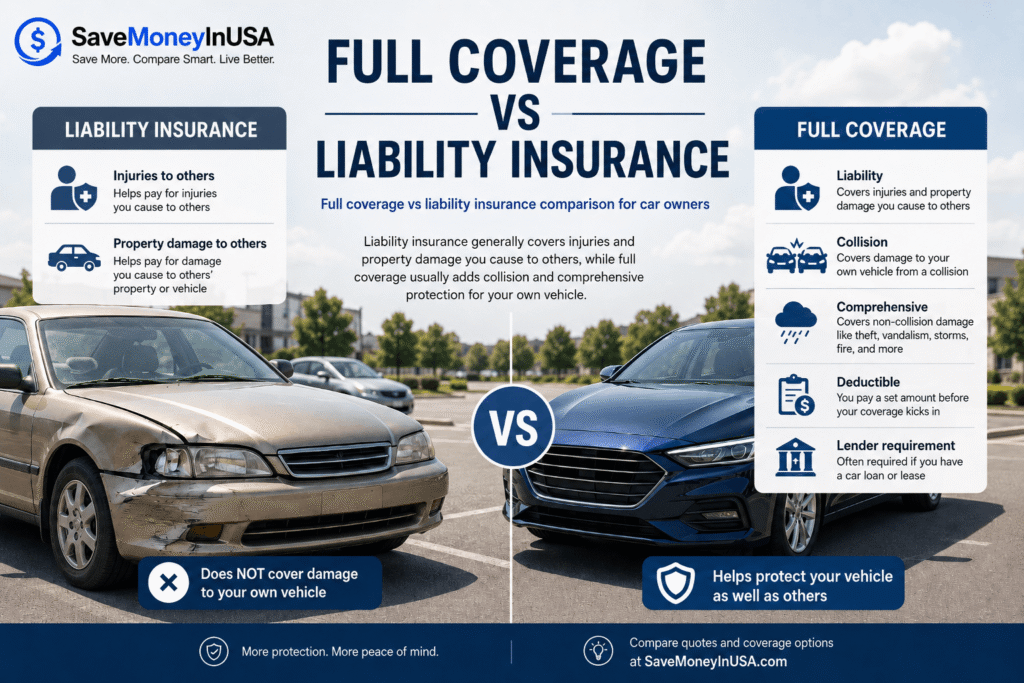
Liability insurance generally helps pay for injuries or property damage you cause to other people. Full coverage usually combines liability insurance with collision and comprehensive coverage, which can also protect your own vehicle in covered situations.
Full coverage may make sense when your vehicle is financed, leased, relatively valuable, or difficult for you to replace. Liability-only insurance may be reasonable when a vehicle has a low market value and you could afford to repair or replace it without an insurance payment.
This guide explains the differences, limitations, costs, lender requirements, deductibles, and financial questions to consider before choosing full coverage or liability insurance.
Compare the cost of liability-only and full coverage options using the same driver, vehicle, limits, and deductible information.
Quick Answer: Full Coverage or Liability Insurance?
Full coverage is generally the stronger option when your vehicle is financed or leased, has significant market value, or would be difficult for you to replace. Liability-only insurance may be worth considering when your vehicle has a low value and you have enough savings to absorb the loss of the vehicle.
- Choose full coverage more often when: the vehicle is financed, leased, newer, valuable, essential for work, or unaffordable to replace.
- Consider liability-only coverage when: the vehicle is paid off, has a low market value, and you could repair or replace it with your own money.
- Do not decide based only on the vehicle’s age: an older vehicle may still be worth protecting if losing it would create a serious financial or transportation problem.
- Compare the actual price difference: the additional cost of collision and comprehensive coverage may be smaller or larger than expected, depending on the driver and insurer.
The best choice depends on your policy requirements, vehicle value, deductible, savings, daily transportation needs, and tolerance for financial risk.
What Is Liability Car Insurance?
Liability car insurance helps pay for injuries and property damage for which you are legally responsible after an accident, subject to the limits and terms of your policy.
Auto liability insurance generally includes two main components:
- Bodily injury liability: helps pay for injuries you cause to another driver, passenger, pedestrian, or other person.
- Property damage liability: helps pay for damage you cause to another person’s vehicle, building, fence, or other property.
Liability insurance does not normally pay to repair or replace your own vehicle after an accident you cause. It also does not provide your vehicle with protection against theft, vandalism, hail, flooding, falling objects, fire, or animal damage.
Most states require drivers to carry some form of financial responsibility, but minimum liability requirements differ by state. Meeting the legal minimum does not necessarily mean you have enough insurance to protect your income, savings, or other assets after a serious accident.
For example, if the cost of injuries or property damage exceeds your liability limits, you may be personally responsible for the remaining amount. Drivers should therefore consider both the legal minimum and the amount of financial exposure they can realistically handle.
Learn more about the different types of car insurance coverage that may be available in addition to basic liability insurance.
What Does “Full Coverage” Mean?
“Full coverage” is a common insurance term, but it is not usually the name of one standardized policy. It generally refers to a policy that includes liability insurance, collision coverage, and comprehensive coverage.
- Liability insurance helps cover injuries and property damage you cause to other people.
- Collision coverage generally helps repair or replace your vehicle after a covered collision with another vehicle or object, minus your deductible.
- Comprehensive coverage generally helps pay for covered non-collision losses such as theft, vandalism, fire, hail, flooding, falling objects, or impact with an animal, minus the applicable deductible.
Full coverage does not mean that every possible loss is covered. A policy can still have limits, deductibles, exclusions, and coverage gaps.
Depending on the state and insurer, the following coverages may be separate or optional:
- Uninsured and underinsured motorist coverage
- Medical payments coverage
- Personal injury protection
- Rental car reimbursement
- Roadside assistance
- Guaranteed asset protection, commonly called GAP
- Rideshare or delivery-driver coverage
- Coverage for custom equipment or aftermarket parts
Before buying a policy described as full coverage, review the declarations page and ask what is included, what is excluded, which deductibles apply, and how the insurer determines the value of a totaled vehicle.
Full Coverage vs Liability Insurance: Key Differences
| Coverage or Feature | Liability Only | Full Coverage |
|---|---|---|
| Bodily injuries you cause to others | Generally covered up to policy limits | Generally covered up to policy limits |
| Property damage you cause to others | Generally covered up to policy limits | Generally covered up to policy limits |
| Damage to your car from a collision | Not normally covered | Generally covered by collision coverage, minus the deductible |
| Vehicle theft | Not normally covered | Generally covered by comprehensive coverage, minus the deductible |
| Hail, flood, fire, vandalism, or falling objects | Not normally covered | Generally covered by comprehensive coverage, subject to policy terms |
| Collision or comprehensive deductible | Not applicable when these coverages are not purchased | Usually applies to covered damage to your own vehicle |
| Required by state law | Liability or another accepted form of financial responsibility is generally required | Collision and comprehensive are generally not required by state law |
| Required by a lender or leasing company | Usually not sufficient by itself | Collision and comprehensive are commonly required |
| Typical premium | Lower | Higher |
| Main financial risk | You may have to repair or replace your own vehicle | You pay a higher premium and remain responsible for deductibles and exclusions |
| Often suitable for | Lower-value, paid-off vehicles whose loss the owner can absorb | Financed, leased, newer, valuable, or difficult-to-replace vehicles |
The most important difference is who carries the risk of damage to your vehicle. With liability-only insurance, you generally keep that risk. With collision and comprehensive coverage, you transfer part of that risk to the insurer, subject to your deductible, policy limits, exclusions, and claims settlement.
Is Full Coverage Required by Law?
State law generally focuses on liability insurance or another accepted form of financial responsibility. Collision and comprehensive coverage are usually optional under state insurance law.
However, optional under state law does not always mean optional under your financial agreement.
If you finance or lease a vehicle, the lender or leasing company will commonly require collision and comprehensive coverage to protect its financial interest in the vehicle. Your loan or lease agreement may also specify deductible limits and other insurance requirements.
If required coverage lapses, a lender may purchase force-placed insurance and charge you for it. Force-placed insurance is generally designed to protect the lender’s interest and may provide less protection for you while costing more than insurance you obtain yourself.
Before reducing coverage on a financed or leased car, review your contract and contact both the lender and insurer. Do not assume that paying the state minimum satisfies your loan or lease agreement.
How Much More Does Full Coverage Cost?
Full coverage usually costs more than liability-only insurance because it adds protection for physical damage to your own vehicle. There is no single national price difference that applies to every driver.
The additional cost can depend on:
- Your state, ZIP code, and local claim patterns
- Your age and driving experience
- Your driving record and prior claims
- The vehicle’s value, repair cost, safety features, and theft rate
- Your annual mileage and how the vehicle is used
- Your liability limits and optional coverages
- Your collision and comprehensive deductibles
- Available discounts
- Credit-based insurance information where permitted by state law
- The insurer’s underwriting and pricing methods
Instead of relying on a general national average, request comparable quotes for your actual vehicle and driver profile.
Ask each insurer to show:
- The price of liability-only coverage
- The price after adding collision coverage
- The price after adding comprehensive coverage
- The price at different deductible levels
- The six-month and annual premium, not only the monthly payment
Use identical liability limits, deductibles, drivers, vehicles, mileage, and optional coverages when comparing companies. Otherwise, the lowest quote may simply provide less protection.
Our guide to comparing car insurance quotes explains how to make an accurate side-by-side comparison.
How Deductibles Affect the Decision
A deductible is the amount you are responsible for paying toward a covered collision or comprehensive claim before the insurer pays the remaining covered amount.
For example, suppose your vehicle has $4,000 of covered collision damage and your collision deductible is $1,000. Subject to the policy and claims determination, the insurer may pay up to $3,000 while you are responsible for the first $1,000.
For a step-by-step explanation of when a deductible applies and how claim payments are calculated, read our guide to how car insurance deductibles work.
A higher deductible may reduce the premium, but it also increases the amount you need to pay after a covered loss. A deductible should therefore be treated as an emergency-fund decision, not only as a way to lower the monthly bill.
Before choosing a deductible, ask:
- Could I pay this deductible immediately after an accident?
- Would paying the deductible interfere with rent, food, debt payments, or other essential expenses?
- How much premium would I actually save by selecting a higher deductible?
- Is the deductible reasonable compared with the current market value of the car?
Learn more about the relationship between your car insurance deductible and premium before changing either amount.
A Better Way to Decide Whether Full Coverage Is Worth It
A common rule says to drop full coverage when a car becomes old. That rule is too simple. Vehicle age matters, but it does not tell you whether losing the vehicle would create a financial emergency.
Use the following decision process instead.
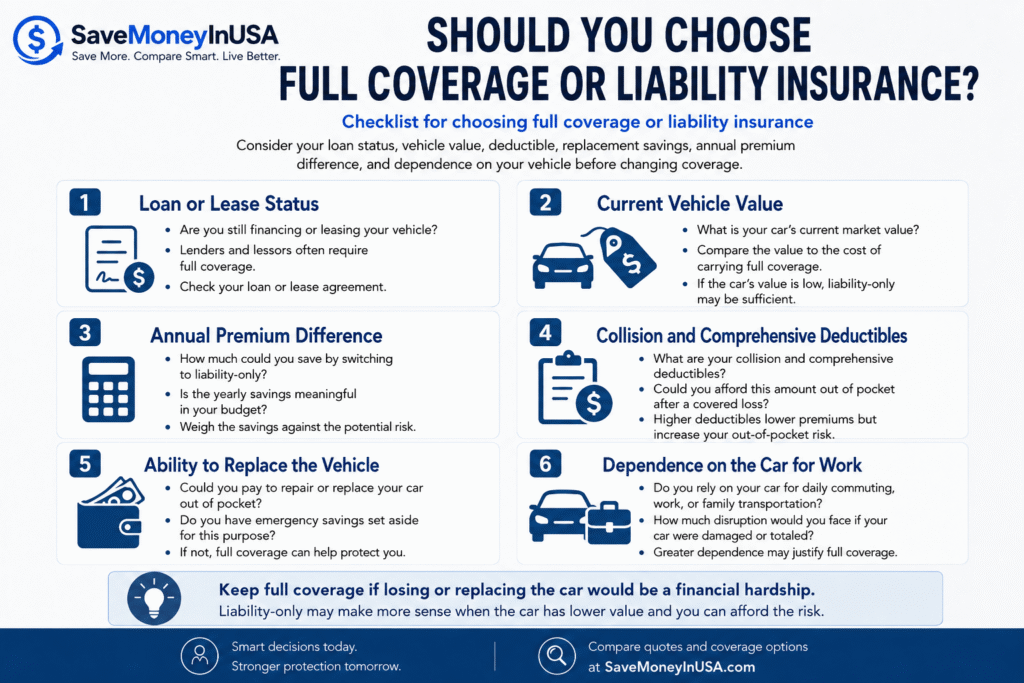
Step 1: Check Whether the Vehicle Is Financed or Leased
If you have a loan or lease, review the agreement before making any coverage change. Collision and comprehensive coverage may be required regardless of the vehicle’s age.
Step 2: Estimate the Vehicle’s Current Market Value
Use realistic local prices for vehicles with a similar year, trim, mileage, condition, and history. Do not base the decision on the original purchase price or the amount you still owe.
Step 3: Find the Additional Annual Cost
Ask the insurer how much of the annual premium is attributable to collision and comprehensive coverage. Do not compare two policies with different liability limits or unrelated optional coverages.
Step 4: Subtract the Deductible From the Vehicle Value
A simple estimate of the maximum practical benefit from a total-loss claim is the vehicle’s current market value minus the applicable deductible. The actual settlement will depend on the insurer’s valuation, policy terms, vehicle condition, and state rules.
For example, consider a vehicle with an estimated market value of $6,000 and a $1,000 collision deductible. A simplified maximum claim estimate after the deductible would be approximately $5,000. This does not mean every covered claim will pay that amount.
Step 5: Measure the Cost Over Several Years
Compare the additional annual premium with the amount of protection you may receive. For example, an additional $700 per year would total $2,100 over three years if premiums remained unchanged.
This calculation does not predict whether you will have a claim. It simply shows the cost of transferring part of the vehicle-loss risk to the insurer.
Step 6: Decide Whether You Could Replace the Vehicle
This is often the most important question. If your car disappeared tomorrow because of theft, fire, flooding, or a total-loss collision, could you obtain another reliable vehicle without high-interest debt or major financial hardship?
A vehicle may have a modest market value and still be financially essential. A driver who depends on a $5,000 car for work may need physical-damage protection more than someone who owns a second vehicle and has substantial savings.
When Liability-Only Insurance May Make Sense
Liability-only insurance may be a reasonable option when all or most of the following conditions apply:
- The vehicle is fully paid off.
- The vehicle has a relatively low current market value.
- The annual cost of collision and comprehensive coverage is high compared with the vehicle’s potential claim value.
- The deductible represents a large portion of the vehicle’s value.
- You have enough savings to repair or replace the vehicle.
- You have access to another vehicle or reliable transportation.
- Losing the vehicle would not threaten your ability to work or meet essential obligations.
Choosing liability-only insurance does not necessarily mean choosing the lowest liability limits. Even if you stop insuring your own vehicle against physical damage, you may still need liability limits above the state minimum to protect against claims involving other people.
You may also be able to keep comprehensive coverage while removing collision coverage. This can sometimes make sense for a low-value vehicle that remains exposed to theft, hail, fire, flooding, falling objects, or animal damage. Ask the insurer whether this option is available and how much it costs.
When Full Coverage Is Usually the Safer Choice
Keeping collision and comprehensive coverage is generally the safer choice when one or more of the following conditions apply:
- Your lender or leasing company requires it.
- The vehicle still has substantial market value.
- You could not comfortably pay for major repairs.
- You could not replace the vehicle from savings.
- You depend on the vehicle for commuting, work, caregiving, or medical appointments.
- Your area has meaningful exposure to theft, hail, flooding, wildfire, falling trees, or animal collisions.
- The additional premium is reasonable compared with the vehicle’s value and your financial risk.
Full coverage may also provide valuable stability for drivers who do not have a large emergency fund. Paying a predictable premium does not eliminate risk, but it may reduce the chance that one covered loss will create an immediate need for a new loan or credit card debt.
What Happens If a Liability-Only Vehicle Is Totaled?
If you cause an accident and carry liability-only insurance, your insurer generally will not pay to repair or replace your own vehicle.
You may have to:
- Pay for repairs yourself
- Sell or dispose of the damaged vehicle
- Use savings to purchase another vehicle
- Borrow money for a replacement vehicle
- Rely temporarily on public transportation, rideshare services, rentals, or help from other people
If another driver is legally responsible, you may be able to pursue a property damage claim against that driver or the driver’s insurer. However, payment can depend on fault, evidence, coverage limits, policy status, state rules, and the other driver’s ability to pay.
Liability-only coverage also leaves your vehicle without comprehensive protection. Therefore, you generally would not receive payment from your own policy if the vehicle were stolen or damaged by a covered weather event, fire, vandalism, falling object, or animal impact.
Does Full Coverage Pay Off Your Car Loan?
Not necessarily. Collision and comprehensive insurance generally pay based on the covered value of the vehicle, subject to the policy, deductible, and claims settlement. They do not automatically pay the entire remaining loan balance.
If you owe more than the vehicle is worth, a total-loss settlement may be less than the amount required to pay off the loan. You may remain responsible for the difference.
GAP is a separate product intended to help cover some or all of the difference between an eligible loan balance and the vehicle insurance settlement after a covered total loss. GAP has its own terms, limits, exclusions, and eligibility rules, so it should not be assumed to be part of full coverage.
Learn more about how this protection differs from collision and comprehensive coverage in our guide to GAP insurance for a financed car.
Common Mistakes to Avoid
Choosing Liability Only Based on the Monthly Price
A lower premium can help your current budget, but it also means accepting more responsibility for damage to your own vehicle. Consider the cost of replacement, not only the next monthly payment.
Keeping Full Coverage Without Checking the Vehicle’s Value
Collision and comprehensive coverage may become less valuable as a vehicle depreciates. Review the vehicle’s market value, annual premium, and deductible at least once a year.
Assuming Full Coverage Covers Everything
Full coverage is an informal description, not a promise of unlimited protection. Review limits, exclusions, deductibles, optional coverages, and policy endorsements.
Reducing Coverage on a Financed Vehicle
Removing required collision or comprehensive coverage may violate the loan or lease agreement. Check the contract before changing the policy.
Comparing Quotes With Different Limits
A cheaper quote may have lower liability limits, higher deductibles, or fewer optional protections. Keep the coverage details consistent when comparing insurers.
Dropping Coverage Without Building Replacement Savings
If you choose liability-only insurance, consider directing part of the premium savings into a dedicated vehicle repair and replacement fund.
Ways to Lower Full Coverage Costs Without Removing It
If full coverage still makes sense but the premium is difficult to manage, consider several alternatives before removing collision and comprehensive coverage entirely.
- Compare quotes from multiple insurers using identical coverage.
- Ask for the price difference between several deductible options.
- Review mileage and vehicle-use information for accuracy.
- Ask about multi-policy, multi-vehicle, safe-driver, payment, defensive-driving, or telematics discounts.
- Remove optional add-ons that duplicate benefits you already receive elsewhere.
- Review coverage after major life changes, relocation, loan payoff, or a significant decrease in vehicle value.
- Improve factors within your control, such as maintaining a clean driving record and avoiding coverage lapses.
See additional strategies for lowering your car insurance premium without automatically sacrificing important protection.
Questions to Ask Before Changing Your Coverage
- Is my vehicle financed or leased?
- What is the vehicle realistically worth today?
- What are my collision and comprehensive deductibles?
- How much would I save annually by removing collision, comprehensive, or both?
- Could I pay for a major repair without using high-interest debt?
- Could I replace the car if it were totaled or stolen?
- How would losing the vehicle affect my employment or essential responsibilities?
- Does my area have significant theft or weather-related risk?
- Could I keep comprehensive while removing collision?
- Have I compared the same coverage with several insurers?
If you cannot answer these questions from your current documents, review the declarations page or contact the insurer before changing the policy.
Frequently Asked Questions
Is full coverage worth it on an older car?
It can be. Vehicle age alone does not determine whether full coverage is worthwhile. Compare the car’s current market value, deductible, additional annual premium, replacement cost, available savings, and importance to your daily life. An older car may still be worth protecting if you cannot afford to replace it.
Can I switch from full coverage to liability insurance?
You can usually request a policy change, but a lender or leasing company may require you to maintain collision and comprehensive coverage. Review your agreement before making the change. Also consider what would happen financially if your vehicle were damaged, totaled, or stolen.
Is liability insurance enough for a paid-off car?
Paying off the car removes the lender requirement, but it does not automatically make liability-only insurance the best choice. Consider the vehicle’s value and whether you could afford to repair or replace it without insurance assistance.
Does full coverage include uninsured motorist insurance?
Not automatically in every policy. Full coverage commonly refers to liability, collision, and comprehensive coverage. Uninsured or underinsured motorist coverage may be separate, required, offered, or rejectable depending on state law and policy terms.
Does full coverage cover mechanical breakdowns?
Standard collision and comprehensive coverage generally do not cover ordinary wear, maintenance, or mechanical failure. Damage may be covered when it results from a separate covered event, but policy terms and exclusions control the claim.
Can I keep comprehensive coverage but remove collision?
Some insurers allow a vehicle owner to keep comprehensive coverage without collision coverage, particularly when the vehicle is paid off. This may preserve protection against theft, fire, hail, flooding, animal impact, and certain other non-collision losses. Availability and pricing vary by insurer and state.
Does full coverage pay the replacement cost of a new car?
Standard collision and comprehensive coverage commonly settle a totaled vehicle based on its covered value at the time of loss, not necessarily the cost of buying a brand-new replacement. New-car replacement coverage may be available as a separate endorsement with eligibility restrictions.
Should I lower my deductible instead of dropping full coverage?
A lower deductible reduces the amount you pay after a covered claim but generally increases the premium. A higher deductible may reduce the premium while preserving collision and comprehensive coverage. Compare the actual savings and select a deductible you could pay from available cash.
Final Thoughts: Which Coverage Should You Choose?
Liability-only insurance may lower your premium, but it generally leaves you responsible for damage to your own vehicle. Full coverage usually costs more because collision and comprehensive coverage transfer part of that risk to the insurer.
Full coverage is generally more appropriate when the vehicle is financed, leased, valuable, essential, or difficult to replace. Liability-only insurance may make sense when the vehicle is paid off, has a low market value, and its loss would not create serious financial hardship.
Do not rely only on the vehicle’s age or a general online average. Check the lender requirements, estimate the vehicle’s current value, compare the deductible with the potential claim payment, calculate the additional annual premium, and consider your ability to replace the car.
Finally, compare both options with several insurers. Companies may price the same driver and coverage very differently, so changing insurers or adjusting a deductible may reduce the premium without requiring you to give up important protection.
Sources
- National Association of Insurance Commissioners: Auto Insurance
- National Association of Insurance Commissioners: What Does Auto Insurance Cover?
- Insurance Information Institute: Auto Insurance Basics
- Consumer Financial Protection Bureau: Force-Placed Insurance
- Consumer Financial Protection Bureau: Guaranteed Asset Protection
Insurance requirements, policy definitions, available coverage, limits, deductibles, and claim outcomes vary by state, insurer, contract, and individual circumstances. Review your policy and contact a licensed insurance professional or state insurance department when necessary.
About the Author
The SaveMoneyInUSA Editorial Team researches car insurance costs, coverage options, state requirements, and quote comparison considerations for drivers in the United States.
Learn more about our Editorial Team.
Disclaimer
SaveMoneyInUSA is an independent informational website and is not an insurance company, broker, or agent.
Some links may be affiliate links. We may receive compensation from partners at no additional cost to users.
Insurance rates, coverage options, and eligibility vary by provider and individual circumstances.
This content is provided for educational purposes only and should not be considered insurance, legal, or financial advice.