

Last Updated: August 2026
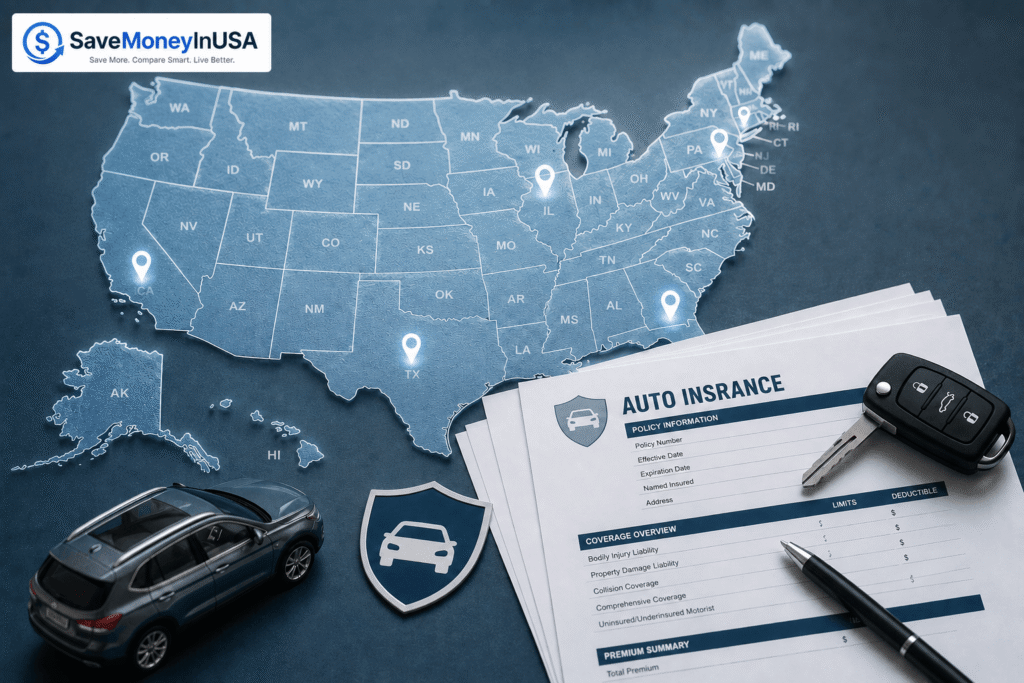
Car insurance laws are not the same across the United States. Each state determines the liability limits, required coverage types, proof-of-insurance rules, and financial responsibility options that apply to its drivers and registered vehicles.
This resource center helps you find SaveMoneyInUSA guides about state car insurance requirements. It is a navigation page—not a substitute for the detailed 50-state comparison or an official state source.
Start here: Use the national guide for a broad comparison, select a detailed state guide when one is available, and verify current requirements with the state insurance department or motor vehicle agency before buying, reducing, or canceling coverage.
Compare Minimum Car Insurance Requirements by State
Our national guide summarizes minimum private-passenger vehicle requirements for all 50 states and Washington, D.C. It also explains liability-limit numbers, required PIP or uninsured motorist coverage in applicable states, special financial responsibility systems, and why a state minimum may not provide enough protection for every driver.
Minimum Car Insurance Requirements by State: 2026 Guide
Use this guide when you want a national overview or need to compare the basic requirements of more than one state.
California Car Insurance Requirements
California’s standard minimum liability limits for private passenger vehicles are currently 30/60/15: $30,000 for injury or death to one person, $60,000 for injury or death to more than one person in one accident, and $15,000 for property damage. Separate rules and eligibility requirements apply to the California Low Cost Automobile Insurance Program.
California Minimum Car Insurance Requirements
Start with this California overview to understand the legal minimum, proof requirements, coverage gaps, and situations in which higher limits may deserve consideration.
California 30/60/15 Liability Insurance Explained
See how the per-person, per-accident, and property-damage limits work and what can happen when a covered loss exceeds the policy limits.
Can You Register a Car Without Insurance in California?
Review how registration, insurance reporting, permission to drive, suspension, and planned nonoperation relate to one another.
California Car Insurance Grace Period
Learn why drivers should not assume that a universal grace period protects a new vehicle, late payment, renewal, or lapse in every situation.
California Guide for New Immigrants and International Drivers
New California residents may need to coordinate licensing, vehicle registration, foreign driving documents, insurance eligibility, and proof of financial responsibility. These are related steps, but they do not all follow the same deadline or eligibility rule.
California Car Insurance for New Immigrants and International Drivers
Use this audience-specific guide for California licensing, foreign-license considerations, insurance documents, 30/60/15 requirements, and lower-cost coverage resources.
SR-22 Rules and Costs Vary by State
An SR-22 is generally a certificate filed by an insurer to show that a driver meets an applicable financial responsibility requirement. It is not a separate insurance policy. The triggering events, required limits, filing period, and consequences of a lapse depend on the state and the driver’s situation.
SR-22 Insurance Cost by State
Use this guide to separate the filing fee from the larger premium effect associated with the underlying violation, compare state requirements, and understand why continuous coverage matters.
What State Minimum Coverage Usually Means
In many states, the foundation of a legal minimum policy is bodily injury and property damage liability coverage. Some states also require coverage such as personal injury protection, uninsured motorist protection, underinsured motorist protection, medical payments coverage, or state-specific property protection.
- Liability coverage: Helps pay covered injuries or property damage you cause to other people, up to the policy limits.
- PIP or medical coverage: May help pay covered medical expenses and other eligible costs under applicable state and policy rules.
- UM/UIM coverage: May protect you when an at-fault driver has no insurance or insufficient insurance, subject to state law and policy terms.
- Collision and comprehensive: Generally are not required by state law, but a lender or leasing company commonly requires them while it has a financial interest in the vehicle.
For a coverage comparison, read Full Coverage vs. Liability Insurance and Best Car Insurance Coverage Options.
Why the Legal Minimum May Not Be Enough
A state minimum is a legal threshold, not a personalized coverage recommendation. One serious injury, damage to a newer vehicle, or an accident involving several vehicles can exceed a low liability limit. If covered damages are higher than the available policy limit, you may be responsible for the remaining amount.
When comparing quotes, request the same liability limits, required state coverages, deductibles, drivers, vehicles, and policy term. A lower price is not a meaningful comparison when one quote provides less protection.
How to Verify Your State’s Current Requirements
State laws, minimum limits, policy forms, and agency procedures can change. Before purchasing or reducing coverage:
- Confirm where the vehicle is registered and principally garaged.
- Check the applicable state insurance department and motor vehicle agency.
- Ask the insurer to identify every coverage required for the vehicle and driver.
- Review any lender, lease, SR-22, rideshare, commercial-use, or special-program requirements.
- Keep proof of coverage in the form and location required by the state.
The NAIC State Insurance Departments directory can help you locate the appropriate insurance regulator. Registration, licensing, and proof-of-insurance procedures may be handled by a separate DMV or motor vehicle agency.
Browse All Car Insurance Guides
State requirements are only one part of choosing a policy. Visit the Car Insurance Guides Resource Center for guides about comparing quotes, coverage choices, deductibles, financed vehicles, high-risk drivers, new immigrants, and international students.
Compare Car Insurance Quotes Using the Same Coverage
Confirm your state’s current requirements first, then compare the same coverage limits, drivers, vehicles, deductibles, and policy term across insurers.
Sources
- National Association of Insurance Commissioners — State Insurance Departments
- California DMV — Auto Insurance Requirements
- California Department of Insurance — Automobile Insurance Guide
State insurance laws, required coverages, minimum limits, financial responsibility alternatives, and agency procedures can change. The guides on this page are educational summaries. Confirm current requirements with the appropriate state insurance department, motor vehicle agency, insurer, or licensed insurance professional.
About the Author
The SaveMoneyInUSA Editorial Team researches car insurance costs, coverage options, state requirements, and quote comparison considerations for drivers in the United States.
Learn more about our Editorial Team and Editorial Guidelines.
Disclaimer
SaveMoneyInUSA is an independent informational website and is not an insurance company, broker, or agent.
Some links may be affiliate links. We may receive compensation from partners at no additional cost to users.
Insurance laws, rates, coverage requirements, policy limits, exclusions, and eligibility vary by state, insurer, policy, vehicle, and individual circumstances.
This content is provided for educational purposes only and should not be considered insurance, legal, tax, or financial advice.