

Last Updated: September 2026
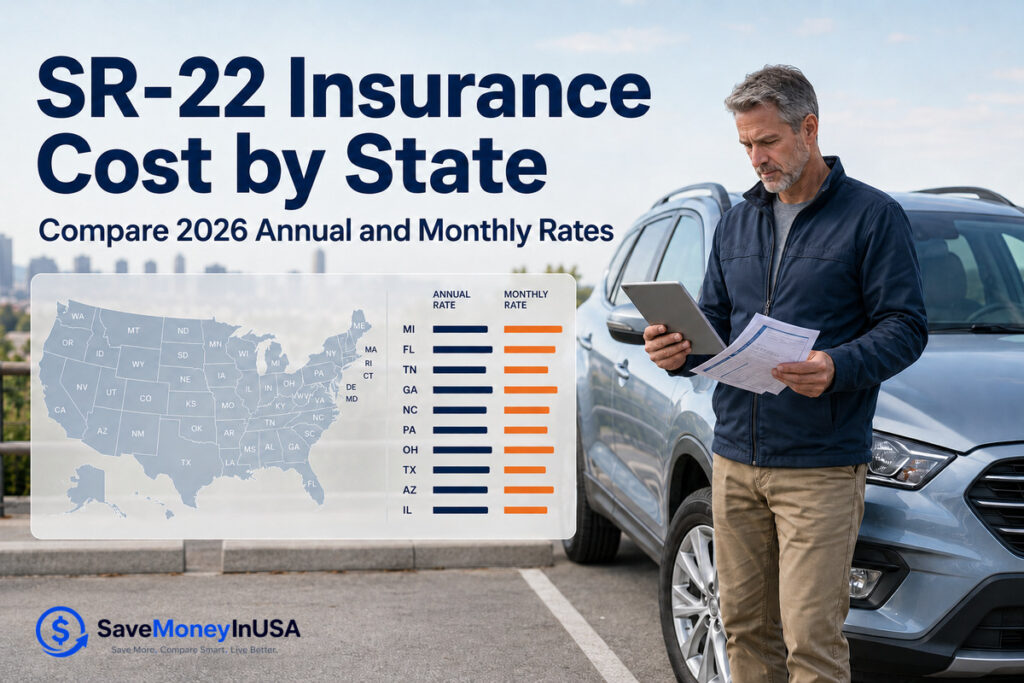
SR-22 insurance costs an average of $3,295 per year, or about $275 per month, for the sample driver in the national rate analysis used in this guide. That figure is not the price of the SR-22 form alone. The insurer’s filing fee is typically about $25; most of the total cost comes from the DUI, uninsured driving, suspension, or other event that caused the state to require the filing.
Your price can be very different because rates depend on the state, violation, insurer, coverage limits, vehicle, age, ZIP code, and whether you need an owner or non-owner policy. Use the state table below as a consistent comparison—not as a guaranteed quote.
Compare the same coverage limits, deductibles, driver details, and SR-22 filing requirement across multiple insurers.
How Much Does SR-22 Insurance Cost?
An SR-22 is a certificate of financial responsibility filed by an insurer; it is not a separate insurance policy. Forbes Advisor’s rate analysis reports an average of $3,295 annually for a driver with a DUI and an SR-22 requirement. That equals approximately $275 per month.
To interpret that number correctly, note the study profile: a 30-year-old driver with a DUI, a Toyota RAV4, 100/300/100 liability limits, 100/300 uninsured motorist coverage, comprehensive and collision coverage, and a $500 deductible. Minimum-coverage, non-owner, older-driver, younger-driver, and non-DUI quotes are not directly comparable with this benchmark.
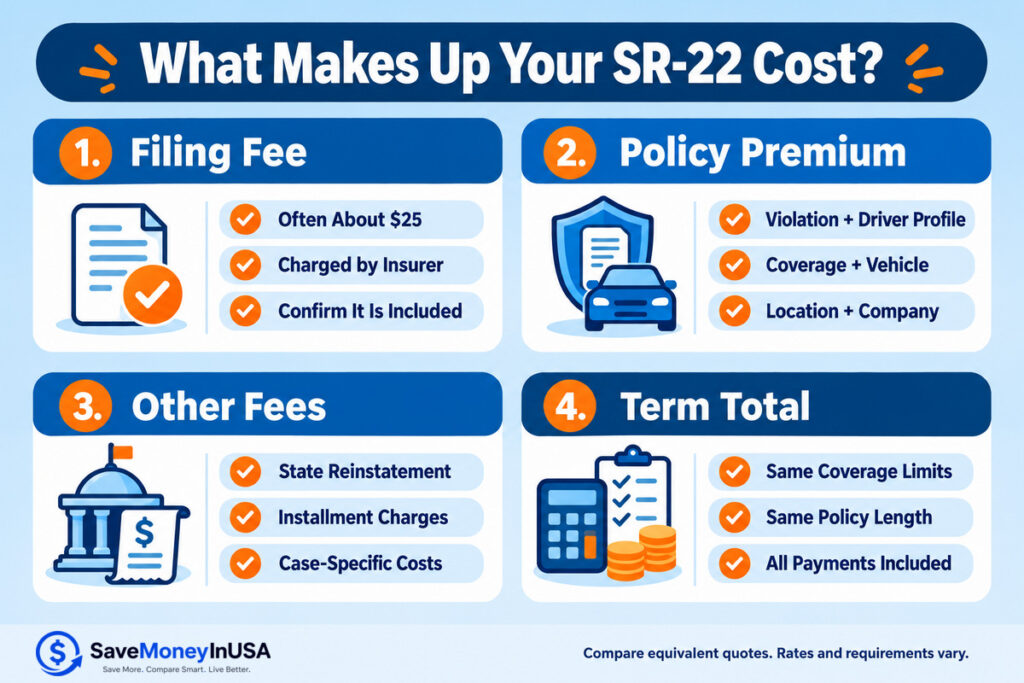
| Cost component | Typical amount | Who receives it | What drives the cost |
|---|---|---|---|
| SR-22 filing fee | Often about $25 | Insurance company | Insurer and state procedures |
| Auto insurance premium | Varies widely | Insurance company | Violation, location, coverage, vehicle, and driver profile |
| Reinstatement or state fee | Varies by state and case | DMV or other state agency | Suspension and reinstatement rules |
| Other compliance costs | Case-specific | Approved providers or government agencies | Court orders, ignition interlock, education, or other requirements |
Key distinction: a $25 filing fee does not mean the policy costs only $25. When drivers search for “SR-22 prices,” they are usually looking for the total insurance premium after the triggering event.
SR-22 Insurance Cost by State in 2026
The following figures come from the Forbes Advisor national rate analysis available when this guide was reviewed in September 2026. Every state uses the same driver, vehicle, violation, coverage, and deductible assumptions. The figures show sample average annual premiums for a driver with a DUI and an SR-22 requirement—not real-time quotes, state-minimum coverage, or the filing fee by itself.
| State | Average annual cost | Approx. monthly cost |
|---|---|---|
| Alabama | $3,250 | $271 |
| Alaska | $3,036 | $253 |
| Arizona | $3,414 | $285 |
| Arkansas | $3,451 | $288 |
| California | $5,593 | $466 |
| Colorado | $3,882 | $324 |
| Connecticut | $3,130 | $261 |
| Delaware | $3,883 | $324 |
| Florida | $4,717 | $393 |
| Georgia | $3,689 | $307 |
| Hawaii | $3,208 | $267 |
| Idaho | $2,174 | $181 |
| Illinois | $3,419 | $285 |
| Indiana | $3,015 | $251 |
| Iowa | $2,709 | $226 |
| Kansas | $3,318 | $277 |
| Kentucky | $4,677 | $390 |
| Louisiana | $5,402 | $450 |
| Maine | $2,340 | $195 |
| Maryland | $3,781 | $315 |
| Massachusetts | $3,542 | $295 |
| Michigan | $5,397 | $450 |
| Minnesota | $3,328 | $277 |
| Mississippi | $3,173 | $264 |
| Missouri | $3,413 | $284 |
| Montana | $3,100 | $258 |
| Nebraska | $3,368 | $281 |
| Nevada | $3,705 | $309 |
| New Hampshire | $3,109 | $259 |
| New Jersey | $4,095 | $341 |
| New Mexico | $2,902 | $242 |
| New York | $4,840 | $403 |
| North Carolina | $5,093 | $424 |
| North Dakota | $3,180 | $265 |
| Ohio | $2,718 | $227 |
| Oklahoma | $3,363 | $280 |
| Oregon | $2,948 | $246 |
| Pennsylvania | $3,708 | $309 |
| Rhode Island | $4,055 | $338 |
| South Carolina | $3,949 | $329 |
| South Dakota | $3,271 | $273 |
| Tennessee | $3,079 | $257 |
| Texas | $3,583 | $299 |
| Utah | $3,417 | $285 |
| Vermont | $2,663 | $222 |
| Virginia | $2,797 | $233 |
| Washington | $2,666 | $222 |
| West Virginia | $3,221 | $268 |
| Wisconsin | $2,799 | $233 |
| Wyoming | $2,540 | $212 |
State-use note: Some states do not use an SR-22 filing. For those states, the figure is best understood as a comparable DUI-policy cost benchmark from the same national rate analysis—not as the price of an SR-22 filing. Follow the financial-responsibility procedure stated in your court or state notice.
The study ranges from $2,174 per year in Idaho to $5,593 in California. This does not mean Idaho will always be cheapest or California will always be most expensive for you. A different insurer, violation, ZIP code, vehicle, or coverage level can change the order.
How to Estimate Your Monthly SR-22 Cost
Start with the annual premium and divide by 12. For example, the study’s California average of $5,593 works out to about $466 per month. That is only an annualized comparison. Your actual installment may differ because insurers can charge installment fees, require a down payment, or divide the term into a number of payments other than 12.
| Question | Why it changes the comparison |
|---|---|
| Is the quote for six or 12 months? | A lower total may simply cover a shorter policy term. |
| Is the quote minimum coverage or full coverage? | Collision, comprehensive, limits, and deductibles materially affect price. |
| Are all fees included? | Filing, installment, and policy fees can change the amount paid. |
| Is the same violation listed? | A DUI quote cannot be compared fairly with a lapse-only or clean-record quote. |
| Is the SR-22 filing confirmed? | A standard policy quote may not include the required filing. |
Why Your Quote May Differ from the State Average
The state table controls for one driver profile, but a real quote is individualized. The largest differences often come from:
- Reason for the filing: a DUI, uninsured accident, license suspension, or repeated violations can produce different rates.
- Coverage level: state-minimum liability generally costs less than a policy with higher limits, collision, and comprehensive coverage.
- Owner status: a non-owner policy may cost less because it does not insure a vehicle, but it is not appropriate for someone who owns a car or has regular access to one.
- Company: insurers price violations differently and some do not accept every SR-22 situation.
- Location and driver profile: ZIP code, age, vehicle, mileage, insurance history, and other permitted rating factors matter.
If the filing follows a DUI, see our guide to finding car insurance after a DUI. Drivers comparing insurers can also use the SR-22 insurance company comparison guide.
Does Every State Use an SR-22?
No. State procedures are not uniform, and a national rate table does not mean every state uses an SR-22 filing in the same circumstances. Some states use other proof-of-financial-responsibility processes. Florida and Virginia also use an FR-44 for certain serious offenses; an FR-44 generally requires higher liability limits than an SR-22.
Follow the exact instructions in your court or state notice. If you move, do not assume the old requirement disappears. Confirm the filing method, coverage limits, and end date with the agency that imposed the requirement and an insurer authorized to make the necessary filing.
California illustrates why current official rules matter. California DMV lists the SR 22 as one form of proof it may request and currently lists private-passenger minimum liability limits of 30/60/15. Virginia DMV separately explains its SR-22 and FR-44 certification rules. These state pages should control over a general national guide.
Owner vs Non-Owner SR-22 Cost
| Policy type | Usually fits | Cost considerations | Important limitation |
|---|---|---|---|
| Owner policy with SR-22 | A driver who owns a vehicle | Price reflects the vehicle and selected coverages | Financed or leased vehicles may require collision and comprehensive coverage |
| Non-owner policy with SR-22 | A driver who owns no vehicle and needs liability coverage while borrowing or renting occasionally | May cost less because no owned vehicle is insured | Generally does not cover a vehicle you own, regular household access, or physical damage to the borrowed vehicle |
Do not choose a non-owner policy only because the quote is cheaper. Disclose vehicle ownership, household vehicles, and regular use accurately. If you finance a car, review coverage requirements for a financed vehicle.
How to Lower the Total Cost
- Confirm the requirement first. Check the filing type, state, deadline, coverage limits, and required duration before requesting quotes.
- Compare matching quotes. Use the same limits, deductibles, vehicle, drivers, term, and payment schedule with each insurer.
- Ask about the full policy-term cost. Include the SR-22 filing fee, down payment, installment fees, and all scheduled premiums.
- Choose coverage deliberately. Do not drop necessary protection merely to lower the quote. Compare full coverage and liability insurance before changing coverage.
- Prevent a lapse. A cancellation can cause the insurer to notify the state and may create additional licensing problems.
- Re-shop at renewal. Rates can change as violations age, but confirm continuous filing before switching.
SR-22 Cost Questions
How much does SR-22 insurance cost per month?
The national study used here averages about $275 per month for its DUI-and-SR-22 sample driver. Your personalized quote may be substantially lower or higher.
Is the SR-22 filing itself expensive?
Usually not. The filing fee is often about $25. The underlying violation and the policy coverage generally account for most of the total expense.
How long do I have to pay SR-22 rates?
Many requirements last about three years, but the exact period and start date depend on the state and the reason for the filing. Verify the end date before asking an insurer to remove the filing.
Will minimum coverage always be the cheapest option?
It generally has a lower premium than higher-limit coverage with collision and comprehensive, but it can leave you with greater financial exposure. A lender or lease agreement may also require physical-damage coverage.
Final Thoughts
SR-22 cost comparisons are useful only when the assumptions match. The form’s filing fee is relatively small; the total premium reflects the violation, state, insurer, vehicle, driver profile, and coverage. Confirm the official requirement, compare equivalent quotes, and keep the filing active for the entire required period.
Sources
- Forbes Advisor — National and state SR-22 cost analysis, rate methodology, and filing-cost explanation.
- California Department of Motor Vehicles — Current liability requirements and acceptable proof, including SR 22.
- Florida Highway Safety and Motor Vehicles — SR-22 and FR-44 insurance filing information.
- Virginia Department of Motor Vehicles — SR-22/SR-26 and FR-44/FR-46 certification requirements.
About the Author
The SaveMoneyInUSA Editorial Team researches car insurance costs, coverage options, state requirements, and quote comparison considerations for drivers in the United States.
Learn more about our Editorial Team.
Disclaimer
SaveMoneyInUSA is an independent informational website and is not an insurance company, broker, or agent.
Some links may be affiliate links. We may receive compensation from partners at no additional cost to users.
Insurance rates, coverage options, filing requirements, policy terms, and eligibility vary by insurer, state, violation, driver profile, vehicle, and time. All prices shown are sample averages based on the cited methodology and are not guaranteed quotes.
This content is provided for educational purposes only and should not be considered insurance, legal, or financial advice.