

Last Updated: September 2026

New immigrants, foreign-license holders, and other non-U.S. citizens can often buy car insurance in the United States. The difficult part is not citizenship—it is finding an insurer that accepts your current license and documents, then comparing policies with the same coverage.
Your options may depend on your state, whether you are a resident or visitor, the type of license you hold, your vehicle, and the insurer’s underwriting rules. A foreign driving record may help with some companies, but it may not be treated the same as a U.S. driving or insurance history.
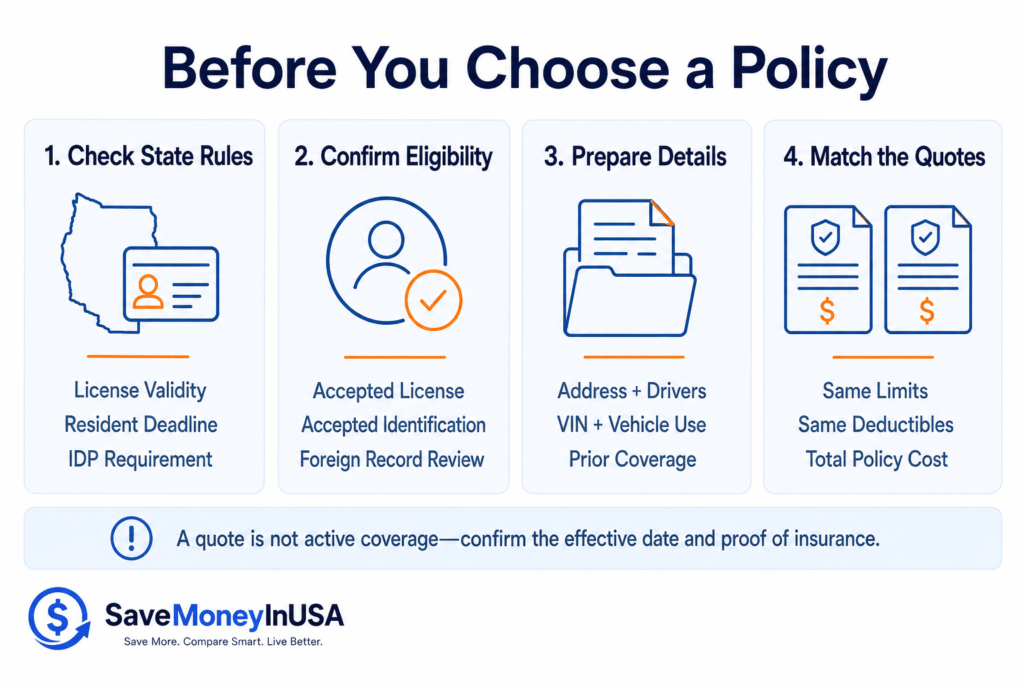
This guide explains the steps to take before requesting quotes, the documents to prepare, and how to choose coverage without relying only on the advertised payment.
Compare license eligibility, coverage limits, deductibles, policy term, and total cost before choosing a policy.
Can New Immigrants and Foreign Drivers Get Car Insurance?
Often, yes. U.S. citizenship is not a universal requirement for buying auto insurance. However, an insurer must be able to identify the applicant, evaluate the driver, and insure the vehicle under its rules.
Some insurers may consider a valid foreign driver’s license. Others may require a license issued by the state where you live. An International Driving Permit may help translate license information, but it is not a substitute for the original license and does not decide whether an insurer will issue a policy.
The practical first step is to check two separate questions:
- May you legally drive with your current license? Ask the motor vehicle agency in the state where you live or plan to drive.
- Will the insurer accept that license? Confirm this with the company or a licensed agent before relying on a quote.
USAGov explains that foreign visitors may need both a license from their home country and an International Driving Permit, depending on the state. Permanent residents should check their state’s licensing requirements. Use the USAGov directory of state motor vehicle services to find the correct agency.
Start With Your License and Residency Situation
| Situation | First Check | Insurance Question |
|---|---|---|
| New state resident with a foreign license | Deadline and documents for obtaining a state license | Whether the foreign license is accepted temporarily |
| Visitor or tourist | Whether the state accepts your license and requires an IDP | Whether you need rental coverage or another temporary option |
| Newly issued U.S. license | License status and any restrictions | How the insurer treats limited U.S. driving history |
| International student | State residency and licensing rules | Whether a foreign, learner’s, or state license is accepted |
| No vehicle owned | How often and whose vehicle you drive | Whether the owner’s policy, rental coverage, or a non-owner policy applies |
Do not assume that an insurance quote gives you permission to drive. Licensing rules come from the state, while policy eligibility comes from the insurer. Both must be checked.
International students can also review our guide to car insurance with a foreign license. California residents should use the more specific guide to California car insurance for new immigrants and international drivers.
What Documents May Be Needed?
Document requirements vary. Prepare accurate information, but ask each insurer what it actually accepts instead of assuming that a passport, visa, ITIN, or foreign license will work in every case.
| Document or Information | Why It May Be Requested |
|---|---|
| Current driver’s license | Confirms license type, number, and driving eligibility |
| Foreign driving record or abstract | May help document prior experience if the insurer accepts it |
| Certified translation | May be requested when records are not in English |
| U.S. address and garaging location | Shows where the vehicle is normally kept and used |
| Vehicle identification number (VIN) | Identifies the exact vehicle and its characteristics |
| Registration, title, or purchase information | Confirms ownership or the vehicle being purchased |
| Prior insurance records | May help establish previous continuous coverage |
| Information for household drivers | Helps the insurer identify people who may regularly use the vehicle |
| Accepted identification or tax number | Company requirements vary; ask whether an SSN, ITIN, passport, or another form is accepted |
| Lender or leasing-company details | Needed when the vehicle is financed or leased |
Enter the true garaging address, annual mileage, vehicle use, and household-driver information. Inaccurate information can change the quote and may create policy or claim problems later.
Can Foreign Driving and Insurance History Help?
It may help, but acceptance is not standardized. Ask whether the insurer will review an official driving abstract, a claims-history letter, or proof of prior insurance from your home country. Also ask whether the document needs a certified English translation and how recent it must be.
Do not assume that submitting a clean foreign record guarantees a discount. One company may consider it for eligibility or experience, while another may rely mainly on information it can verify through U.S. records. This difference is one reason foreign drivers can receive very different quotes.
Foreign Record Checklist
- Ask whether foreign driving experience is considered.
- Request an official record from the issuing authority.
- Get a translation if the insurer requires one.
- Keep previous insurer letters or claim records.
- Confirm how the information changed the final offer, if at all.
Choose the Policy That Matches How You Drive
The correct starting point depends on whether you own, finance, borrow, or rent a vehicle. A policy designed for one situation may not protect you in another.
| Your Situation | Likely Starting Point | What to Confirm |
|---|---|---|
| Own a paid-off car | Standard auto policy | State-required liability plus any optional protection for your vehicle |
| Finance or lease a car | Standard auto policy with lender-required coverage | Collision, comprehensive, deductibles, and lienholder or lessor details |
| Regularly drive a household vehicle | Household policy review | Whether you must be listed as a driver |
| Borrow cars occasionally | Owner’s policy review and possible non-owner policy | Permission, primary coverage, exclusions, and your own liability needs |
| Rent a car | Rental-company options plus any existing coverage | Liability, damage waiver, deductibles, exclusions, and coverage from cards or other policies |
If you do not own a car but sometimes drive, read about non-owner car insurance for international students and new drivers. If a vehicle is financed, review full-coverage requirements for financed cars before signing the loan.
How to Compare Quotes Fairly
A cheaper quote may simply contain less coverage, a higher deductible, or a different payment schedule. The NAIC recommends comparing matching coverages and limits. Use the same information for every quote:
- All drivers and the same license information
- The same vehicle, VIN, use, mileage, and garaging address
- The same liability limits
- The same collision and comprehensive deductibles
- The same optional coverages and limits
- The same policy term and payment schedule
- All fees, discounts, and the amount due to start coverage
Then confirm whether the price is preliminary or final. Ask whether the insurer still needs to verify your license, driving history, prior coverage, address, or vehicle information. Do not cancel another policy or drive until you know the new coverage is active and have proof of insurance.
Why a Foreign Driver’s Quote May Be Higher
A high quote does not necessarily mean the insurer considers you an unsafe driver. It may reflect limited information, the policy selected, or other permitted rating factors. Depending on state law and company rules, factors may include:
- Years of verifiable driving experience
- Driving violations and claims
- Prior insurance and coverage gaps
- Age and other permitted driver characteristics
- Vehicle type, repair cost, and safety features
- Garaging location and annual mileage
- Coverage limits and deductibles
- A credit-based insurance score where its use is permitted
Credit-based insurance scores are not the same as consumer credit scores, and states differ in whether and how insurers may use them. The NAIC overview of credit-based insurance scores explains that credit information is normally only one of several inputs.
Ways to Control the Cost Without Cutting the Wrong Coverage
- Price insurance before buying a car. Compare the exact vehicles you are considering because repair cost, theft risk, and coverage needs can change the premium.
- Compare several companies. License acceptance and treatment of foreign records may differ.
- Keep quote inputs identical. Otherwise, the lowest number may not represent the same protection.
- Choose a deductible you can pay. A higher deductible can reduce the premium, but it increases your cost after a covered loss.
- Ask about available discounts. Eligibility may depend on the state and insurer. Examples can include multi-policy, multi-vehicle, defensive-driving, paperless, payment, or telematics programs.
- Avoid an accidental lapse. Confirm the new policy’s effective date before canceling the old one and keep payment information current.
- Recheck at renewal. Your U.S. license, driving, insurance, and credit-related information may change over time, but no particular savings result is guaranteed.
For a broader process, use our guide on how to compare car insurance quotes. Also check the minimum car insurance requirements by state before selecting limits.
Common Mistakes to Avoid
- Treating an IDP as a driver’s license: it generally works as a translation and should be carried with the original valid license.
- Assuming one company’s answer applies to every insurer: underwriting and document rules vary.
- Leaving out a regular household driver: disclose who lives with you and who may drive the vehicle.
- Using the wrong address or vehicle use: the garaging location, commute, business use, delivery work, or rideshare use may affect eligibility and coverage.
- Buying minimum liability without understanding the limit: state minimums may not cover the full cost of a serious loss.
- Forgetting lender requirements: a financed or leased vehicle may require collision, comprehensive, specified deductibles, and the lender or lessor listed on the policy.
- Assuming a quote means coverage is active: verify the effective date and obtain proof of insurance.
Frequently Asked Questions
Can a non-U.S. citizen buy car insurance?
Often, yes. Citizenship is not a universal requirement. The insurer will still apply its rules for licenses, identification, drivers, address, vehicle, and payment.
Can I get car insurance without a Social Security number?
Possibly. Some insurers may accept an ITIN or other identification, while others may require an SSN for their application process. Ask the company what it accepts before submitting personal information.
Can I buy car insurance with a foreign driver’s license?
Some insurers may accept a foreign license, but availability varies. Separately confirm how long your state allows you to drive with that license after becoming a resident.
Does an International Driving Permit replace my license?
No. An IDP translates information from a valid license; it does not replace the original license. USAGov advises foreign visitors to obtain an IDP before traveling when it is required.
Will my foreign driving record lower my premium?
Not necessarily. An insurer may consider the record, request a translation, or decline to use it. Ask how foreign experience affects eligibility and pricing, and compare the final offers.
Do I need full coverage?
“Full coverage” is not a standardized policy name. It commonly refers to liability plus collision and comprehensive. A lender or leasing company will usually require protection for the vehicle. If the car is paid off, those physical-damage coverages may be optional, but you should compare their cost with the value you could lose.
Final Thoughts
Car insurance for new immigrants and foreign drivers is available in many situations, but there is no single company or document rule that fits everyone. Check your state license requirements first, then confirm that the insurer accepts your current license and identification.
Prepare accurate records, match the policy to how you use the vehicle, and compare identical coverage across quotes. The goal is not simply to find the lowest payment—it is to obtain active coverage that meets state rules, any lender requirements, and the risks you need to protect.
Sources
- USAGov — Driving in the U.S. if You Are Not a Citizen
- USAGov — State Motor Vehicle Services
- National Association of Insurance Commissioners — Comparing Online Auto Insurance Quotes
- National Association of Insurance Commissioners — Best Practices for Buying Auto Insurance
- National Association of Insurance Commissioners — Credit-Based Insurance Scores
About the Author
The SaveMoneyInUSA Editorial Team researches car insurance costs, coverage options, state requirements, and quote comparison considerations for drivers in the United States.
Learn more about our Editorial Team.
Disclaimer
SaveMoneyInUSA is an independent informational website and is not an insurance company, broker, or agent.
Some links may be affiliate links. We may receive compensation from partners at no additional cost to users.
Insurance laws, driver’s-license rules, rates, coverage options, document requirements, and eligibility vary by state, insurer, and individual circumstances.
This content is provided for educational purposes only and should not be considered insurance, legal, financial, or immigration advice.