

Last Updated: September 2026
New immigrants and international drivers can often buy car insurance in California, but getting a quote and being legally allowed to drive are two separate questions. Your visitor or resident status affects which driver’s license rules apply, while each insurer decides which licenses and documents it will accept.
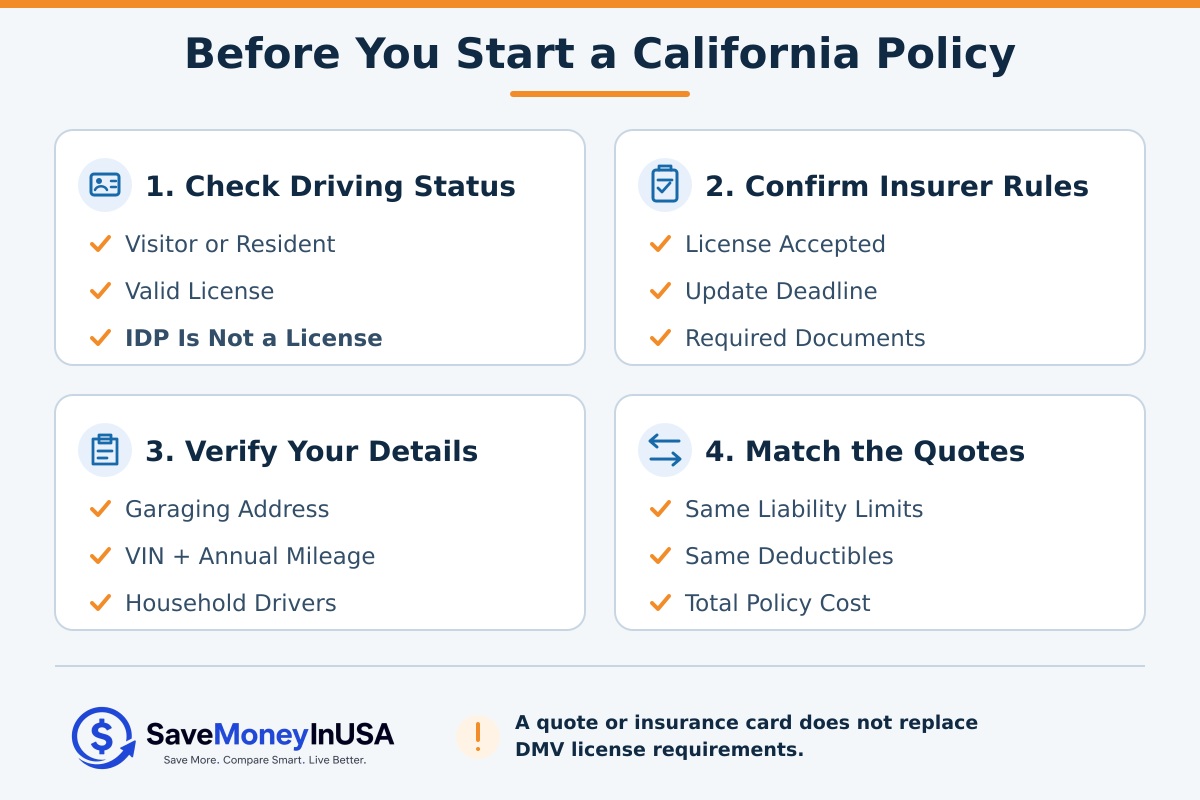
The safest sequence is to confirm your driving eligibility, verify that the insurer accepts your current license, provide accurate driver and vehicle information, and compare identical coverage. This California-specific guide explains that process without assuming that every foreign license, International Driving Permit (IDP), or quote works in every situation.
Comparing options does not require you to purchase a policy immediately. Confirm the final price, effective date, license acceptance, and coverage before paying.
Start With Driving Eligibility—not the Insurance Quote
An insurer may be willing to prepare a quote using the information you provide, but that does not decide whether California law allows you to drive with your current license. Check the California DMV rule that matches your situation first.
| Situation | Driving-rule starting point | Insurance action |
|---|---|---|
| Adult visitor who is not a California resident | A valid license issued by the foreign jurisdiction where you reside may be recognized; confirm the current DMV rule for your facts | Ask whether the insurer accepts that license and whether supporting documents are required |
| Person who becomes a California resident | California DMV says a new resident must apply for a California driver’s license within 10 days | Tell the insurer about the transition and ask when the California license information must be added |
| Driver carrying an IDP | An IDP is not a standalone driver’s license and does not replace the original valid license | Ask whether it is useful or required as a translation or supporting document |
| Driver with a California permit or temporary license | Follow all restrictions and expiration dates shown by DMV | Confirm that the insurer accepts the document before relying on the policy |
Residency is a legal determination, not simply the number of days you have been in California. If you are unsure whether you have established residency or whether your license is valid for your planned driving, use the DMV’s current guidance or ask the DMV directly. Our broader foreign-license car insurance guide explains why state driving rules and insurer acceptance must be checked separately.
Can You Get California Car Insurance With a Foreign License?
Some insurers may consider an application from a driver with a valid foreign license, while others may require a California license or allow only a limited transition period. Acceptance, documentation, and final pricing vary by insurer and by the information it can verify.
Do not describe an IDP as an “international driver’s license.” It generally translates information from an underlying license; it does not create driving privileges by itself. Also do not assume that a passport, visa, student record, Social Security number, or ITIN is universally required. Ask the insurer what it needs for your specific application.
If the insurer initially accepts a foreign license, ask three questions before paying:
- Must I obtain or report a California license by a particular date?
- Will the quoted premium or eligibility change after license verification?
- What documents must I submit before coverage becomes active?
Information to Prepare Before Requesting Quotes
Accurate information makes quotes easier to compare and reduces the chance that the price changes during verification. Requirements differ, but the following checklist covers the main categories.
| Category | Information to prepare | Why it matters |
|---|---|---|
| Driver | Current valid license, legal name, date of birth, and foreign driving record if requested | Helps the insurer identify the driver and verify driving experience |
| California location | Residential address, mailing address if different, and actual garaging location | Location and where the vehicle is normally kept can affect rating and eligibility |
| Vehicle | VIN, year, make, model, ownership status, and estimated annual mileage | Identifies the vehicle and its use |
| Household | Other licensed household members and anyone who regularly uses the vehicle | Unlisted drivers or undisclosed regular use can create policy or claim problems |
| Coverage | Requested liability limits, deductibles, and optional coverages | Keeps competing quotes comparable |
| Prior records | Prior insurance or claims information if the insurer requests it | Lets the insurer complete its verification without guessing |
Do not upload sensitive identity or payment information to an unfamiliar website merely because it promises an instant quote. Verify that you are dealing with a licensed insurer, agent, or broker. International students who want a deeper document checklist can use our guide to documents needed for car insurance.
California’s 30/60/15 Minimum Liability Requirements
For a standard private-passenger auto policy, California’s minimum liability limits are commonly written as 30/60/15:
| Required liability coverage | Standard minimum limit | What it generally addresses |
|---|---|---|
| Bodily injury or death to one person | $30,000 | A covered injury or death claim for one person when you are legally responsible |
| Bodily injury or death to more than one person | $60,000 per accident | Covered claims involving multiple people in one accident |
| Property damage | $15,000 per accident | Covered damage to another person’s vehicle or property |
These limits do not pay to repair your own vehicle. They are also limits, not a promise that every loss will be paid. A covered claim can exceed the minimum, leaving you responsible for amounts above the policy limit. Review our dedicated explanation of California minimum car insurance requirements before deciding whether higher limits fit your finances.
Match the Policy to How You Use the Vehicle
Your immigration or visitor status does not by itself determine the right policy type. Start with who owns the vehicle, how often you drive it, and whether a loan or lease contract requires physical-damage coverage.
| Driving situation | Likely starting point | Important check |
|---|---|---|
| You own a paid-off vehicle | Standard owner policy | Compare liability limits and decide whether collision and comprehensive fit the vehicle’s value and your budget |
| You finance or lease a vehicle | Owner policy with contract-required coverage | The lender or lessor commonly requires collision, comprehensive, specified deductibles, and continuous coverage |
| You regularly use a household vehicle | Household policy review | Disclose the driver and regular use; do not assume a separate non-owner policy is appropriate |
| You borrow or rent only occasionally and own no vehicle | Review the vehicle owner’s coverage, rental terms, and possible non-owner coverage | Non-owner insurance is mainly liability coverage and does not replace coverage for a vehicle you own or regularly use |
“Full coverage” is an informal phrase, not a policy that covers every loss. It usually refers to liability plus collision and comprehensive, subject to limits, deductibles, exclusions, and policy terms. Compare full coverage and liability insurance, or review non-owner insurance if you do not own a vehicle.
Why Quotes Can Vary for Newly Arrived Drivers
California auto premiums are primarily influenced by driving safety record, annual mileage, and years of driving experience, along with other permitted factors and the coverage selected. Insurers may differ in how they verify or classify foreign driving experience, so two companies can return very different results from similar information.
Vehicle type, garaging location, coverage limits, deductibles, regular drivers, and vehicle use can also change the premium. California does not permit personal auto insurers to use a consumer’s credit score as an auto rating factor, so do not apply generic national advice about “improving credit to lower California car insurance” to this decision.
The best response to a high first quote is not to hide information. Use the same accurate facts and coverage selections with several insurers, then compare the final verified offers.
How to Compare California Quotes Fairly
A low monthly payment may reflect lower liability limits, a higher deductible, fewer optional coverages, a large initial payment, or additional installment fees. Put each quote on the same basis before choosing.
- Use identical driver and vehicle facts. Keep the garaging address, annual mileage, use, VIN, and listed drivers consistent.
- Match liability limits. Do not compare a 30/60/15 quote with one using higher limits as though they provide the same protection.
- Match physical-damage coverage. Use the same collision and comprehensive deductibles and confirm lender requirements.
- Match optional coverage. Check uninsured/underinsured motorist, medical payments, rental reimbursement, and roadside assistance individually.
- Compare total policy-term cost. Include the amount due today, installments, fees, discounts, and policy length—not only the advertised monthly payment.
- Confirm activation. Verify the effective date and time, final documents, accepted license status, and proof of insurance before driving.
What If Standard Insurance Is Unaffordable?
Income-eligible California drivers may qualify for California’s Low Cost Auto Insurance Program (CLCA). Current program qualifications include license, income, vehicle-value, age, and driving-record requirements. Check the official program rather than assuming eligibility.
CLCA’s basic liability policy currently uses 10/20/3 limits under a separate statutory program that satisfies California’s mandatory insurance law. It is not the same as a standard 30/60/15 policy, and basic liability does not cover repairs to your own vehicle. Review its current qualifications, coverage, optional benefits, and limitations before applying.
Mistakes New Immigrants and International Drivers Should Avoid
- Treating an IDP as a standalone license. Keep the original valid license and follow California residency rules.
- Assuming a quote makes driving legal. A quote does not settle DMV eligibility or prove that coverage is active.
- Buying a vehicle before checking insurance. Compare the total payment, insurance, registration, fuel, and maintenance cost first.
- Using an incorrect garaging address or omitting drivers. Give the insurer accurate household, location, and vehicle-use information.
- Choosing by monthly payment alone. Compare identical limits, deductibles, optional coverage, terms, and total cost.
- Allowing a lapse. Confirm that replacement coverage is active before canceling an existing policy.
FAQ: California Car Insurance for New Immigrants
Can a new immigrant buy car insurance in California?
Often, yes, but the insurer must accept the driver’s license and application information. Separately confirm that California law allows you to drive with that license.
Do I need a California driver’s license first?
It depends on your residency and the insurer’s rules. California DMV says a person who becomes a California resident must apply for a California driver’s license within 10 days. A nonresident adult visitor may fall under a different rule.
Does an IDP replace my foreign license?
No. An IDP is not a standalone California driver’s license. It may serve as a translation or supporting document, but you must carry the valid underlying license and follow applicable DMV rules.
Does California use credit scores for car insurance rates?
No. California does not permit personal auto insurers to use credit scores as an auto insurance rating factor. Driving safety record, annual mileage, years of driving experience, and other permitted factors are relevant instead.
Is 30/60/15 enough coverage?
It is the standard California minimum for private-passenger liability policies, but a serious covered claim can exceed those limits. Compare the price of higher limits based on your income, savings, vehicle use, and ability to pay after a loss.
Can I register a California vehicle without insurance?
California requires evidence of financial responsibility and insurers electronically report private-use vehicle liability policies to DMV. Review our guide to registering a car and California insurance requirements before buying or registering a vehicle.
Final Thoughts
California car insurance for a new immigrant or international driver begins with the correct order of decisions. Confirm whether your current license allows you to drive, check whether the insurer accepts it, provide accurate driver and vehicle information, and compare the same protection across companies.
Do not rely on an IDP, preliminary quote, or insurance card to answer every legal and underwriting question. Verify the policy’s effective date and terms before driving, then review your options again when your license, vehicle, address, mileage, or driving history changes.
Sources
- California DMV — Auto Insurance Requirements
- California DMV — Requirements for a California Driver License
- California Department of Insurance — Automobile Insurance Guide
- California Department of Insurance — Auto Premium Rating Factors
- California’s Low Cost Auto Insurance Program — Qualifications and Coverage
About the Author
The SaveMoneyInUSA Editorial Team researches car insurance requirements, coverage choices, and quote-comparison considerations using government and insurance-regulator sources.
Learn more about our Editorial Team and review process.
Disclaimer
SaveMoneyInUSA is an independent informational website and is not an insurance company, broker, or agent.
Some links may be affiliate links. We may receive compensation from partners at no additional cost to users.
Insurance rates, coverage, eligibility, licensing rules, and program requirements vary and may change. Confirm current information with the California DMV, California Department of Insurance, the insurer, and your contract before acting.
This content is provided for educational purposes only and is not insurance, legal, financial, or immigration advice.