

Last Updated: September 2026
For most drivers, the minimum car insurance required in California in 2026 is 30/60/15 liability coverage: $30,000 for injury or death to one person, $60,000 for injury or death to more than one person in one accident, and $15,000 for property damage. California requires insurance or another DMV-accepted form of financial responsibility for vehicles operated or parked on California roads.
These limits can satisfy California’s minimum legal requirement, but they do not pay for damage to your own car and may not cover the full cost of a serious accident. This guide explains what California’s minimum car insurance requirements mean, when proof is required, and how to compare minimum coverage with stronger protection.
Compare the same limits and deductibles so you can evaluate each option fairly.
Table of Contents
- California’s Minimum Car Insurance Requirements in 2026
- What 30/60/15 Liability Coverage Means
- What Minimum Liability Insurance Does Not Cover
- Alternatives to a Liability Insurance Policy
- When Drivers Need Proof of Insurance
- Is Minimum Liability Insurance Enough?
- Financed or Leased Vehicles
- New Drivers and New California Residents
- How to Compare California Quotes
- California Minimum Insurance Checklist
- Frequently Asked Questions
What Are California’s Minimum Car Insurance Requirements in 2026?
California’s standard minimum liability insurance requirements for most private passenger vehicles are 30/60/15:
| Coverage | California Minimum | What It Helps Pay |
|---|---|---|
| Bodily injury liability per person | $30,000 | Covered injury or death claim for one person |
| Bodily injury liability per accident | $60,000 | Combined covered injury or death claims for more than one person |
| Property damage liability | $15,000 | Covered damage you cause to another person’s vehicle or property |
These limits are commonly written as 30/60/15. California increased its standard minimum limits from 15/30/5 to 30/60/15 beginning January 1, 2025. The limits continue to apply in 2026.
Important exception: Eligible drivers insured through the California Low Cost Automobile Insurance Program (CLCA) can use the program’s separate 10/20/3 basic liability limits to meet California’s financial responsibility law. CLCA has income, driver, and vehicle eligibility requirements.
For a more detailed explanation and examples, see our guide to California 30/60/15 liability insurance. Drivers who travel or move outside California can also compare minimum car insurance requirements by state.
For a faster one-page summary of California auto insurance rules, see our California Auto Insurance Quick Reference 2026.
What Does 30/60/15 Liability Coverage Mean?
The three numbers are policy limits, not amounts automatically paid after every accident.
- 30: Up to $30,000 for a covered bodily injury or death claim involving one person.
- 60: Up to $60,000 total for covered bodily injury or death claims involving more than one person in the same accident.
- 15: Up to $15,000 for covered property damage caused in the accident.
These limits apply separately, and covered losses above the applicable limit may become your responsibility. This page focuses on California’s overall minimum insurance requirements. For worked accident examples, per-person versus per-accident limits, and comparisons with higher liability limits, see our dedicated guide to California 30/60/15 liability insurance.
What Does California Minimum Liability Insurance Not Cover?
Minimum liability coverage is designed mainly to help pay for injuries and property damage you cause to other people. It generally does not pay for:
- Repairs to your own car after a collision
- Theft, vandalism, fire, weather, or falling-object damage to your vehicle
- Your own medical expenses simply because you caused the accident
- Losses above the policy’s liability limits
Collision and comprehensive coverage can protect your vehicle in different situations, but those coverages alone do not satisfy California’s financial responsibility requirement. A policy still needs qualifying liability coverage. Learn more in our comparison of full coverage vs liability insurance.
Are There Alternatives to a Liability Insurance Policy?
Most drivers meet California’s requirement with a motor vehicle liability insurance policy. The California DMV also lists other accepted forms of financial responsibility:
| Accepted Method | Basic Requirement |
|---|---|
| Motor vehicle liability insurance | An active policy meeting California’s minimum limits |
| Cash deposit with DMV | $75,000 cash deposit |
| DMV self-insurance certificate | Approval and certificate issued by DMV |
| Surety bond | $75,000 bond from a company licensed in California |
The alternatives are less common for individual drivers and have their own requirements. Confirm current eligibility and procedures directly with the California DMV before relying on an alternative form.
When Do California Drivers Need Proof of Insurance?
California drivers must carry evidence of insurance or financial responsibility and provide it when:
- Requested by law enforcement
- Renewing vehicle registration
- The vehicle is involved in a traffic collision
Insurance companies electronically report vehicle insurance information to DMV. If DMV does not receive proof for a vehicle, its registration may be suspended, and the vehicle may not be operated or parked on public roadways until proof is submitted.
If you are buying or registering a vehicle, read whether you can register a car without insurance in California. If a policy has ended or a payment was missed, do not assume you automatically have time to keep driving; review our guide to the California car insurance grace period and confirm your status with the insurer.
Is Minimum Liability Insurance Enough in California?
Minimum liability insurance may be enough to meet the legal requirement, but legal compliance and adequate financial protection are different questions.
The $15,000 property damage limit can be exhausted by damage to a newer vehicle or multiple vehicles. Bodily injury claims can also exceed minimum limits because medical treatment, lost income, and other covered losses may become expensive quickly.
| Option to Compare | Potential Advantage | Main Limitation |
|---|---|---|
| California minimum liability | May have a lower premium and can meet the legal minimum | Low limits and no physical-damage protection for your own car |
| Higher liability limits | More protection against covered claims you cause | Usually costs more than minimum limits |
| Liability plus optional coverages | Can add protection such as uninsured motorist or medical payments coverage | Coverage and exclusions vary by policy |
| Liability, collision, and comprehensive | Adds physical-damage protection for your vehicle | Higher premium and deductibles may apply |
Compare the price difference between minimum limits and stronger options before deciding. Consider your vehicle value, savings, income, driving frequency, commute, and ability to pay after a loss.
Compare the same limits and deductibles so you can evaluate each option fairly.
What If Your Car Is Financed or Leased?
California law does not require drivers to buy collision or comprehensive coverage. A lender or leasing company, however, can require both coverages under the finance or lease agreement.
That means a minimum liability policy may allow you to meet the state requirement but still violate your contract. The lender may require continuous coverage, specific deductibles, and proof that its interest is listed on the policy. See whether you need full coverage on a financed car before changing or removing coverage.
What Should New Drivers and New California Residents Know?
Newly licensed drivers and people with limited U.S. driving experience may receive very different quotes from different insurers. California auto premiums are strongly influenced by driving safety record, annual mileage, and years of driving experience, along with other permitted rating factors.
New immigrants, international students, and foreign-license holders must still follow California’s insurance and financial responsibility rules. Insurer acceptance and document requirements can vary, so confirm license eligibility before relying on a quote. For more detail, see our guides to California car insurance for new immigrants and car insurance with a foreign license.
How to Compare California Car Insurance Quotes
A lower monthly payment does not always mean a better value. One quote may use minimum liability limits while another includes higher limits, collision, comprehensive, or different deductibles.
For a fair comparison, keep these items the same across quotes:
- Driver and vehicle information
- Garaging address and estimated annual mileage
- Liability limits
- Collision and comprehensive deductibles
- Optional coverages and limits
- Policy term and payment schedule
- Installment fees, discounts, and amount due to start coverage
Also confirm whether the quote is preliminary or final. A price may change after the insurer verifies driving history, mileage, vehicle details, garaging address, prior coverage, and other underwriting information. Our car insurance quote comparison guide explains the process step by step.
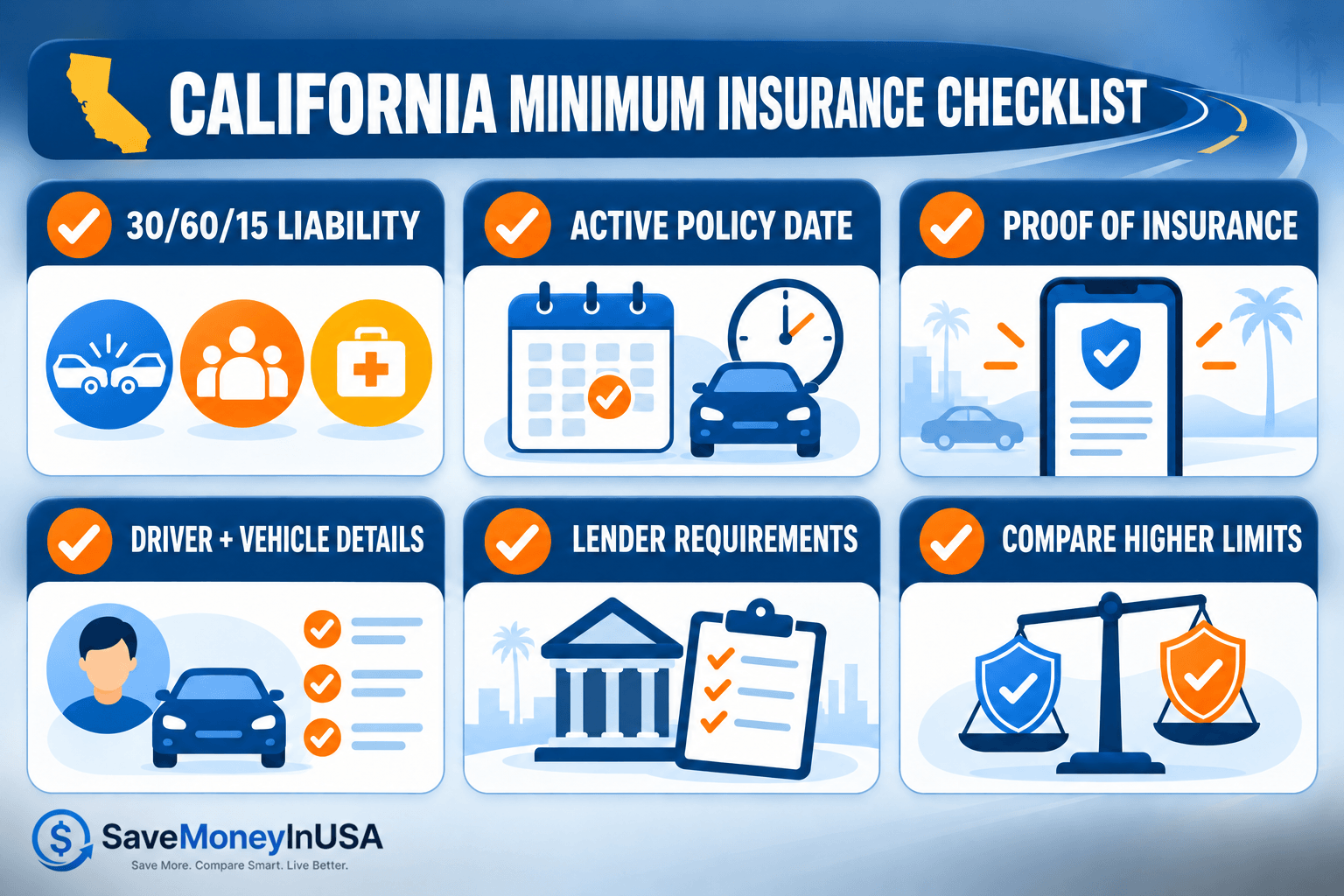
California Minimum Insurance Checklist
| Item to Check | Why It Matters |
|---|---|
| 30/60/15 liability limits | Confirms the policy meets California’s standard minimum limits |
| Policy effective date | A quote alone does not mean coverage is active |
| Driver, vehicle, and VIN | Incorrect information can create coverage or registration problems |
| Proof of insurance | May be required by law enforcement, DMV, or after a collision |
| Higher liability options | Shows the additional cost of stronger protection |
| Collision and comprehensive | May protect your vehicle and may be required by a lender |
| Deductibles | Affects premium and out-of-pocket cost after a covered loss |
| Payment schedule and fees | Helps prevent unexpected costs or a coverage lapse |
FAQ: California Minimum Car Insurance Requirements
What is the minimum car insurance required in California in 2026?
California’s standard minimum liability limits are $30,000 for injury or death to one person, $60,000 for injury or death to more than one person in one accident, and $15,000 for property damage.
Is California minimum liability insurance called 30/60/15?
Yes. The numbers refer to $30,000 per person and $60,000 per accident for bodily injury liability, plus $15,000 for property damage liability.
Does California minimum insurance cover my own car?
No. Minimum liability insurance generally pays covered injury and property damage claims you cause to others. Collision and comprehensive coverage are normally needed for covered physical damage to your own vehicle.
Do I need full coverage in California?
California law does not require “full coverage,” but a lender or leasing company may require collision and comprehensive coverage. Drivers with paid-off vehicles can choose based on their budget, vehicle value, and risk tolerance.
What happens if DMV does not receive proof of insurance?
DMV states that a vehicle’s registration will be suspended if it does not receive proof of insurance. The vehicle may not be operated or parked on public roadways until proof is submitted.
Is low-cost car insurance available in California?
Drivers who cannot afford standard liability insurance may qualify for the California Low Cost Automobile Insurance Program. Its basic liability policy currently provides 10/20/3 limits under a separate statutory program that satisfies California’s financial responsibility law. Confirm eligibility, coverage, and current terms through the official CLCA website.
Final Thoughts
California’s 30/60/15 limits are the legal starting point for most drivers, not a guarantee that every accident will be fully covered. Before buying, compare minimum liability with higher limits and any optional coverage that fits your vehicle and financial situation.
Use matching limits, deductibles, and policy terms when comparing quotes. Confirm that coverage is active and that the policy meets both California law and any lender or lease requirements.
Compare the same limits and deductibles so you can evaluate each option fairly.
Sources
- California DMV — Auto Insurance Requirements
- California DMV — Driver Handbook: Financial Responsibility and Insurance
- California Department of Insurance — Automobile Coverage Limits
- California Department of Insurance — 2025 Minimum Liability Limit Update
- California Legislative Information — Vehicle Code §16028
- California Low Cost Automobile Insurance Program — Coverage
Insurance laws, program rules, policy terms, eligibility, prices, and coverage options may change. Confirm current requirements with the California DMV, California Department of Insurance, and your insurer.
About the Author
The SaveMoneyInUSA Editorial Team researches car insurance costs, coverage options, state requirements, and quote comparison considerations for drivers in the United States.
Learn more about our Editorial Team.
Disclaimer
SaveMoneyInUSA is an independent informational website and is not an insurance company, broker, or agent.
Some links may be affiliate links. We may receive compensation from partners at no additional cost to users.
Insurance rates, coverage options, eligibility, and requirements vary by provider, state, and individual circumstances.
This content is provided for educational purposes only and should not be considered insurance, legal, or financial advice.