

Last Updated: September 2026
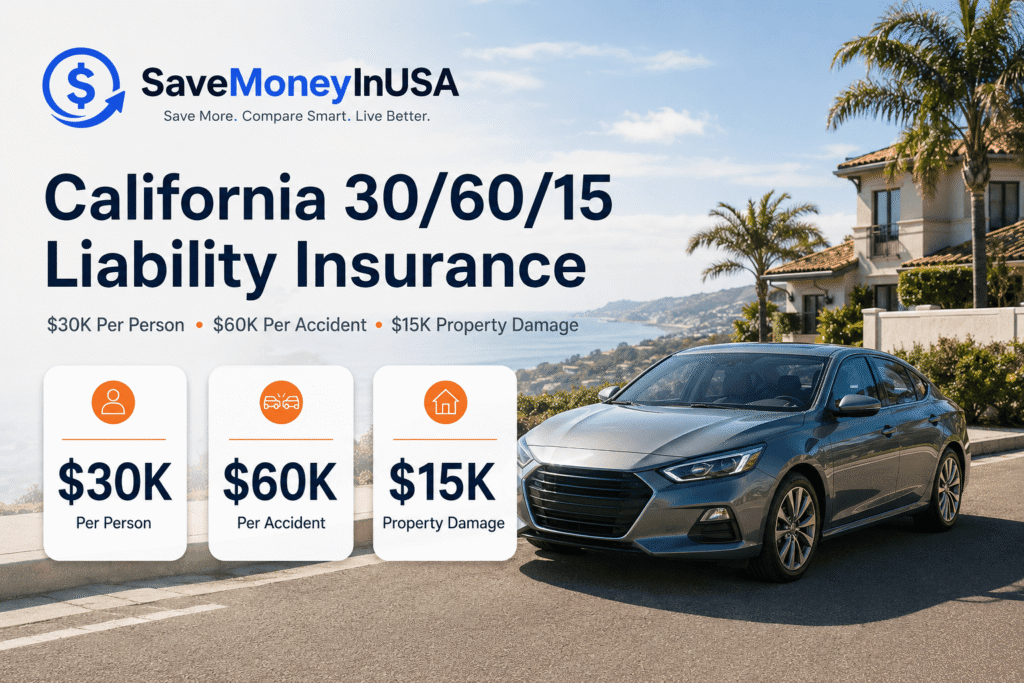
California 30/60/15 liability insurance means up to $30,000 of bodily injury liability coverage for one person, up to $60,000 for bodily injuries to everyone in one accident, and up to $15,000 for property damage in one accident. These are the standard minimum liability limits for most California private passenger auto policies issued or renewed in 2026.
The three limits work together, not independently. A policy will not pay $60,000 to each injured person, and the $15,000 property damage limit does not repair your own car. This guide explains the numbers with a worked accident example, compares common higher-limit options, and helps you decide what to review before buying coverage.
Comparing quotes does not require you to purchase a policy immediately. Review the limits, final price, effective date, and policy terms before choosing coverage.
Table of Contents
- What 30/60/15 means
- How the limits work together
- What 30/60/15 does not cover
- Worked accident example
- 30/60/15 vs. higher limits
- Is 30/60/15 enough?
- California Low Cost Auto exception
- Common mistakes
- Frequently asked questions
What Does 30/60/15 Mean in California?
Insurers shorten liability limits by removing the zeros. Each number represents thousands of dollars of coverage available for a covered at-fault accident, subject to the policy terms and exclusions.
| Number | Coverage | Maximum for one covered accident |
|---|---|---|
| 30 | Bodily injury per person | $30,000 for any one injured person |
| 60 | Bodily injury per accident | $60,000 total for all injured people |
| 15 | Property damage per accident | $15,000 total for property you damage |
California raised its standard minimum limits from 15/30/5 to 30/60/15 for policies issued or renewed on or after January 1, 2025. For a broader overview of state rules, see California minimum car insurance requirements. Drivers moving between states can also compare minimum liability requirements by state.
If you want the bigger picture beyond liability limits, use our California Auto Insurance Quick Reference 2026 for a quick overview of DMV proof rules, registration, grace periods, and new-driver considerations.
Under current California Vehicle Code §16056, standard minimum limits are scheduled to increase again for policies or bonds issued or renewed on or after January 1, 2035. The scheduled limits are 50/100/25. This article focuses on the 30/60/15 limits that apply in 2026.
How the Per-Person and Per-Accident Limits Work Together
The $30,000 and $60,000 bodily injury limits apply at the same time. The insurer may pay no more than $30,000 for one injured person and no more than $60,000 combined for all injured people in one covered accident.
Suppose three people have covered injury claims of $25,000 each. No individual claim exceeds $30,000, but the three claims total $75,000. The policy’s bodily injury payment is still capped at $60,000 for the accident. How that amount is resolved can depend on the claims, negotiations, policy language, and applicable law.
This distinction matters because “30/60” does not create $90,000 of bodily injury coverage. The first number limits each person’s recovery under the policy; the second limits the total available for the accident.
The $30,000 Bodily Injury Limit Per Person
The first limit may help pay another person’s covered medical expenses, lost income, pain and suffering, or other injury-related damages when you are legally responsible. It is a maximum, not an automatic payment.
If one person’s covered damages reach $45,000, a 30/60 policy generally has no more than $30,000 available for that person. The remaining amount does not move to the property damage limit, and the policyholder could face exposure above the insurance limit. The actual result depends on fault, damages, settlements, and the policy.
The $60,000 Bodily Injury Limit Per Accident
The second limit is shared across all people injured in the same covered accident. It becomes especially important in a multi-vehicle crash or when a vehicle carries several passengers.
For example, if two people each have $30,000 in covered injuries, the policy could reach both the $30,000 per-person limit and the $60,000 per-accident limit. If a third person also has an injury claim, no additional bodily injury limit remains under that 30/60 policy for the accident.
The $15,000 Property Damage Limit Per Accident
The third number may help pay for covered damage you cause to someone else’s vehicle or other property, such as a fence, garage door, building, sign, or light pole. The $15,000 limit is shared across all damaged property in the accident.
A single newer vehicle can cost more than $15,000 to repair, especially when cameras, sensors, batteries, or structural components are involved. If you damage two vehicles, the same $15,000 is divided across both property claims; it is not $15,000 for each vehicle.
What 30/60/15 Liability Insurance Does Not Cover
Liability insurance is primarily for injuries and property damage you cause to others. It does not normally pay to repair your own vehicle after an at-fault collision. It also does not replace comprehensive coverage for theft, vandalism, fire, falling objects, or certain weather losses.
- Your own collision damage: typically requires collision coverage.
- Non-collision damage to your car: typically requires comprehensive coverage.
- Your own injuries: other coverages or health insurance may apply, depending on the situation.
- Damage above the limits: the insurer does not automatically pay the excess.
See our comparison of full coverage versus liability insurance for the coverage differences. If a vehicle is financed or leased, review coverage requirements for a financed car, because a lender may require collision and comprehensive coverage.
A Worked 30/60/15 Accident Example
Assume you cause a covered accident involving two people in another car. Person A has $38,000 in covered injury damages, Person B has $22,000, and the other vehicle has $19,000 in covered property damage.
| Claim | Covered damages | Relevant 30/60/15 limit | Amount within the limit |
|---|---|---|---|
| Person A injury | $38,000 | $30,000 per person | Up to $30,000 |
| Person B injury | $22,000 | $30,000 per person | Up to $22,000 |
| Total injuries | $60,000 | $60,000 per accident | Up to $52,000 in this example |
| Vehicle damage | $19,000 | $15,000 per accident | Up to $15,000 |
In this simplified example, $8,000 of Person A’s damages and $4,000 of property damage are above the applicable limits. The unused portion of the bodily injury per-accident limit cannot be transferred to Person A or to property damage. Real claims can involve disputed fault, multiple insurers, legal defenses, settlements, exclusions, and other facts, so this example is educational rather than a prediction of payment.
Comparing quotes does not require you to purchase a policy immediately. Review the limits, final price, effective date, and policy terms before choosing coverage.
30/60/15 vs. Higher Liability Limits
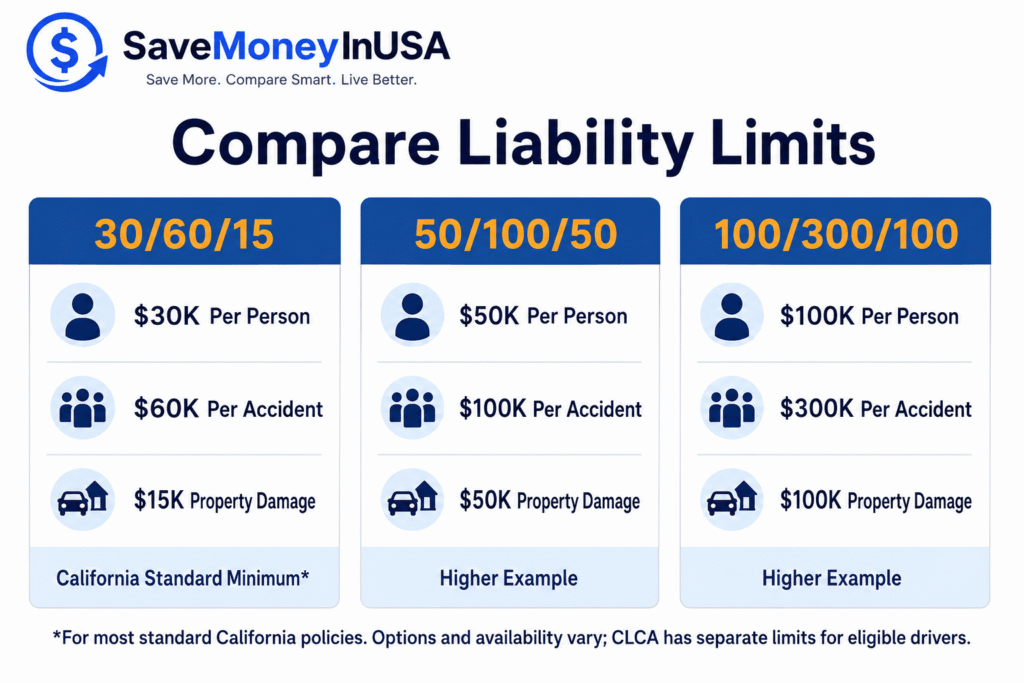
California’s minimum is a legal threshold for most standard policies, not a recommendation tailored to every household. Insurers may offer higher limits such as 50/100/50 or 100/300/100, although options and underwriting vary.
| Example limits | Injury per person | Injury per accident | Property damage | Practical difference |
|---|---|---|---|---|
| 30/60/15 | $30,000 | $60,000 | $15,000 | Standard California minimum for most policies |
| 50/100/50 | $50,000 | $100,000 | $50,000 | More room for one serious injury and vehicle damage |
| 100/300/100 | $100,000 | $300,000 | $100,000 | Substantially higher protection for severe or multi-person claims |
The premium difference between limits is not the same for every driver. Request the same deductibles, drivers, vehicles, and optional coverages on each quote so the comparison is meaningful. Our guide to comparing car insurance quotes explains how to keep the inputs consistent.
Is 30/60/15 Enough for You?
Decision Check: Review Your Exposure
- Assets and income: Could a claim above the policy limits threaten savings, income, or other property?
- Road use: Do you drive frequently, commute in heavy traffic, carry passengers, or travel long distances?
- Property costs: Would $15,000 be enough if you damaged a newer vehicle or several vehicles?
- Budget: What is the actual quote difference between minimum limits and the next two limit options?
- Umbrella requirements: Does an umbrella insurer require higher underlying auto liability limits?
Ask a licensed insurance professional how the limits interact with your finances and policy. The right answer is not determined by the cheapest premium alone.
Special Note About California’s Low Cost Auto Program
California’s Low Cost Automobile Insurance Program (CLCA) is a separate state program for eligible drivers. The California Department of Insurance states that its basic liability limits remain 10/20/3. Therefore, 30/60/15 is the standard minimum for most California policies, but it is not an absolute description of every qualifying policy available through a special program.
Eligibility, coverage choices, and current program rules should be confirmed through the official CLCA program or a licensed agent before relying on the exception.
Registration, Policy Start Dates, and DMV Reporting
Liability limits answer how much insurance may be available; they do not answer whether a policy is active on a particular date. Before driving or parking on public roads, confirm the effective date and time shown on your proof of insurance. A carrier’s electronic report to DMV is an administrative process, not permission to drive uninsured.
If you are handling paperwork, see whether you can register a car before insurance information reaches California DMV. If you recently bought or replaced a vehicle, review the separate rules discussed in our California car insurance grace period guide.
Common 30/60/15 Mistakes to Avoid
- Adding the numbers together: 30/60/15 is not one $105,000 pool. Each limit has a separate job.
- Reading 60 as per person: $60,000 is the total bodily injury limit for the accident.
- Assuming liability repairs your car: collision and comprehensive are separate coverages.
- Assuming “legal” means “enough”: the state minimum is not a personalized risk analysis.
- Comparing unlike quotes: a cheaper quote may simply contain lower liability limits or fewer optional coverages.
- Ignoring the effective time: a quote, payment receipt, or pending DMV update is not always proof that coverage is active.
Quote Comparison Check
Ask each insurer to show at least three liability options—30/60/15, the next available tier, and a higher tier appropriate for your situation. Record the six- or twelve-month premium for each. This reveals the actual cost of additional protection instead of assuming it is unaffordable.
Keep vehicles, drivers, deductibles, mileage, and optional coverages identical across quotes. Then compare insurer service, discounts, payment fees, and financial considerations alongside price.
Frequently Asked Questions
Is 30/60/15 the California minimum in 2026?
Yes, 30/60/15 is the standard minimum liability limit for most California private passenger auto policies issued or renewed in 2026. A notable exception is the separate California Low Cost Automobile Insurance Program for eligible drivers, whose basic limits remain lower according to the California Department of Insurance.
What does 30/60 liability coverage mean?
It means up to $30,000 of bodily injury liability coverage for one person and up to $60,000 total for all injured people in one covered accident. When written as 30/60/15, the final $15,000 is the property damage liability limit per accident.
Does each injured person get $30,000?
No. $30,000 is the maximum available for any one person’s covered injury claim, not a guaranteed payment. The total for everyone is also subject to the $60,000 per-accident limit.
Does 30/60/15 cover damage to my own car?
Normally, no. Liability coverage pays covered claims made by others when you are responsible. Damage to your own vehicle generally requires collision or comprehensive coverage, depending on what caused the loss.
Can I buy more than 30/60/15 in California?
Yes. Insurers commonly offer higher liability limits, although available tiers vary. Compare the price of several limits using the same drivers, vehicles, deductibles, and other coverages.
Will higher liability limits cover my own medical bills?
Not by themselves. Higher bodily injury liability limits increase the amount available for covered injuries to other people when you are legally responsible. Ask about medical payments, uninsured/underinsured motorist coverage, and how health insurance may apply to your own injuries.
Final Takeaway
California 30/60/15 liability insurance provides $30,000 per injured person, $60,000 total for bodily injuries in one accident, and $15,000 total for property damage. It satisfies the standard 2026 minimum for most policies, but it can leave a gap when one person is seriously injured, several people are hurt, or a newer vehicle is heavily damaged.
Before choosing limits, compare the exact premium at several levels and review your driving, assets, income, passengers, and tolerance for an uninsured amount above the policy. A licensed professional can explain how a specific policy would respond.
Comparing quotes does not require you to purchase a policy immediately. Review the limits, final price, effective date, and policy terms before choosing coverage.
Sources
- California DMV — Insurance Requirements
- California Legislative Information — Vehicle Code Section 16056
- California Department of Insurance — New Insurance Changes
- California Low Cost Auto — Coverage
About the Author
The SaveMoneyInUSA Editorial Team researches car insurance costs, coverage options, state requirements, and quote comparison considerations for drivers in the United States.
Learn more about our Editorial Team.
Disclaimer
SaveMoneyInUSA is an independent informational website and is not an insurance company, broker, or agent.
Some links may be affiliate links. We may receive compensation from partners at no additional cost to users.
Insurance rates, coverage options, eligibility, requirements, policy terms, and liability limits vary by provider, state, and individual circumstances.
This content is provided for educational purposes only and should not be considered insurance, legal, or financial advice. Confirm current requirements with the appropriate agency and consult a licensed insurance professional about your situation.