

Last Updated: September 2026
Quick Answer
California does not have one universal car insurance grace period. Whether a grace period applies depends on the situation—for example, temporary coverage for a newly purchased new or used car under an existing policy, a missed premium payment, or a policy that is being canceled or terminated. DMV insurance-reporting deadlines are a separate issue and do not allow uninsured driving.
Those rules are not interchangeable. A DMV reporting deadline is not permission to drive uninsured, and a cancellation notice does not extend coverage beyond its effective cancellation date. This guide explains the differences for new cars, used cars, missed payments, terminated policies, and vehicle registration.
Compare the same limits, deductibles, effective dates, and payment terms across quotes. Confirm the exact start time before replacing or canceling existing coverage.
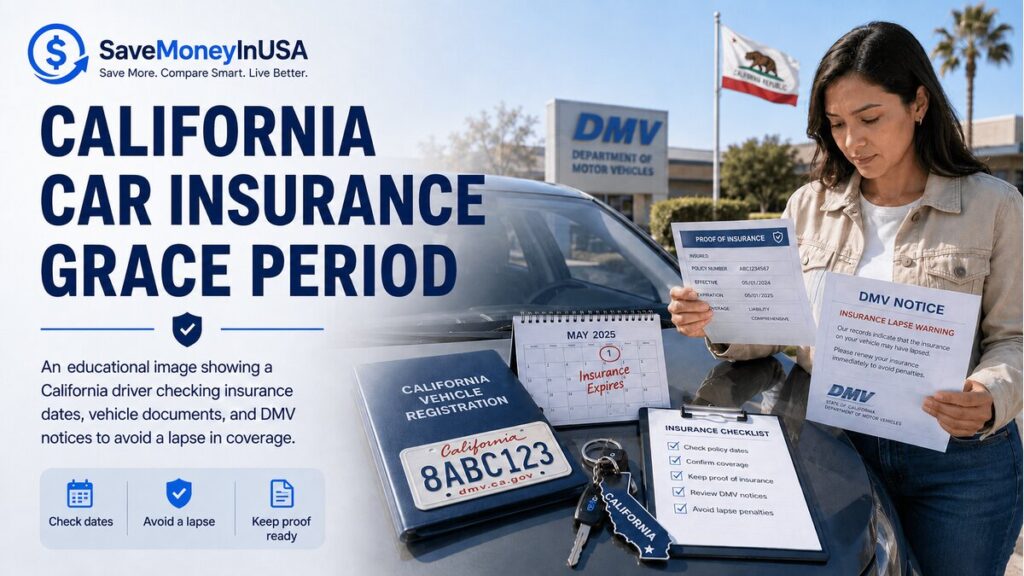
Is There a Car Insurance Grace Period in California?
There is no single statewide grace period that lets California drivers operate or park an uninsured vehicle on a public road. California DMV states that insurance or another accepted form of financial responsibility is required for vehicles operated or parked on California roads.
A grace period may still exist under a specific insurance policy. For example, an existing policy may temporarily cover a newly acquired vehicle, or an insurer may send a notice before canceling a policy for nonpayment. Whether coverage remains active depends on the policy terms, the insurer’s notice, and the effective date shown on the documents.
California’s standard minimum liability limits are 30/60/15. For a full explanation of the state requirement, see our guide to California minimum car insurance requirements.
For a broader snapshot of California auto insurance rules, including minimum limits, DMV reporting, registration, and proof-of-insurance requirements, see our California Auto Insurance Quick Reference 2026.
Three Different “Grace Periods” Drivers Often Confuse
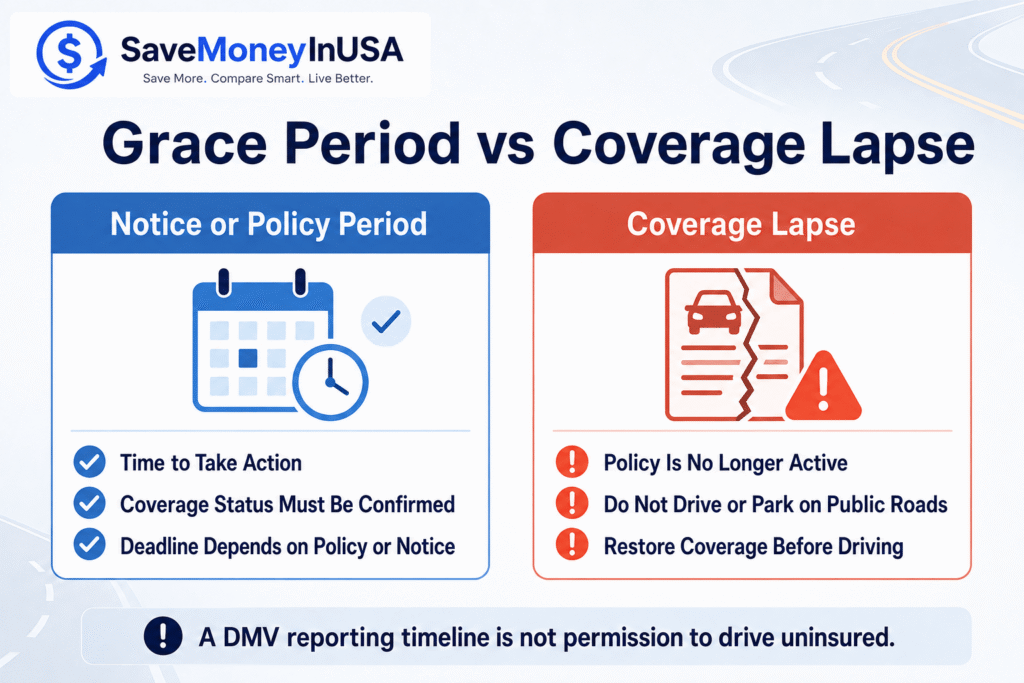
| Situation | What the Rule May Do | What It Does Not Mean |
|---|---|---|
| New or used vehicle added to an existing policy | Your policy may temporarily extend coverage to a newly acquired vehicle | California does not guarantee the same number of days or the same coverage for every driver |
| Missed premium payment | California law generally requires at least 10 days’ cancellation notice for nonpayment and allows the identified nonpayment to be cured by the end of that period | It is not permission to drive after the cancellation becomes effective |
| DMV reporting or suspension timeline | DMV gives time for proof or replacement coverage information to reach its records | It is not a 30-day or 45-day period of legal uninsured driving |
The safest question is not “How many grace-period days do I get?” Ask instead: Is this vehicle covered right now, under which coverages, and when does that protection end?
New Car Insurance Grace Period in California
If you already have an active auto policy, it may provide temporary coverage for a newly acquired vehicle. The number of days and the coverage provided come from your policy—not from a universal California rule.
Before taking possession or driving away, ask your insurer:
- Is the new vehicle covered immediately?
- What is the exact deadline to report it?
- Is the vehicle replacing one already insured, or is it an additional vehicle?
- Do liability, collision, and comprehensive coverage apply during the temporary period?
- What effective date and time will appear on the updated insurance card?
If you do not already have a policy, there is normally no existing coverage to extend. Arrange and bind insurance before driving. A quote, application, or payment attempt is not proof that coverage is active. Drivers buying their first California vehicle can also review whether a car can be registered without insurance in California.
Used Car Insurance Grace Period in California
There is no universal used car insurance grace period in California. If you already have an active auto insurance policy, it may temporarily extend coverage to a newly acquired used car, but the number of days and the coverage depend on your policy. Buying from a private seller does not create a separate state grace period.
Private-sale buyers should contact the insurer before meeting the seller. Provide the VIN, year, make, model, purchase date, garaging address, driver information, and lienholder details if the vehicle is financed. Ask the insurer to confirm the effective date and send an insurance card before you drive the car home.
New immigrants and drivers without a prior U.S. policy should be especially careful not to assume that a seller’s insurance, a family member’s policy, or a dealership process covers them. Our guide to California car insurance for new immigrants explains additional document and license considerations.
California’s 10-Day Notice Rule for a Missed Payment
California Insurance Code §662 states that when an auto policy is canceled for nonpayment, the insurer must generally give at least 10 days’ notice after the premium was not paid by the specified due date. A cancellation for nonpayment becomes effective on the date in the notice only if the insured has not cured the identified nonpayment by the end of the 10-day period.
This is best understood as a cancellation notice and cure period, not a universal promise of extra payment days. Read the notice immediately and verify all of the following with the insurer:
- The policy’s current active or canceled status
- The exact amount required to cure the nonpayment
- The payment deadline, including the effective date and time
- Whether an accepted payment will keep coverage continuous
- Whether updated proof of insurance will be issued
If the deadline has already passed, do not drive until the insurer confirms reinstatement without a lapse or a new policy is active.
Car Insurance Grace Period After Termination or Cancellation
There is no general car insurance grace period after a policy has been terminated or canceled in California. Once cancellation becomes effective, do not assume coverage continues while you look for replacement insurance. A vehicle driven or parked on a California public road must have active financial responsibility.
Reinstatement rules vary by insurer. The company may require payment, a new application, or confirmation that no loss occurred. Ask whether reinstatement will be retroactive with no lapse or will start only at a new effective time. Get the answer in writing.
If the insurer cannot reinstate the policy without a gap, bind replacement coverage and wait until its stated effective time before driving. When changing companies, start the new policy before ending the old one. Even a one-day gap can leave a claim uninsured.
Comparing options does not require an immediate purchase. Verify that replacement coverage is active before allowing an existing policy to end.
Do DMV’s 30-Day and 45-Day Timelines Create a Grace Period?
No. These are insurance-reporting and registration-suspension timelines, not permission to operate an uninsured vehicle.
- Newly acquired vehicle: For a private-use vehicle, the insurer must report insurance information to DMV within 30 days after a registration card is issued.
- Canceled policy: DMV says registration is subject to suspension when it is notified of a cancellation and replacement coverage is not submitted within 45 days. If new insurance information arrives within that period, a suspension notice generally will not be sent.
Neither rule changes the requirement that a vehicle driven or parked on California public roads must have financial responsibility. Do not use “DMV has not suspended my registration yet” as proof that the insurance policy is active.
What Happens After a California Insurance Lapse?
A lapse creates an uninsured period. If a collision occurs during that period, the former insurer generally will not cover a loss that happened after cancellation. A lender may also treat the lapse as a contract violation.
DMV can suspend vehicle registration if it does not receive required proof of insurance. A vehicle with suspended registration may not be driven or parked on public roadways. To reinstate it, DMV currently requires proof of financial responsibility and a $14 reinstatement fee. If a notice results from an incorrect VIN or missing electronic report, contact the insurer and correct the record before the suspension date shown.
Financed and Leased Cars Have Additional Requirements
California minimum liability rules and lender requirements are separate. Finance and lease agreements commonly require continuous collision and comprehensive coverage, specified deductibles, and the lender or leasing company listed on the policy.
A temporary extension under an existing policy may not automatically provide the physical-damage coverage required for the newly purchased car. Confirm the coverage before possession. If required coverage lapses, the lender may purchase force-placed coverage that mainly protects the lender and charge the cost to you.
Before reducing or canceling coverage, read whether full coverage is needed on a financed car and compare full coverage vs liability insurance.
How to Avoid a Coverage Gap
| Check | What to Confirm |
|---|---|
| Policy status | Active, canceled, or pending cancellation |
| Vehicle details | Correct VIN, year, make, model, and garaging address |
| Effective time | The exact date and time coverage starts or ends |
| Coverage | Liability limits plus any required collision and comprehensive coverage |
| Payment | Amount due, payment deadline, and confirmation that payment was accepted |
| Proof | Updated insurance card and written confirmation from the insurer |
When switching insurers, bind the new policy first and confirm its effective time. Cancel the old policy only after the new coverage is active. Compare identical coverage terms by following our car insurance quote comparison guide.
What If the Vehicle Will Not Be Driven?
If a currently registered vehicle will not be operated or parked on a California roadway, DMV says you may submit an Affidavit of Non-Use (ANU) before canceling liability insurance. When registration renewal is due and the vehicle will remain unused, Planned Nonoperation (PNO) may be appropriate instead.
A vehicle under ANU or PNO cannot be driven or parked on California public roads. Follow DMV’s current instructions rather than simply canceling insurance and assuming the registration will remain unaffected.
FAQ: California Car Insurance Grace Period
Is there a 30-day car insurance grace period in California?
No universal 30-day period allows uninsured driving. An existing policy may temporarily cover a newly acquired car, but the deadline and coverage depend on that policy. DMV’s 30-day reporting rule for a new registration is not a driving grace period.
Can I drive a new or used car home before adding insurance?
Only if your insurer confirms that active coverage already applies to that vehicle. If you have no existing policy or cannot confirm temporary coverage, bind insurance before driving.
Do I have 10 days to pay every late insurance bill?
California generally requires at least 10 days’ notice before cancellation for nonpayment and allows the identified nonpayment to be cured by the end of that period. Follow the exact notice and confirm payment and policy status with the insurer.
Is there a grace period after my policy is terminated?
No general grace period allows you to keep driving after cancellation is effective. Reinstate the policy or obtain new active coverage before driving or parking the vehicle on a California public road.
Will DMV suspend registration immediately after cancellation?
Not necessarily. DMV has reporting and notice procedures, including a 45-day replacement-coverage timeline after cancellation. That administrative timeline does not mean the canceled insurance remains active.
How do I fix a suspended California vehicle registration?
DMV says you must submit proof of financial responsibility and pay the current $14 reinstatement fee. Follow the notice and correct any VIN or insurance-reporting error before attempting to drive the vehicle.
Final Thoughts
California’s car insurance “grace period” is not one rule. Temporary new-car coverage depends on the existing policy. Nonpayment generally triggers a 10-day cancellation notice and cure period. DMV’s 30-day and 45-day reporting timelines deal with registration records, not legal uninsured driving.
Before driving, confirm the vehicle, coverage, payment status, and exact effective time directly with the insurer. If coverage has ended, wait until reinstatement or a new policy is active.
Review the final premium, coverage, payment schedule, and effective date before choosing a policy. Do not drive until the insurer confirms that coverage is active.
Sources
- California DMV — Auto Insurance Requirements
- California DMV — Vehicle Registration Suspension and Proof of Insurance
- California DMV — Affidavit of Non-Use
- California Legislative Information — Insurance Code §662
- California Department of Insurance — Automobile Insurance Guide
Insurance laws, DMV procedures, fees, policy terms, and coverage options may change. Confirm current requirements with the California DMV, California Department of Insurance, and your insurer.
About the Author
The SaveMoneyInUSA Editorial Team researches car insurance costs, coverage options, state requirements, and quote comparison considerations for drivers in the United States.
Learn more about our Editorial Team.
Disclaimer
SaveMoneyInUSA is an independent informational website and is not an insurance company, broker, or agent.
Some links may be affiliate links. We may receive compensation from partners at no additional cost to users.
Insurance rates, coverage options, eligibility, requirements, policy terms, and cancellation procedures vary by provider, state, and individual circumstances.
This content is provided for educational purposes only and should not be considered insurance, legal, or financial advice. Review your policy and official notices and consult a licensed insurance professional about your situation.