

Last Updated: September 2026
A financed car usually must remain insured according to both state law and the auto-loan contract. If the lender cannot verify the physical-damage coverage required by the contract, it may purchase coverage for the vehicle and charge the cost to your loan account. This is commonly called force-placed insurance, lender-placed insurance, or collateral protection insurance (CPI).
Quick answer: Force-placed auto insurance is lender-arranged coverage used to protect the vehicle serving as collateral when required insurance appears to be missing or inadequate. It generally protects the lender’s financial interest, may cost more than borrower-purchased coverage, and may not provide the liability or personal protections you need to drive legally. To remove it, obtain or verify qualifying coverage, list the lender correctly as lienholder, submit complete proof, and request written confirmation of the cancellation date and any credit or refund.
Compare equivalent liability limits, collision and comprehensive coverage, deductibles, drivers, and optional benefits before switching policies.
What Is Force-Placed Insurance on a Car Loan?
When you finance a vehicle, the lender has a financial interest in the car until the loan is paid off. Auto-finance contracts commonly require the borrower to maintain collision and comprehensive coverage so damage, theft, or a total loss does not leave the collateral unprotected.
If the lender’s records show that this coverage lapsed, was canceled, does not satisfy the contract, or cannot be verified, the contract may allow the lender or servicer to arrange physical-damage coverage and add the charge to the account. The Consumer Financial Protection Bureau (CFPB) describes this as force-placed insurance and warns that it protects the lender rather than the borrower.
“Force-placed insurance,” “lender-placed insurance,” and “collateral protection insurance” are often used for similar auto-loan situations, although the exact policy and contract language may differ. Read the notice and your financing agreement to learn what your lender purchased, when it became effective, and how the cost is charged.
Why Would a Lender Add Force-Placed Auto Insurance?
A true insurance lapse is only one possible trigger. Sometimes the borrower has coverage, but the lender cannot verify it because the policy records are incomplete or incorrect.
- The policy expired or was canceled. Missed premiums, nonrenewal, or another cancellation event created a coverage gap.
- Collision or comprehensive coverage was removed. State-required liability insurance alone usually does not meet a financed-car contract’s physical-damage requirement.
- The lender was not listed correctly as lienholder. The insurer may not have sent the required policy information or notices to the correct party.
- The VIN or borrower information did not match. A simple record mismatch can prevent automated verification.
- The deductible or coverage did not meet the contract. A lender may require specific physical-damage coverage or a maximum deductible.
- The borrower changed insurers, refinanced, or moved. Updated proof may not have reached the new servicer or correct insurance-verification department.
Do not assume a force-placed charge proves that you were uninsured. CFPB enforcement actions have documented auto borrowers being charged for unnecessary or duplicative lender-placed coverage. Treat the notice as a problem to investigate immediately.
What Does Force-Placed Insurance Cover?
Force-placed auto coverage is not a substitute for a normal personal auto policy. It is generally designed to protect the lender’s interest in the vehicle, and CFPB supervisory material describes CPI policies that cover physical damage to the collateral.
| Feature | Borrower-Purchased Auto Policy | Force-Placed or CPI Coverage |
|---|---|---|
| Primary purpose | Protects the insured according to the selected policy | Protects the lender’s interest in the vehicle |
| Liability coverage | Included when purchased to meet state and policy needs | May not be included |
| Collision and comprehensive | Selected by the policyholder, subject to lender requirements | Physical-damage protection may be arranged by the lender |
| Choice of insurer and deductible | Borrower can shop and compare | Lender or servicer controls the arrangement |
| Protection for injuries or other property | Depends on liability, medical, uninsured-motorist, and other selected coverage | May be absent or very limited |
| How cost is paid | Premium paid to the insurer | Charge may be added to the loan account or payment |
Because coverage varies, review the actual force-placed policy or notice. Do not drive based only on the assumption that a lender-added charge makes the vehicle legal to operate. You still need the liability insurance required by your state and any other coverage required by your contract. For the underlying financed-car rules, see our guide to full coverage on a financed car.
How to Tell Whether Force-Placed Insurance Was Added
The first warning may be a letter asking for proof of insurance, but sometimes the borrower notices a higher required payment or a new line item on the loan statement. Look for terms such as “CPI,” “collateral protection,” “lender-placed,” “force-placed,” “insurance advance,” or “insurance premium.”
- Read every lender or servicer notice, including the stated missing-coverage dates.
- Compare the new payment with the previous statement and identify every added charge.
- Check whether the cost was added as a separate balance, financed charge, or monthly amount.
- Ask for the force-placed policy’s effective date, cancellation procedure, and itemized account history.
- Compare those dates with your declarations pages and insurance payment records.
Continue making the required loan payment unless the lender gives you a different written arrangement. Ignoring a disputed charge can allow the account to become delinquent while the dispute is being reviewed.
Decision Module 1: Identify Your Insurance Situation
| Your Situation | First Action | What to Request |
|---|---|---|
| Qualifying coverage existed for the entire disputed period | Send declarations pages and proof covering all dates | Retroactive cancellation and removal or refund of overlapping charges |
| Coverage exists now but began after a lapse | Submit the new policy immediately | Cancellation from the verified effective date and an itemized balance |
| No qualifying coverage is active | Obtain coverage that meets state and lender requirements before driving | Cancellation after the lender verifies the new policy |
| The policy is active but lienholder, VIN, or borrower data is wrong | Ask the insurer to correct the policy or endorsement | Reverification and written confirmation that the record is corrected |
| Coverage existed for only part of the force-placed period | Provide proof for every covered date | Partial cancellation or credit for the overlapping period |
The goal is to document the exact dates, not simply tell the lender that you “have insurance.” A current ID card may not prove that coverage existed during an earlier disputed period.
How to Remove Force-Placed Auto Insurance
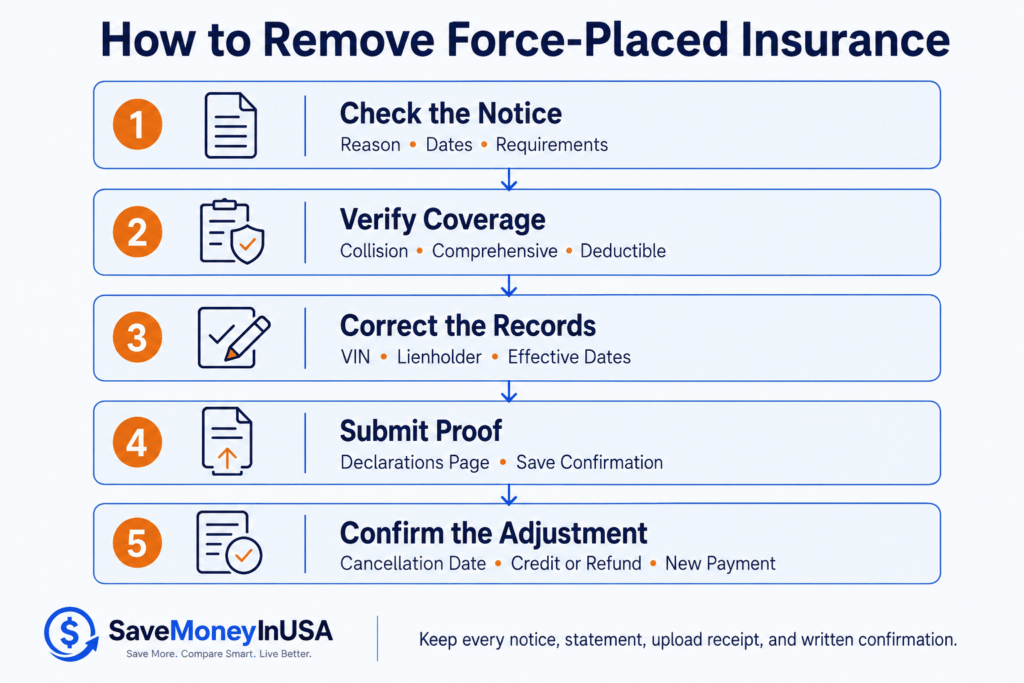
Removal is a verification process. Complete each step and keep a record so you can show what was submitted, when it was received, and what effective date the lender approved.
Step 1: Read the Notice and Loan Contract
Identify the reason for placement, the alleged lapse dates, the required coverage and deductible, the verification address or portal, and the deadline stated in the notice. Use the lender’s official contact information from your statement or account—not an unverified phone number from an unexpected message.
Step 2: Obtain or Confirm Qualifying Coverage
If your policy truly lapsed, obtain insurance that meets both state requirements and the financing contract. The lender commonly expects collision and comprehensive coverage and may limit the deductible. If you already have coverage, ask the insurer to confirm that it remained active for the relevant dates.
When comparing replacements, do not choose based only on the lowest premium. Match the same liability limits, physical-damage coverage, deductibles, drivers, vehicles, and optional benefits. Our car insurance quote comparison guide explains how to compare equivalent policies.
Step 3: Correct the Lienholder and Vehicle Information
Ask the insurer to list the lender or servicer exactly as required, including its lienholder name and address. Confirm the VIN, borrower name, vehicle description, policy number, effective dates, and deductibles. Request an updated declarations page or policy endorsement if anything changes.
Step 4: Submit Complete Proof of Insurance
Use the lender’s designated insurance-verification channel. A declarations page is usually more useful than an ID card because it can show the covered vehicle, effective dates, collision and comprehensive coverage, deductibles, and lienholder. Depending on the request, include:
- Declarations pages for the current policy and any earlier disputed period
- Insurance ID card and policy number
- Correct VIN and lienholder information
- Effective and expiration dates
- Collision and comprehensive deductibles
- Insurer or agent contact information
Save the upload confirmation, email, fax receipt, case number, representative’s name, and date of every call.
Step 5: Confirm Cancellation, Credit, and the New Payment
After verification, ask for written confirmation showing the force-placed policy’s cancellation date. Also request an itemized calculation of any premium reversal, account credit, refund, interest adjustment, and new required payment. Check later statements to make sure the charge does not continue or reappear.
Can You Get a Refund for Force-Placed Insurance?
You may be able to obtain a credit or refund for dates when qualifying borrower-purchased coverage overlapped with the lender-placed policy. CFPB supervisory findings explain that, when consumers later prove they had adequate insurance for part of a CPI period, servicers generally remove the CPI charges for that covered period.
The result depends on the evidence, contract, servicer process, policy, and applicable law. Do not assume that cancellation automatically corrects every related amount. Ask the lender to review:
- The first and last dates of the alleged insurance gap
- The force-placed policy’s issue and cancellation dates
- Every date covered by your own policy
- Premiums, interest, late charges, or other amounts connected to the placement
- Whether the credit goes to the loan balance, reduces the required payment, or is returned directly
If coverage existed for the full period, ask for a full retroactive cancellation review. If it existed for only part of the period, request a partial credit for the documented overlap. Keep the revised account history and compare it with the next statement.
What If the Lender Does Not Remove Incorrect Charges?
Start with the lender or servicer’s written dispute or escalation process. State the account number, disputed dates, amount, reason, requested correction, and a list of attached proof. Keep the original documents and send copies through a trackable or confirmed channel.
- Ask for a case number and written response deadline.
- Escalate to the servicer’s insurance-verification or complaint department.
- Request a complete itemized account history and explanation of the decision.
- If the issue remains unresolved, consider a complaint to the CFPB regarding the auto lender or servicer.
- For an insurance-company issue, use the NAIC directory to find your state insurance department. State law and complaint options vary.
Keep letters, declarations pages, billing statements, screenshots, upload receipts, emails, and call notes together. If the amount is large, repossession is threatened, or the dispute involves state-law rights, consider advice from a qualified consumer attorney or legal-aid organization in your state.
Can a Car Be Repossessed Because of Insurance Problems?
Repossession rights depend on the loan contract and state law. The more immediate risk is that lender-placed charges increase the amount due, the borrower pays less than the new required payment, and the account becomes delinquent. The Federal Trade Commission notes that, in many states, a lender may repossess a vehicle after a loan default, subject to applicable rules.
Do not stop paying simply because you dispute the insurance charge. Contact the lender promptly, ask what amount is currently required to keep the account from becoming delinquent, and obtain any payment arrangement in writing. Continue the insurance dispute separately and preserve proof of each payment.
Force-Placed Insurance vs. GAP Insurance
These products address different risks. Force-placed coverage is lender-arranged physical-damage protection triggered when required coverage appears missing. GAP is generally an optional product intended to address some or all of an eligible difference between the loan balance and the primary insurer’s payment after a qualifying total loss or theft.
| Question | Force-Placed Insurance or CPI | GAP |
|---|---|---|
| Why does it exist? | Protects the lender’s collateral when required physical-damage coverage appears absent | Addresses an eligible loan shortfall after a qualifying total loss or theft |
| What triggers it? | Insurance lapse, inadequate coverage, or verification problem | A covered total loss or theft plus an eligible difference |
| Who arranges it? | Lender or servicer | Borrower may purchase it from an eligible provider |
| Does it replace normal auto insurance? | No | No |
| How is it removed? | Provide qualifying insurance proof and complete lender verification | Follow the GAP contract’s cancellation procedure |
For more detail, read our guides to GAP insurance for a financed car and whether GAP may be worth it on a used car.
Decision Module 2: Prevent Force-Placed Coverage
- Use reliable premium reminders or autopay. Confirm that the payment method remains valid and review renewal notices.
- Do not cancel the old policy too early. Make sure replacement coverage is active before ending the prior policy.
- Keep collision and comprehensive coverage. Do not remove lender-required coverage merely to reduce the premium.
- Confirm the deductible. Check the loan contract before selecting a higher deductible.
- List the lienholder accurately. Recheck the lender name and address after refinancing or a servicing transfer.
- Send proof after every relevant change. Keep the confirmation when switching insurers, moving, refinancing, or replacing the vehicle.
- Open lender mail and monitor statements. Respond to verification requests before charges accumulate.
- Shop before renewal. If affordability is the problem, compare equivalent coverage early rather than allowing the policy to lapse. See our guide on ways to lower a car insurance premium.
Frequently Asked Questions
How do I remove force-placed auto insurance?
Obtain or verify insurance that meets the loan contract, correct the VIN and lienholder information, submit declarations pages through the lender’s verification channel, and request written confirmation of the cancellation date, account credit, refund, and new payment.
Can force-placed insurance be removed retroactively?
Possibly. If you prove qualifying coverage existed during all or part of the force-placed period, request retroactive cancellation and removal or refund of overlapping charges. The evidence, contract, servicer procedure, policy, and applicable law control the result.
Is an insurance ID card enough to remove CPI?
Not always. A lender may need a declarations page showing the VIN, effective dates, collision and comprehensive coverage, deductibles, and correct lienholder. Follow the specific verification request.
Does force-placed insurance satisfy state liability requirements?
Do not assume it does. Lender-placed coverage may focus on physical damage to the vehicle and may not include the liability coverage needed under state law. Verify your personal auto policy before driving.
Why is force-placed auto insurance expensive?
The borrower does not shop or select the lender-arranged coverage, and the cost may be added to the loan account. The CFPB states that force-placed insurance is usually more expensive than insurance a borrower can obtain independently.
How long does force-placed insurance remain on a car loan?
There is no single nationwide auto-loan timeline that fits every lender and state. It may remain until the lender verifies qualifying coverage or until another event ends the need for the policy. Ask for the effective and cancellation dates in writing.
Final Takeaway
Force-placed insurance is a warning that the lender believes required physical-damage coverage is missing, inadequate, or unverified. It is not the same as normal full coverage, and it may leave you without important liability and personal protections.
Respond by matching the lender’s dates with your insurance records, correcting the VIN and lienholder information, submitting complete declarations pages, and obtaining written confirmation of the cancellation and account adjustment. If the placement overlaps with valid coverage, request a documented review of every related charge.
Sources
- Consumer Financial Protection Bureau — What Is Force-Placed Insurance?
- Consumer Financial Protection Bureau — Supervisory Highlights: Collateral Protection Insurance
- Consumer Financial Protection Bureau — Fifth Third Bank Force-Placed Insurance Enforcement Action
- Consumer Financial Protection Bureau — Complaints About an Auto Lender or Dealer
- Federal Trade Commission — Vehicle Repossession
- National Association of Insurance Commissioners — State Insurance Departments
About the Author
The SaveMoneyInUSA Editorial Team researches car insurance costs, coverage options, state requirements, and quote comparison considerations for drivers in the United States.
Learn more about our Editorial Team.
Disclaimer
SaveMoneyInUSA is an independent informational website and is not an insurance company, broker, lender, dealer, or agent.
Some links may be affiliate links. We may receive compensation from partners at no additional cost to users.
Insurance rates, coverage options, loan terms, contract requirements, complaint rights, and eligibility vary by provider, state, and individual circumstances.
This content is provided for educational purposes only and should not be considered insurance, legal, or financial advice.