

Last Updated: September 2026
GAP insurance is not only a new-car decision. A financed used car can also be worth less than its current loan payoff, especially when the buyer makes a small down payment, chooses a long loan term, or rolls negative equity from a trade-in into the new loan.
Quick answer: GAP insurance may be worth considering on a used car when the current loan payoff is meaningfully higher than a conservative estimate of the vehicle’s value and paying the possible shortfall would disrupt your finances. It may provide less benefit when the vehicle’s value is already at or above the payoff amount. Eligibility, benefit caps, exclusions, deductible treatment, and cancellation rules still control what a particular product may pay.
Compare equivalent collision and comprehensive coverage before evaluating any GAP option.
What Makes GAP Different on a Used Car?
GAP commonly refers to Guaranteed Asset Protection. Depending on the provider and applicable state law, the product may be structured as insurance, a waiver, or a debt-cancellation agreement. It is intended to address some or all of an eligible difference between the amount owed and the primary auto insurer’s payment after a qualifying theft or total loss.
The basic claim process is similar for new and used vehicles, but used-car eligibility can be more restrictive. A provider may consider vehicle age, mileage, purchase date, loan age, original ownership, loan-to-value ratio, and whether collision and comprehensive coverage remain in force. The name “GAP” alone does not tell you whether a particular used car qualifies or how a benefit will be calculated.
For a complete explanation of the underlying product and total-loss claim process, review our guide to GAP insurance for a financed car. This article focuses on the narrower used-car decision.
Decision Module 1: Calculate Your Potential Used-Car Loan Gap
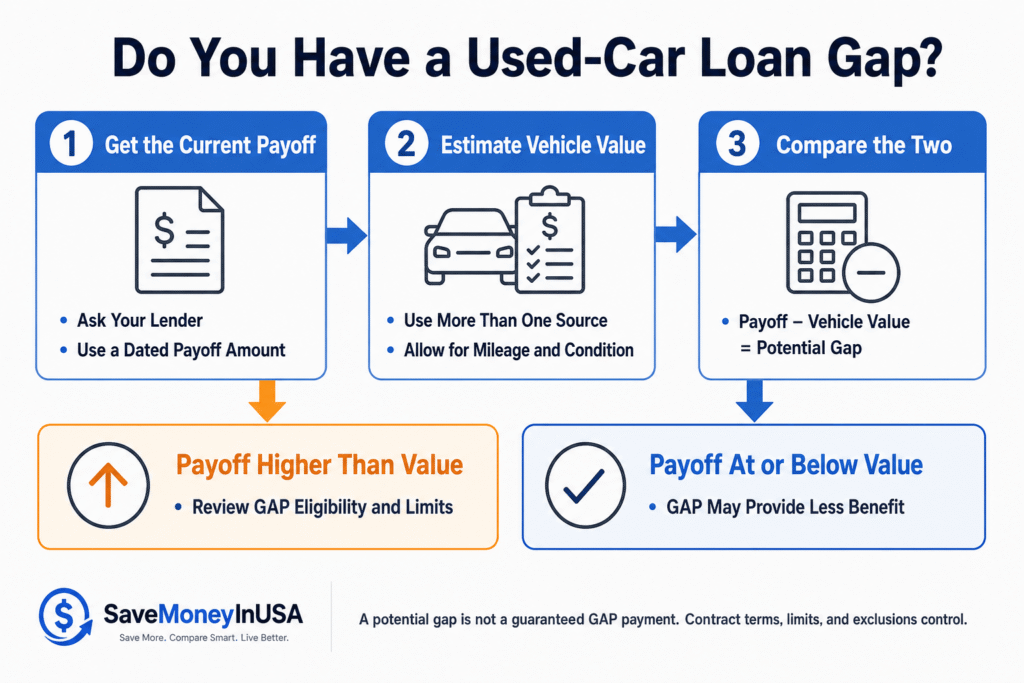
Do not decide based only on the vehicle’s age or the monthly payment. Start by comparing the amount required to pay off the loan with a conservative estimate of what the vehicle is worth today.
- Request the current payoff amount. Ask the lender for the amount needed to satisfy the loan as of a specific date. It may differ from the balance shown on a monthly statement because of accrued interest, fees, or other adjustments.
- Estimate a conservative vehicle value. Check more than one current valuation source and adjust for mileage, condition, equipment, accident history, and the local market. An online estimate is not a guaranteed insurance settlement.
- Compare the two amounts. Subtract the conservative vehicle value from the current payoff. A positive result indicates a potential shortfall; a zero or negative result suggests that the financial gap may be small or absent.
Current Loan Payoff − Conservative Vehicle Value = Potential Gap
The potential gap is not a promised GAP payment. The provider may apply a maximum benefit, a loan-to-value cap, limits on rolled-in negative equity, exclusions for overdue payments or add-ons, and rules for the auto-insurance deductible. Use the estimate to identify your exposure, then read the written agreement to see how much of that exposure is eligible.
Used-Car GAP Example
Consider an illustrative borrower who recently financed a used vehicle:
| Item | Illustrative Amount |
|---|---|
| Current loan payoff | $23,500 |
| Conservative current vehicle value | $20,000 |
| Potential difference before contract review | $3,500 |
| Possible GAP benefit | Depends on eligibility, limits, exclusions, deductible treatment, and contract terms |
The borrower has a possible $3,500 exposure, but that does not establish the final benefit. If the loan includes past-due amounts, a service contract, or rolled-in negative equity above the GAP product’s limit, part of the difference may remain the borrower’s responsibility. The borrower should compare that residual risk with the product’s total cost and written protections.
When GAP Insurance May Be Worth It on a Used Car
A used-car loan can begin with little or no equity. The following conditions create a stronger reason to investigate GAP, although none makes the product automatically necessary:
- Small down payment: The loan begins close to—or above—the vehicle’s purchase value after taxes, fees, and financed add-ons.
- Long loan term: Principal may decline slowly during the early part of a 72- or 84-month loan, especially when the interest rate is high.
- Rolled-in negative equity: The new used-car loan includes an unpaid balance from a trade-in, increasing the amount financed beyond the replacement vehicle’s value.
- High amount financed: Taxes, dealer fees, warranties, service contracts, or other add-ons increase the loan even though some of those charges may not increase the vehicle’s claim value.
- Limited emergency reserves: Paying a remaining loan balance while also arranging replacement transportation would disrupt essential expenses.
- Meaningful verified shortfall: The current payoff clearly exceeds a conservative estimate of vehicle value, and the available GAP contract addresses much of that risk.
When GAP May Provide Less Benefit
An older vehicle does not automatically make GAP unnecessary. The more useful question is whether the loan payoff is above the vehicle’s current value and whether the available contract would address that difference.
- The conservative vehicle value is comfortably above the current payoff amount.
- You made a large down payment or have already paid down substantial principal.
- The possible shortfall is small enough that you could pay it without disrupting essential expenses.
- The available product excludes or sharply limits the negative equity, deductible, or other amount you are concerned about.
- The total cost, including interest when the product is financed, is high relative to the eligible risk.
- Your vehicle, mileage, loan age, or purchase timing does not satisfy the provider’s eligibility rules.
Used-Car GAP Decision Table
| Used-Car Financing Situation | Reason to Consider GAP | What to Check First |
|---|---|---|
| Payoff is clearly above conservative vehicle value | Higher | Benefit cap, exclusions, and total cost |
| Small down payment with a long loan | Higher | Current payoff and vehicle-value estimate |
| Negative equity rolled into the loan | Potentially higher | How much prior negative equity the contract permits |
| Payoff and vehicle value are close | Uncertain | Recalculate periodically and compare contract cost |
| Vehicle value comfortably exceeds payoff | Lower | Whether any meaningful eligible shortfall remains |
| Vehicle exceeds age or mileage limits | May be unavailable | Written provider eligibility rules |
The table is a screening tool, not a coverage determination. A provider must confirm eligibility, and the written agreement controls any claim.
Can You Get GAP Insurance on Any Used Car?
No. Availability varies by provider, state, vehicle, loan, and timing. Some auto insurers offer a loan- or lease-payoff add-on only when they also provide collision and comprehensive coverage. A dealer, lender, credit union, or GAP administrator may use different rules.
Before relying on a quote or dealership presentation, obtain written answers to these questions:
- What vehicle-age and mileage limits apply?
- Must the product be purchased at the time of the loan or within a specific period?
- Does the vehicle have to be purchased from a dealer or financed by a particular lender?
- What maximum loan-to-value ratio is eligible?
- How are rolled-in negative equity and financed add-ons treated?
- Must collision and comprehensive coverage remain active?
Do not assume that a product advertised as GAP is identical to an auto insurer’s loan/lease payoff coverage. Compare definitions, limits, cancellation rules, and the exact claim formula.
What Used-Car GAP May Not Pay
GAP does not replace the underlying auto policy and does not promise to erase every amount connected to a loan. Contract language varies, but buyers should specifically investigate the following items:
| Issue | Why It Requires Review |
|---|---|
| Past-due installments, late fees, or payment extensions | They may be excluded from the eligible balance |
| Rolled-in negative equity | The agreement may apply a percentage or dollar cap |
| Auto-insurance deductible | Some products address it up to a limit; others do not |
| Service contracts, warranties, or other add-ons | They may not be included in the benefit calculation |
| Mechanical failure or ordinary repairs | GAP generally concerns a qualifying theft or total loss, not maintenance |
| Failure to maintain required auto coverage | It may affect eligibility under the agreement |
Ask for an example using your actual amount financed, trade-in equity, loan term, and proposed product. Keep the contract and administrator contact information where you can find them after a loss.
Before Accepting GAP at a Used-Car Dealership
GAP is generally an optional add-on in most auto-financing transactions. If a dealer or lender says it is required, ask where that requirement appears in the proposed financing contract and confirm it directly with the lender.
Request the GAP price separately from the vehicle price and other add-ons. If the cost is included in the loan, identify how much additional principal and interest it creates over the full term. Then compare other available options without assuming that a dealership, lender, credit union, or auto insurer will always be cheaper or more comprehensive.
- What is the total product price rather than only its monthly-payment effect?
- Who administers a claim, and what documents and deadlines apply?
- What is the maximum benefit and loan-to-value limit?
- How are the deductible, prior negative equity, late payments, and add-ons treated?
- How can you cancel, and how is any refund calculated?
Decision Module 2: Used-Car GAP Buying Checklist
- Confirm the payoff: Obtain a current payoff amount from the lender.
- Estimate value conservatively: Use multiple sources and account for mileage, condition, equipment, history, and local prices.
- Calculate the possible difference: Compare payoff with value rather than relying on the monthly payment.
- Confirm used-car eligibility: Check vehicle age, mileage, loan age, purchase timing, ownership, and loan-to-value restrictions.
- Review existing protection: Make sure GAP or a similar waiver is not already included in the financing agreement.
- Compare total cost: Include interest if the product will be financed inside the auto loan.
- Read limits and exclusions: Review negative-equity caps, deductible treatment, excluded charges, claim deadlines, and document requirements.
- Check cancellation and refunds: Ask what happens after early payoff, refinancing, sale, trade-in, or cancellation.
- Keep your documents: Save the agreement, loan records, and administrator contact information.
If you also compare auto policies, keep liability limits, collision and comprehensive coverage, deductibles, drivers, and optional benefits identical. Use our car insurance quote comparison guide to avoid comparing unlike policies.
When Should You Cancel GAP on a Used Car?
Review the payoff-to-value comparison after major principal payments and periodically during the loan. Once a conservative vehicle value is clearly above the payoff amount, the financial gap may have disappeared even though the loan remains open.
The Consumer Financial Protection Bureau states that optional add-on products can be canceled during the loan term and that you may be entitled to a refund if you sell, refinance, or prepay the loan. Do not assume that a cancellation or refund will be processed automatically. Contact the provider or administrator, follow the written procedure, and request a written refund calculation. When the GAP cost was financed, a refund may be applied to the loan balance instead of being sent directly to you.
Canceling GAP does not remove the collision and comprehensive coverage required by the auto loan. Review the lender’s insurance requirements before changing the underlying policy.
GAP vs. Full Coverage on a Used Car
GAP and “full coverage” address different risks. Full coverage is an informal term usually referring to liability coverage plus collision and comprehensive coverage. Collision or comprehensive may pay for a covered loss to the vehicle, subject to the policy, deductible, and valuation. GAP concerns an eligible remaining loan difference after a qualifying primary-insurance payment.
GAP does not replace liability, collision, or comprehensive coverage. A lender commonly requires collision and comprehensive coverage on a financed used car. Before changing the policy, review our guides to full coverage on a financed car and full coverage vs. liability insurance.
Frequently Asked Questions
Is GAP insurance worth it on a used car?
It may be worth considering when the current payoff is meaningfully higher than a conservative vehicle-value estimate, the contract covers much of that potential difference, and paying the shortfall yourself would create financial difficulty. It may provide less value when the car is worth more than the payoff or the contract excludes much of the risk.
Is GAP insurance necessary for a used car?
GAP is generally optional in most auto-financing transactions. A lender is much more likely to require collision and comprehensive coverage. If someone says GAP is mandatory, ask for the requirement in writing and confirm it with the lender.
Can an older used car qualify for GAP?
Possibly, but eligibility varies. Providers may limit vehicle age, mileage, purchase timing, loan age, loan-to-value ratio, or ownership history. Confirm the rules before including GAP in your financing decision.
Can I buy GAP after purchasing a used car?
Possibly. A lender, credit union, insurer, or other provider may allow a later purchase, but vehicle and loan eligibility rules differ. Ask whether a deadline applies and whether the product requires the same company to provide collision and comprehensive coverage.
Does used-car GAP cover the auto-insurance deductible?
Some agreements may address a deductible up to a stated limit, while others exclude it. Check the benefit calculation rather than assuming the deductible is included.
Does GAP cover negative equity rolled into a used-car loan?
Some products may address eligible prior negative equity only within a percentage or dollar cap. Others may exclude part or all of it. Compare the rolled-in amount with the agreement’s maximum eligible balance.
Does GAP cover repairs on a used car?
No. GAP is not a repair plan, mechanical-breakdown product, or extended warranty. It generally concerns an eligible loan difference after a qualifying theft or total loss.
Final Takeaway
Whether GAP insurance is worth it on a used car depends more on the financing than on the “used” label. Compare the current payoff with a conservative vehicle value, identify any negative equity and financed add-ons, then measure the potential shortfall against the product’s total cost, eligibility rules, caps, and exclusions.
Keep GAP only while it addresses a meaningful eligible risk. Recheck the numbers as the loan balance falls, retain the collision and comprehensive coverage required by the lender, and follow the written cancellation procedure when the potential gap has disappeared.
Sources
- Consumer Financial Protection Bureau — What Is Guaranteed Asset Protection (GAP) Insurance?
- Consumer Financial Protection Bureau — Is GAP Required to Get an Auto Loan?
- Consumer Financial Protection Bureau — Trading In a Car With an Existing Loan
- Federal Trade Commission — Buying a Used Car From a Dealer
- National Association of Insurance Commissioners — Auto Insurance Consumer Guide
About the Author
The SaveMoneyInUSA Editorial Team researches car insurance costs, coverage options, state requirements, and quote comparison considerations for drivers in the United States.
Learn more about our Editorial Team.
Disclaimer
SaveMoneyInUSA is an independent informational website and is not an insurance company, broker, lender, dealer, or agent.
Some links may be affiliate links. We may receive compensation from partners at no additional cost to users.
Insurance rates, coverage options, loan terms, product terms, and eligibility vary by provider and individual circumstances.
This content is provided for educational purposes only and should not be considered insurance, legal, or financial advice.