

Last Updated: August 2026

GAP insurance is designed for a specific problem: a financed or leased vehicle is stolen or declared a total loss, the primary auto insurer pays based on the vehicle’s value, and the borrower still owes more than that payment. Subject to the agreement’s limits and exclusions, GAP may cover some or all of the eligible difference.
Quick answer: GAP may be useful when your loan balance is higher than the car’s actual cash value, especially after a small down payment, a long loan term, or negative equity from a trade-in. It does not replace liability, collision, or comprehensive coverage, and it does not guarantee that every amount connected to the loan will be paid.
Compare equivalent collision and comprehensive coverage before evaluating any GAP option.
What Is GAP Insurance on a Financed Car?
GAP commonly refers to Guaranteed Asset Protection. Depending on who sells it and how state law treats the product, it may be structured as insurance, a waiver, or a debt-cancellation agreement. The label matters less than the written terms: the product is intended to address an eligible difference between the balance owed and the primary insurer’s payment after a qualifying theft or total loss.
Standard collision or comprehensive coverage generally values the vehicle rather than promising to pay the entire auto loan. If the vehicle depreciates faster than the loan balance falls, the borrower can become “upside down” or have negative equity.
GAP does not pay routine repairs, ordinary depreciation, missed monthly payments, or the cost of replacing the vehicle. It normally becomes relevant only after the primary insurer treats a covered vehicle as stolen or a total loss and the GAP contract’s other conditions are satisfied.
How Does GAP Insurance Work on a Financed Car?
The process usually begins with a claim under the vehicle’s collision or comprehensive coverage. After the insurer determines the covered loss and vehicle value, the insurer pays according to the auto policy. The lender applies the payment to the loan. If an eligible balance remains, the borrower submits the documents required by the GAP provider.
- The vehicle is stolen and not recovered, or it is declared a total loss after a covered event.
- The primary auto insurer calculates and pays the covered vehicle-value claim, less any applicable deductible.
- The lender applies the insurance payment to the outstanding loan.
- The GAP administrator reviews the remaining balance, contract limit, payment history, exclusions, and required documents.
- The borrower remains responsible for any amount the GAP agreement does not cover.
Do not assume the lender or auto insurer will automatically open the GAP claim. Ask who administers the product, what deadline applies, and which documents must be submitted.
GAP Insurance Example
Consider an illustrative financed-car total loss:
| Item | Illustrative Amount |
|---|---|
| Qualifying loan balance before claim payments | $32,000 |
| Primary insurer’s vehicle-value payment | $27,000 |
| Difference before GAP review | $5,000 |
| Possible GAP payment | Depends on limits, exclusions, deductible treatment, and contract terms |
The $5,000 difference is not automatically the final GAP payment. The contract may exclude past-due installments, late fees, skipped payments, service contracts, warranties, or negative equity above a stated limit. Some products address an auto-insurance deductible; others do not. The actual calculation must come from the written agreement.
GAP Insurance vs. Full Coverage
“Full coverage” and GAP address different risks. Full coverage is an informal term usually referring to liability coverage plus collision and comprehensive coverage. GAP is a separate product related to the loan balance after a qualifying total loss. See our full coverage vs. liability insurance comparison for a closer look at what these core coverages generally protect.
| Protection | What It Generally Addresses | What It Does Not Replace |
|---|---|---|
| Liability | Covered injuries or property damage you cause to others | Protection for damage to your own financed vehicle |
| Collision | Covered collision or rollover damage to your car, subject to deductible and terms | Every dollar still owed on the loan |
| Comprehensive | Covered non-collision losses such as theft, fire, weather, or vandalism | Every dollar still owed on the loan |
| GAP product | Some or all of an eligible difference after a qualifying primary-insurance payment | Liability, collision, comprehensive, repairs, or maintenance |
A lender will commonly require collision and comprehensive coverage on a financed car. GAP does not satisfy those requirements. Review full coverage requirements for a financed car before changing the underlying auto policy.
Dealership GAP Insurance vs. Other GAP Options
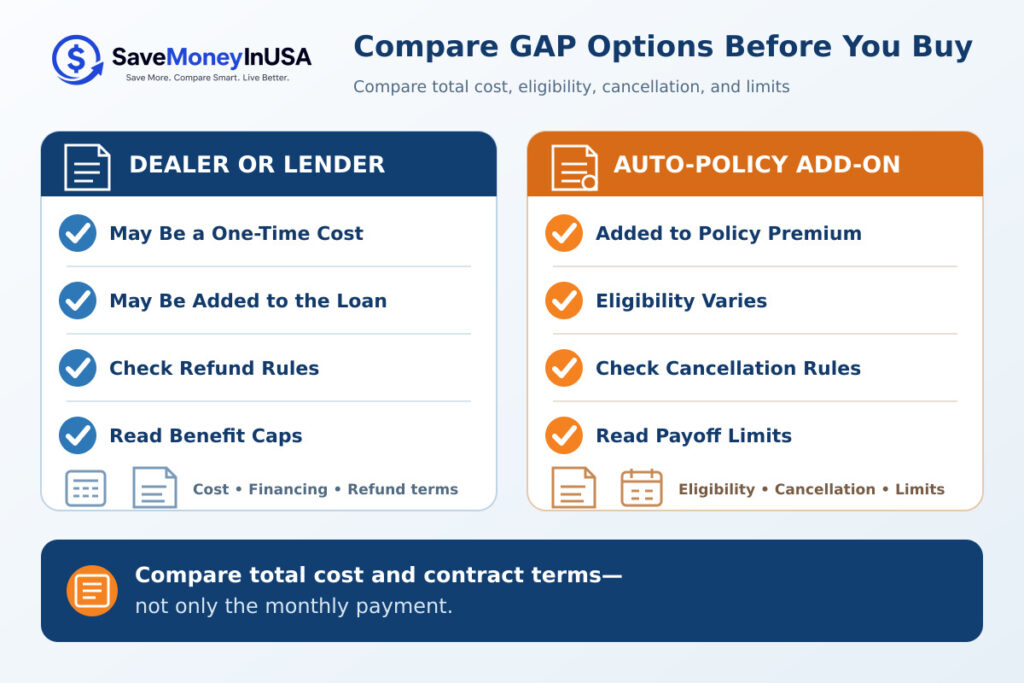
A dealership may offer GAP while arranging financing, but that is not necessarily the only source. Depending on availability, a lender, credit union, auto insurer, or other provider may offer a similar product under names such as GAP, loan/lease payoff, or debt cancellation.
| Comparison Point | Dealership or Lender Product | Auto-Insurance Add-On |
|---|---|---|
| How it may be charged | May be a one-time amount paid upfront or included in the auto loan | May be added to the auto-policy premium |
| Financing effect | If added to the loan, it can increase principal and total interest | Normally not financed inside the vehicle loan |
| Eligibility | Depends on vehicle, lender, loan, and contract rules | Depends on insurer, state, vehicle age, ownership timing, and coverage rules |
| Cancellation | Refund and cancellation procedures depend on the agreement and applicable law | May be removed from the policy, subject to insurer rules |
| Claim limits | Read percentage caps, maximum benefits, exclusions, and document requirements | Read loan/lease payoff limits, exclusions, and underlying coverage requirements |
Do not compare only the immediate monthly payment. Ask for the total product price, the amount financed, the interest effect, the maximum benefit, deductible treatment, cancellation rules, and an example of how a claim would be calculated.
In most situations, GAP is optional. If a dealer or lender says it is required, ask where that requirement appears in the financing contract. Review every line of the buyer’s order and loan documents so an unwanted add-on is not included without your informed agreement.
What GAP May Cover—and What It May Exclude
No single list applies to every GAP product. The following comparison identifies issues to verify rather than promises about a particular contract.
| May Be Addressed | May Be Limited or Excluded |
|---|---|
| Eligible difference between the qualifying loan balance and primary insurance payment | Past-due payments, late fees, skipped payments, or payment extensions |
| Some negative equity, if permitted within the contract limit | Negative equity above the product’s percentage or dollar cap |
| An auto-insurance deductible under some agreements | The deductible when the agreement does not include it |
| A qualifying leased-vehicle balance | Excess mileage, wear, lease penalties, or charges outside the covered calculation |
| A qualifying theft or total-loss balance | Repairs, mechanical failure, maintenance, diminished value, or a vehicle that is not a total loss |
Also check whether refinancing, missed payments, policy cancellation, commercial use, an excluded loss, or failure to maintain required collision and comprehensive coverage could affect eligibility.
Decision Module 1: When Should You Consider GAP?
- Small down payment: You began the loan with little equity in the vehicle.
- Long loan term: The balance may fall slowly during the early years.
- Rolled-in negative equity: The new loan includes an unpaid balance from a trade-in, subject to the GAP contract’s limits.
- Fast depreciation: The vehicle’s value may decline more quickly than the principal balance.
- Lease exposure: The lease agreement creates a potential balance after a qualifying total loss and does not already include adequate protection.
- Limited ability to absorb a shortfall: Paying a remaining balance while replacing the car would disrupt your finances.
GAP is not automatically necessary just because a vehicle is financed. Estimate the current payoff amount and vehicle value, then compare the possible shortfall with the total cost and contract limitations.
When GAP May Not Be Necessary
You may have little need for GAP when the vehicle’s realistic value comfortably exceeds the current loan payoff amount. That can occur after a large down payment, faster principal payments, or enough time for the loan balance to fall below the car’s value.
- The lease already includes GAP protection or a comparable waiver.
- The outstanding payoff is below the vehicle’s conservative current value.
- You could comfortably pay a possible difference without disrupting essential expenses or replacement transportation.
- The available product excludes or caps much of the risk you are trying to cover.
Before declining coverage, remember that online vehicle-value estimates are not guaranteed claim payments. Use a conservative estimate and review the decision periodically.
Decision Module 2: GAP Buying Checklist
- Confirm the payoff: Ask the lender for the current loan payoff amount, not only the account balance shown online.
- Estimate vehicle value: Use more than one current source and allow for mileage, condition, equipment, and local market differences.
- Check existing protection: Review the lease, purchase documents, auto policy, and financing agreement so you do not buy duplicate coverage.
- Compare total cost: Include any interest paid when a dealership product is financed inside the loan.
- Read the calculation: Identify benefit caps, negative-equity limits, deductible treatment, exclusions, deadlines, and required documents.
- Review cancellation: Ask how refunds are calculated after early payoff, refinancing, sale, trade-in, or cancellation.
- Keep the agreement: Store the contract and administrator contact information where you can find them after a total loss.
If you are comparing the underlying auto policy at the same time, keep liability limits, collision and comprehensive coverage, deductibles, drivers, and optional benefits identical. Follow our car insurance quote comparison guide.
For a broader cost-reduction plan, see How to Save Money on Car Insurance in the USA. You can also browse the Car Insurance Guides Resource Center for related financing, GAP, full-coverage, deductible, payment, and state-specific topics.
When Should You Cancel GAP Insurance?
Review GAP after major principal payments and at least periodically during the loan. Once the conservative vehicle value is clearly above the payoff amount, the financial gap may have disappeared.
Do not simply stop paying or assume that refinancing, selling, trading in, or paying off the car automatically produces a refund. Contact the provider or administrator, follow the written cancellation procedure, and ask which documents are required. If the product was financed, a refund may be applied to the loan balance rather than paid directly to you.
Keep confirmation of the cancellation and any refund calculation. Continue the collision and comprehensive coverage required by the loan agreement even if GAP is removed.
Frequently Asked Questions
Is GAP insurance required on a financed car?
GAP is generally optional in most financing transactions. Collision and comprehensive coverage are much more commonly required by the lender. If someone says GAP is mandatory, ask them to show the requirement in the signed or proposed financing agreement.
Is GAP insurance only for financed cars?
GAP addresses an eligible loan or lease balance, so it is generally relevant to financed or leased vehicles rather than a car owned free and clear. A cash buyer has no auto-loan balance for GAP to protect.
Can I buy GAP after purchasing the car?
Possibly. Availability depends on the provider, state, vehicle age, loan age, original ownership, and underlying auto coverage. Ask the insurer or lender about eligibility and compare the written terms before buying.
Does GAP pay my auto-insurance deductible?
Some agreements may address a deductible up to a stated limit, while others exclude it. Do not assume it is included; check the benefit calculation and exclusions.
Does GAP cover negative equity from a trade-in?
Some products may include eligible negative equity only within a percentage or dollar cap. Others may exclude part or all of it. Compare the amount rolled into the loan with the contract’s maximum covered balance.
What happens to GAP if I refinance the car?
Refinancing replaces the original loan and may end or change the existing GAP protection. Contact the administrator before refinancing, ask whether cancellation or a refund is available, and determine whether the new loan needs a separate product.
Final Takeaway
GAP insurance can reduce a real risk when a financed vehicle’s loan balance is higher than its value, but the name alone does not tell you what will be paid. Compare the current payoff with a conservative vehicle value, verify whether protection is already included, compare dealership, lender, and insurer options when available, and read the benefit limits and exclusions before buying.
GAP supplements rather than replaces the underlying auto policy. Keep the collision and comprehensive coverage required by the financing agreement, avoid a coverage lapse, and review GAP again as the loan balance falls.
Sources
- Consumer Financial Protection Bureau — What Is Guaranteed Asset Protection (GAP) Insurance?
- Consumer Financial Protection Bureau — Is GAP Required to Get an Auto Loan?
- Consumer Financial Protection Bureau — Auto Insurance Options When Financing a Car
- National Association of Insurance Commissioners — What Does Auto Insurance Cover?
- Federal Trade Commission — Buying a Used Car From a Dealer
About the Author
The SaveMoneyInUSA Editorial Team researches car insurance costs, coverage options, state requirements, discounts, and quote-comparison considerations for drivers in the United States.
Learn more about our Editorial Team.
Disclaimer
SaveMoneyInUSA is an independent informational website and is not an insurance company, broker, lender, dealer, GAP provider, or agent.
Some links may be affiliate links. We may receive compensation from partners at no additional cost to users.
Insurance premiums, vehicle valuations, loan balances, GAP benefits, exclusions, cancellations, refunds, product terms, and eligibility vary by insurer, lender, provider, contract, state law, and individual circumstances.
This content is provided for educational purposes only and should not be considered insurance, legal, or financial advice.