

Last Updated: August 2026
Your regular consumer credit score is not the exact score most insurers use. In many states, however, information from your credit report may help create a separate credit-based insurance score that can influence your car insurance rate.
The effect may be substantial for some drivers, but it is not the same in every state or at every insurance company. California does not permit credit information as a private-passenger auto rating factor, and Massachusetts prohibits its use for auto underwriting or rating. Hawaii prohibits insurers from refusing coverage based on a driver’s credit bureau rating, but that rule should not be described as a complete ban on every possible use. Other states allow some use of credit information with different consumer protections and restrictions.
That means a driver with the same vehicle, driving history, and coverage can receive very different quotes from different insurers.
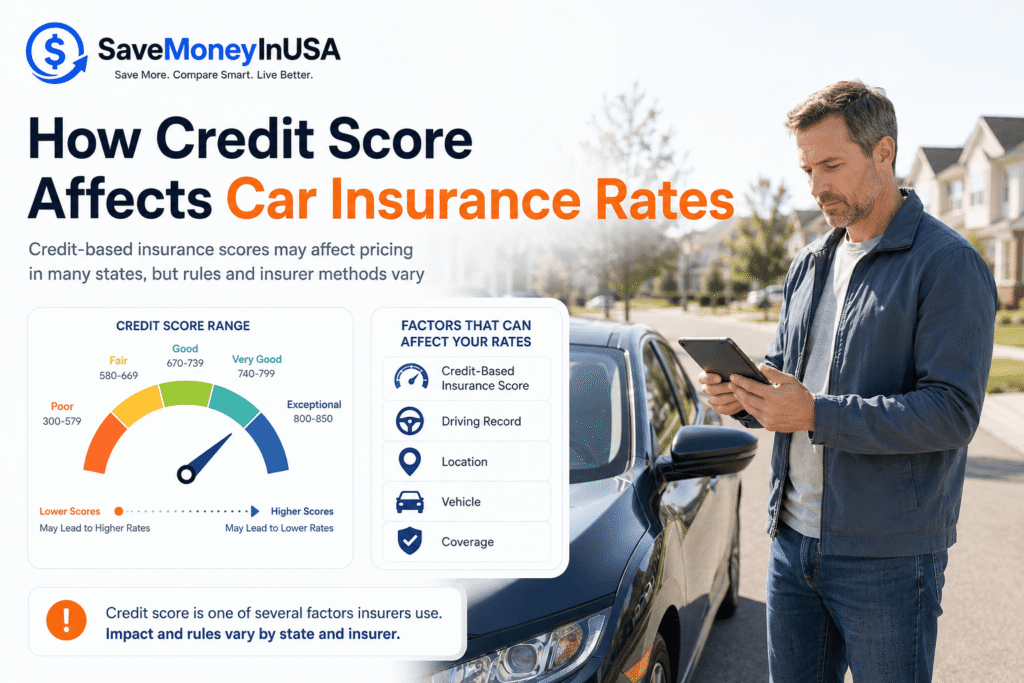
Comparing quotes is free and does not affect your credit score.
Does Credit Score Affect Car Insurance Rates?
In most states, the answer is yes—but usually through a credit-based insurance score rather than the consumer credit score you may see from a bank, credit card company, or credit-monitoring service.
An insurer may use permitted information from your credit report as one part of its pricing model. The company then combines that result with other factors such as your driving record, age or driving experience where permitted, ZIP code or garaging location, annual mileage, vehicle, coverage limits, deductibles, prior claims, and insurance history.
If information from a consumer report contributes to an adverse action, federal law generally requires the insurer to provide a notice identifying the consumer reporting agency and explaining the consumer’s right to obtain and dispute the report. State rules may provide additional protections, so drivers should check their state insurance department for the requirements that apply.
Credit Score vs. Credit-Based Insurance Score
These two scores are related, but they are designed for different purposes.
| Type of Score | Main Purpose | Typical User |
|---|---|---|
| Consumer credit score | Estimates the likelihood that a borrower will repay debt | Lenders, credit card companies, and financing providers |
| Credit-based insurance score | Helps estimate insurance loss or claim risk | Insurance companies where state law permits |
You usually will not see the exact proprietary insurance score used by a carrier. Two insurers may also interpret the same credit-report information differently because their scoring and underwriting models are not identical.
Why Do Car Insurance Companies Use Credit Information?
Insurers use rating factors to estimate the likelihood and expected cost of future claims. Industry scoring models treat certain patterns in a consumer’s credit history as statistically associated with insurance loss risk.
This does not mean that a low score proves someone is an unsafe driver. It means the insurer may treat the score as one statistical factor within a much larger pricing model.
The practice remains controversial because credit problems may result from medical bills, job loss, divorce, identity theft, or other hardships that are not directly related to driving. For this reason, state laws often restrict which credit factors insurers may use, require notices when credit information leads to an adverse action, or provide exceptions for extraordinary life circumstances.
What Insurers May Review in a Credit-Based Insurance Score
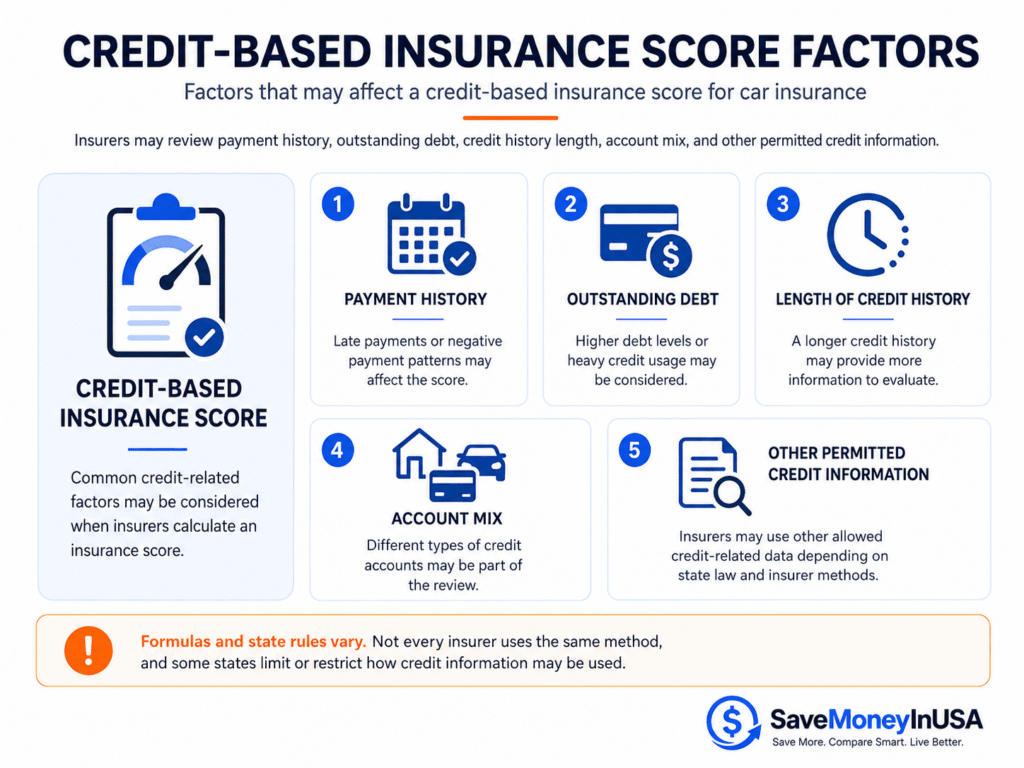
The exact formula is proprietary and varies by company. Depending on state law, a model may consider information such as:
- Payment history and late payments
- Outstanding debt and balances
- Length of credit history
- Types and mix of credit accounts
- Recent account activity
- Collections, bankruptcies, or other negative records when legally permitted
Federal and state laws may exclude or limit certain information. Some states also require special treatment when a consumer has little or no credit history, so the exact rules depend on where the policy is issued.
How Much Can Credit Affect Car Insurance Rates?
There is no single nationwide percentage that applies to every driver. The difference depends on the insurer, state, vehicle, coverage, location, driving history, and the company’s approved rating plan.
In a state where credit-based insurance scoring is permitted, the general pricing pattern may look like this:
| Credit Profile | Possible Pricing Effect | Important Limitation |
|---|---|---|
| Stronger credit history | May qualify for a more favorable insurance tier | Does not guarantee the lowest rate |
| Average or mixed credit history | May produce a moderate effect | Other rating factors may matter more |
| Weak or limited credit history | May lead to a higher quoted premium | State protections and insurer models vary |
A driver with excellent credit can still pay a high premium because of accidents, violations, expensive vehicles, high coverage limits, a high-cost location, or a lapse in insurance. A driver with weaker credit may still find a competitive price from an insurer that gives less weight to credit information.
Example: Why Two Drivers Can Receive Different Quotes
Consider two drivers who own the same model vehicle and request the same coverage:
- Driver A has a clean driving record, continuous insurance, low annual mileage, and a stronger credit-based insurance profile.
- Driver B also has a clean driving record but has a recent coverage lapse and a weaker credit-based insurance profile.
Driver B may receive a higher quote in a state that permits credit-based scoring. But the difference cannot be predicted from credit alone, and another insurer may price the two drivers much more closely.
This is why an online average should not be treated as your expected premium. The only reliable way to see the effect on your situation is to compare quotes using the same driver information, vehicle, coverage limits, and deductibles.
States That Prohibit or Restrict Credit Use
State rules change, and the legal details are not identical. As of August 2026, several important examples include:
| State | General Treatment | What Drivers Should Know |
|---|---|---|
| California | Credit information is not an approved private-passenger auto rating factor | Driving safety record, annual mileage, and years of driving experience are the three mandatory rating factors |
| Hawaii | An insurer may not refuse auto insurance because of a driver’s credit bureau rating | This refusal-to-insure protection should not be described as a complete ban on every possible use of credit information |
| Massachusetts | Insurers may not use consumer credit information for auto underwriting or rating | Compare coverage, driving-related factors, discounts, and company pricing instead |
| Michigan | Ordinary credit score is prohibited as an auto rating factor, but a qualifying insurance score may still be used under filed rating rules | Michigan’s rules are more precise than a simple “credit ban,” so ask which permitted factor affected the quote |
| Maryland | Credit history may be used for a new policy, subject to specific limits | A credit-based surcharge may not exceed 40%; an insurer may not increase a renewal premium based on credit history or rate on certain prohibited credit factors |
This table gives selected examples rather than a complete 50-state list. Do not assume that any online list applies permanently. Insurance laws can change, and a state may regulate underwriting, initial pricing, renewal pricing, or individual credit characteristics differently.
For the most reliable answer, contact your state department of insurance. If credit information contributed to an adverse action, review the insurer’s notice and use it to identify the reporting agency, obtain the relevant credit report, and dispute any inaccurate information.
Does Getting a Car Insurance Quote Hurt Your Credit?
Generally, no. Requesting a car insurance quote normally does not create the type of hard credit inquiry used for a loan or credit card application, so comparing insurance quotes should not lower your consumer credit score.
An insurer may access credit-related information where permitted, but this is generally treated differently from applying for new credit. You can therefore shop with several insurers without assuming that each quote will damage your score.
How to Check the Credit Information Behind Your Rate
You may not be able to see an insurer’s proprietary insurance score, but you can review the credit reports that may supply information to the model.
1. Request Your Official Credit Reports
Use AnnualCreditReport.com, the federally authorized source for reports from Equifax, Experian, and TransUnion. Reviewing your own report does not hurt your score.
2. Check All Three Reports
Information can differ between credit bureaus. Look for accounts you do not recognize, incorrect late payments, duplicate collections, wrong balances, or outdated information.
3. Dispute Errors
Dispute inaccurate information with the credit bureau and, when appropriate, with the company that supplied the data. Keep copies of supporting records and confirmation numbers.
4. Ask the Insurer to Recalculate
If an error affected your insurance pricing, notify the insurer after the report is corrected. Ask whether the company can rerun the insurance score and apply any lower rate allowed under state law.
How to Lower Car Insurance Rates with Poor Credit
Improving credit can take time. You do not need to wait for a perfect score before looking for savings.
Compare the Same Coverage with Multiple Insurers
This is usually the fastest step because insurers weigh rating factors differently. Keep liability limits, deductibles, optional coverage, drivers, vehicles, and annual mileage consistent so the quotes are comparable.
Use our guide on how to compare car insurance quotes to avoid choosing a cheaper quote that provides less protection.
Correct Credit-Report Errors
An incorrect collection, late payment, or balance can affect more than borrowing. Review all three reports and dispute inaccurate information promptly.
Pay Bills on Time and Reduce Revolving Balances
Consistent on-time payments and lower credit card balances may gradually strengthen your overall credit profile. Avoid opening several unnecessary accounts solely to chase a quick insurance discount.
Avoid a Coverage Lapse
A lapse can raise rates even when credit is not considered. Arrange the new policy before canceling the old one and keep proof of continuous insurance.
Review Deductibles Carefully
A higher collision or comprehensive deductible may reduce the premium, but it also increases what you must pay after a covered claim. Read our car insurance deductible guide before changing it.
Ask About Discounts and Usage-Based Programs
Bundling, low-mileage, defensive-driving, vehicle-safety, automatic-payment, paperless, and telematics discounts may offset part of a high base rate. Review the privacy and driving-behavior terms before joining a usage-based program.
Choose Coverage Based on Risk—not Credit Alone
Do not remove important coverage only because the premium is high. Compare the financial tradeoffs in our guide to full coverage vs. liability insurance.
When Should You Shop for New Quotes?
Consider comparing rates:
- At least once every 6 to 12 months
- After your credit report improves
- After a ticket or accident ages off the insurer’s rating period
- When you move, change vehicles, or change annual mileage
- Before adding a driver or changing coverage
- When your renewal premium increases significantly
Do not cancel an existing policy until the replacement policy is active and you have confirmed its effective date, coverage, limits, deductibles, and payment requirements.
Common Mistakes to Avoid
- Assuming your consumer credit score is the insurer’s exact score: The models and purposes are different.
- Believing every insurer treats credit the same way: Rating models and approved factors vary.
- Using an online average as your expected premium: Your rate depends on your full risk profile.
- Ignoring state law: Credit use may be prohibited, limited, or treated differently for new and renewal policies.
- Reducing coverage without checking the risk: A lower premium can create a much larger out-of-pocket loss after an accident.
- Letting insurance lapse while shopping: Continuous coverage can be an important rating factor.
Frequently Asked Questions
Does a car insurance quote lower my credit score?
Normally, no. Insurance quote activity generally does not create the hard inquiry associated with applying for a loan or credit card.
Can I get affordable car insurance with bad credit?
Yes. A weaker credit profile may raise quotes in some states, but insurers weigh factors differently. Comparing several companies, maintaining continuous coverage, reviewing discounts, and correcting report errors can help.
Will improving my credit immediately lower my premium?
Not necessarily. The insurer may update credit information only at certain times, and state law or company procedures may control when a policy can be rerated. Ask the insurer whether it will recalculate your rate after an improvement.
Can an insurer cancel my policy only because of my credit?
In many states, credit information cannot be the sole reason to cancel, deny, or refuse to renew a policy. The exact protection depends on state law.
Which states prohibit or restrict credit use in auto insurance?
California does not permit credit information as a private-passenger auto rating factor, and Massachusetts prohibits its use for auto underwriting or rating. Hawaii prohibits refusing auto insurance because of a driver’s credit bureau rating. Michigan prohibits ordinary credit score as an auto rating factor but permits certain qualifying insurance scores, while Maryland allows limited use of credit history under specific rules. Always verify current requirements with the state insurance regulator.
Is credit more important than my driving record?
There is no universal ranking across all insurers and states. Driving history, location, vehicle, coverage, claims, mileage, insurance history, and permitted credit information may all affect the final quote.
The Bottom Line
A credit-based insurance score can affect car insurance pricing in many states, but it is only one part of the calculation. Your regular credit score is not the same as the insurer’s proprietary score, and state rules may prohibit or restrict how credit information is used.
The most practical strategy is to keep your credit reports accurate, avoid coverage lapses, compare equivalent policies from several companies, and review your rate again when your financial or driving profile improves.
Ready to check whether another insurer offers a better rate for the same coverage?
Sources
- National Association of Insurance Commissioners: Credit-Based Insurance Scores
- AnnualCreditReport.com: Federally Authorized Credit Reports
- Massachusetts Division of Insurance: Basics of Auto Insurance
- Maryland Insurance Administration: Automobile Insurance Rates
- Michigan Department of Insurance and Financial Services: Auto Insurance Reform FAQ
- California Department of Insurance: Automobile Rating Factors
- Hawaii Insurance Division: What You Need to Know About Auto Insurance
About the Author
The SaveMoneyInUSA Editorial Team researches car insurance costs, coverage options, state requirements, and quote comparison considerations for drivers in the United States.
Learn more about our Editorial Team.
Disclaimer
SaveMoneyInUSA is an independent informational website and is not an insurance company, broker, or agent.
Some links may be affiliate links. We may receive compensation from partners at no additional cost to users.
Insurance rates, coverage options, rating factors, and eligibility vary by provider, state law, and individual circumstances.
This content is provided for educational purposes only and should not be considered insurance, legal, credit, or financial advice.