

Last Updated: August 2026
Saving money on car insurance does not mean choosing the smallest amount of coverage or accepting the first low price you see. The most effective approach is to compare equivalent policies, remove costs that do not fit your needs, claim every available discount, and review the policy whenever your circumstances change.
Quick Answer: To lower your car insurance cost, compare several quotes using the same coverage limits and deductibles, ask about discounts, choose a deductible you could afford after a claim, report accurate mileage, avoid coverage lapses, and review your policy before each renewal.
This is the site’s comprehensive car insurance savings guide. If you want a shorter list of actions to review first, see how to lower your car insurance premium. For coverage, driver, financing, and state-specific topics, use the Car Insurance Guides Resource Center.

Comparing quotes is free and does not require you to change insurers.
Why Car Insurance Prices Can Vary So Much
Car insurance pricing is not standardized. Each insurer uses its own approved rating method to evaluate factors such as your driving history, vehicle, garaging location, annual mileage, coverage choices, claims history, and insurance history. Age, driving experience, and credit-based insurance information may also be considered where state law permits.
Because companies weigh these factors differently, the same driver can receive noticeably different prices for similar coverage. This is why shopping around can help even if your driving record and vehicle have not changed.
1. Compare Several Quotes Using the Same Coverage
Comparing quotes is usually the fastest way to check whether you are overpaying. However, the quotes must be based on the same information. A policy that looks cheaper may simply have lower liability limits, a higher deductible, or fewer optional coverages.
For a fair comparison, keep these items identical:
- Drivers and vehicles listed on the policy
- Liability and uninsured/underinsured motorist limits
- Collision and comprehensive deductibles
- Annual mileage and vehicle use
- Optional benefits such as rental reimbursement and roadside assistance
- Policy term, payment schedule, and fees
Compare the total six-month or annual premium—not only the monthly installment. Our step-by-step quote comparison guide explains how to make an apples-to-apples comparison.
2. Ask for Every Discount You May Qualify For
Discount names, eligibility rules, and savings vary by insurer and state. Do not assume every available discount was automatically added to your quote. Ask the company or agent to review your profile.
| Possible Discount | Who May Qualify | What to Verify |
|---|---|---|
| Multi-policy | Drivers who combine auto with home, renters, or another policy | Compare the bundled total with separate policies |
| Multi-vehicle | Households insuring more than one vehicle | Confirm every eligible vehicle is included |
| Safe-driver | Drivers meeting the insurer’s accident and violation rules | Ask how long the lookback period lasts |
| Low-mileage | Drivers with limited annual mileage | Provide an accurate mileage estimate |
| Good-student | Eligible young drivers who meet grade requirements | Ask which records are required |
| Defensive-driving | Drivers who complete an approved course | Check eligibility before paying for a course |
| Vehicle-safety or anti-theft | Vehicles with qualifying equipment | Verify the VIN reflects factory-installed features |
| Payment or paperless | Customers using automatic payment, electronic documents, or pay-in-full options | Compare fees and the total policy cost |
A bundle is not automatically cheaper. Compare the combined price and coverage against the best separate-policy options before deciding.
3. Choose a Deductible You Can Actually Afford
A deductible is the amount you are responsible for on a covered collision or comprehensive claim before the insurer pays the remaining covered loss. In general, a higher deductible lowers the premium, while a lower deductible increases it.
Before increasing a deductible, ask the insurer for prices at several levels, such as $500 and $1,000. Then compare the premium difference with the additional amount you would need after a claim.
Example: If raising a deductible from $500 to $1,000 saves $120 per year, you accept $500 more potential out-of-pocket cost for that $120 annual reduction. Whether that tradeoff makes sense depends on your emergency savings, driving exposure, vehicle value, and tolerance for risk.
Do not choose a $1,000 or $2,000 deductible if paying it unexpectedly would force you into high-interest debt. Review the tradeoff in our car insurance deductible guide.
4. Review Coverage Without Creating a Dangerous Gap
Reducing coverage can lower the premium, but it can also transfer more financial risk to you. First confirm your state’s minimum requirements and any coverage required by a lender or leasing company.
Then review each part of the policy:
- Liability coverage: State minimum limits may not be enough for a serious accident. Consider your assets, income, and potential exposure before lowering limits.
- Collision coverage: Compare its cost and deductible with the vehicle’s value and your ability to replace or repair the car.
- Comprehensive coverage: Consider theft, weather, fire, vandalism, glass, and animal-related risks in your area.
- Optional benefits: Avoid paying twice for roadside assistance, rental benefits, or similar services you already receive elsewhere.
If a vehicle is financed or leased, the contract will normally require collision and comprehensive coverage. If you own an older vehicle outright, compare the annual cost with the vehicle’s value and the maximum realistic claim payment after the deductible. Read full coverage vs. liability insurance before removing physical-damage coverage.
5. Report Accurate Mileage and Vehicle Use
Annual mileage and how you use the vehicle can affect pricing. If you now work from home, have a shorter commute, have retired, or have stopped using the car for business, ask whether the policy can be updated.
Do not intentionally understate mileage or vehicle use. Incorrect information can cause pricing problems and may complicate a claim. Provide a realistic estimate and update it when your situation changes.
Low-mileage, pay-per-mile, or usage-based programs may benefit some drivers. Usage-based programs can measure factors such as mileage, time of day, acceleration, braking, or phone distraction. Before enrolling, read the program terms and confirm:
- Which driving data is collected
- How the data affects renewal pricing
- Whether poor results can increase the rate where allowed
- Whether every driver must participate
- How long the insurer keeps or shares the data
6. Maintain Continuous Coverage
Avoid canceling an existing policy before the replacement coverage begins. A lapse can leave you personally responsible for an accident, violate state law, create lender problems, and lead to less favorable pricing later.
When switching companies:
- Confirm the new policy’s effective date and time.
- Review the declarations page, limits, deductibles, drivers, and vehicles.
- Pay any amount required to activate the new policy.
- Obtain proof that the new coverage is active.
- Only then request cancellation of the old policy.
Ask whether the old insurer owes you a prorated refund and whether a cancellation fee applies. Never allow a policy to lapse just because you are still comparing prices.
7. Improve the Rating Factors You Can Control
A clean driving record can help over time. Drive safely, avoid distracted driving, and address tickets or required courses promptly. Ask the insurer when an older accident or violation will stop affecting your rate; lookback periods vary.
In many states, insurers may use a credit-based insurance score—not necessarily the consumer credit score you see from a lender—as one pricing factor. California, Hawaii, and Massachusetts are important examples where credit use for private-passenger auto insurance is prohibited or substantially restricted. Other states apply different rules.
Where credit information is permitted, check your credit reports for errors, pay bills on time, and reduce unnecessary revolving balances. Improving credit does not guarantee an immediate insurance reduction, and it should not replace quote comparison. Learn more in our guide to how credit affects car insurance rates.
8. Consider Insurance Cost Before Buying a Car
The vehicle itself can materially affect the premium. Repair cost, replacement value, theft experience, safety features, performance, and claim history can all matter. Two similarly priced vehicles may have different insurance costs.
Before buying or leasing, request quotes using the exact VIN when possible. Compare insurance costs for each vehicle under consideration using the same driver and coverage information. Also check whether the vehicle qualifies for safety or anti-theft discounts.
9. Compare Payment Options and Fees
Monthly installments may be easier for cash flow, but some insurers charge installment or service fees. Paying the full policy term may reduce the total cost when a pay-in-full discount or fee savings applies.
Compare the total amount due under each option. Do not drain emergency savings or carry a high-interest credit card balance merely to receive a modest discount. See our guide to paying car insurance in full vs. monthly.
10. Review Your Policy at Every Renewal
Reviewing a policy does not mean you must switch every six or twelve months. It helps you confirm that your current coverage, drivers, vehicles, mileage, discounts, and price still fit your situation.
Request updated quotes when:
- Your renewal premium increases significantly
- You move or change where the vehicle is garaged
- You add or remove a vehicle or driver
- Your annual mileage or commute changes
- An accident or violation becomes older
- You become eligible for a new discount
- You pay off a vehicle and want to reconsider optional coverage
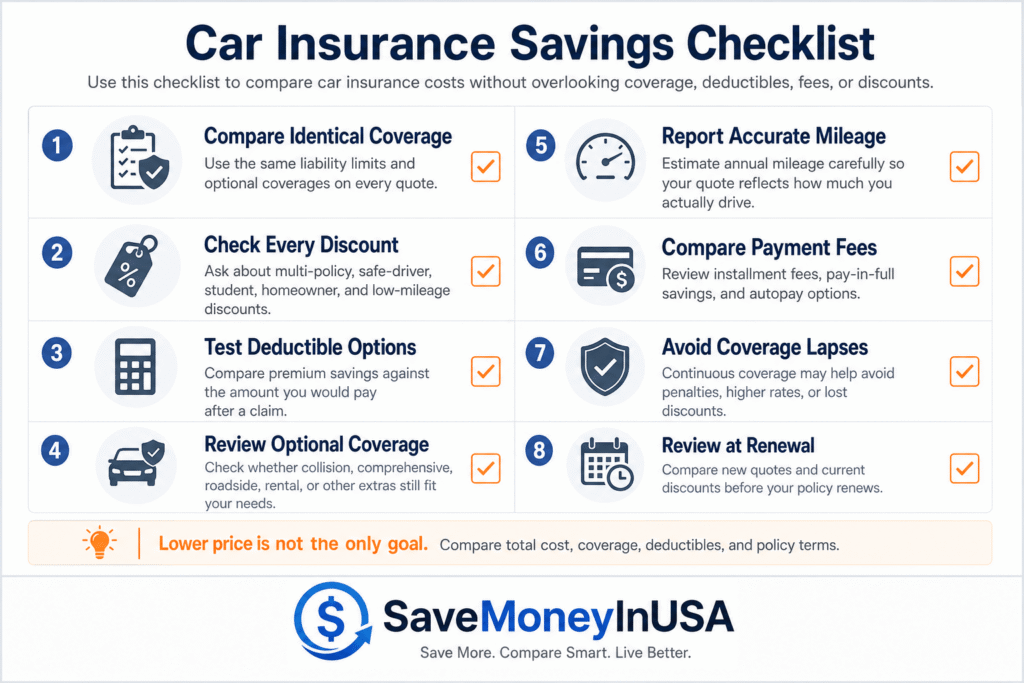
A Simple Car Insurance Savings Checklist
- Use the current declarations page when requesting quotes.
- Compare several insurers with identical limits and deductibles.
- Review total policy cost, fees, and payment terms.
- Ask for a complete discount review.
- Test different deductible levels without choosing one you cannot afford.
- Verify mileage, vehicle use, drivers, and safety equipment.
- Review optional coverage and avoid duplicate benefits.
- Activate replacement coverage before canceling the old policy.
Common Mistakes That Can Cost More
- Choosing the lowest monthly price: The quote may include weaker coverage, a higher deductible, or extra installment fees.
- Carrying only state minimum liability without considering the risk: You may be personally responsible for losses above the policy limits.
- Raising the deductible without emergency savings: A lower premium is not useful if you cannot afford to repair the car after a claim.
- Assuming loyalty always produces the best price: Renewal pricing and competing offers can change.
- Letting coverage lapse while shopping: This creates immediate financial and legal risk and may affect future pricing.
- Hiding a driver or misstating use: Incorrect information can create underwriting or claim problems.
Frequently Asked Questions
What is the fastest way to lower car insurance?
Compare several equivalent quotes and ask your current insurer for a complete discount review. These steps can reveal savings without immediately reducing coverage.
Does a higher deductible always save money?
A higher deductible generally lowers the premium, but it increases your share of a covered collision or comprehensive claim. It only makes sense if the premium reduction is worthwhile and you can pay the deductible at any time.
Should I switch car insurance companies every year?
Not necessarily. Compare around renewal to test the market, then evaluate price, coverage, deductibles, fees, claims service, and discounts. Keep the current policy if it still provides the best overall value.
Can I save by removing collision and comprehensive coverage?
Possibly, if you own the vehicle outright. Before removing coverage, compare its cost with the vehicle’s value and decide whether you could afford repair or replacement after theft, weather damage, or an at-fault collision. Lenders and lessors normally require both coverages.
Will comparing car insurance quotes hurt my credit score?
Generally, requesting insurance quotes does not create the hard inquiry associated with applying for a loan or credit card. Insurers may use credit-based insurance information where state law allows, but quote shopping itself normally does not lower your consumer credit score.
The Bottom Line
The best car insurance savings strategy combines price comparison with careful coverage decisions. Compare equivalent quotes, claim applicable discounts, choose an affordable deductible, report accurate information, avoid coverage lapses, and review the policy whenever your life or vehicle changes.
A lower premium is only a real saving when the policy still protects you against losses you cannot comfortably pay yourself.
Sources
- National Association of Insurance Commissioners — Comparing Online Auto Insurance Quotes
- National Association of Insurance Commissioners — A Consumer’s Guide to Auto Insurance
- National Association of Insurance Commissioners — Auto Insurance Shopping Tool
About the Author
The SaveMoneyInUSA Editorial Team researches car insurance costs, coverage options, state requirements, discounts, and quote-comparison considerations for drivers in the United States.
Learn more about our Editorial Team and Editorial Guidelines.
Disclaimer
SaveMoneyInUSA is an independent informational website and is not an insurance company, broker, or agent.
Some links may be affiliate links. We may receive compensation from partners at no additional cost to users.
Insurance rates, coverage options, rating factors, discounts, and eligibility vary by provider, state law, and individual circumstances.
This content is provided for educational purposes only and should not be considered insurance, legal, or financial advice.