

Last Updated: August 2026
Lowering your car insurance premium does not always require reducing important coverage. Some changes, such as comparing equivalent quotes, confirming discounts, updating your mileage, or changing your payment method, may affect your cost relatively quickly. Other improvements, including maintaining a clean driving record or correcting credit-report errors, may take longer.
The right strategy depends on your location, driving history, vehicle, coverage limits, deductibles, insurer, and household circumstances. A method that lowers one driver’s premium may have little effect for another.
Quick answer: Start by comparing at least three quotes using identical coverage, asking your current insurer to review every available discount, and checking whether your mileage, deductibles, payment schedule, and vehicle use are accurate. Do not reduce liability limits or remove collision or comprehensive coverage before evaluating the financial risk and any lender requirements. The amount you may save depends on your insurer, state, vehicle, driver profile, and policy choices.

Before making any changes, use your current declarations page and renewal notice as a baseline. Record the full policy-term premium, liability limits, deductibles, optional coverages, discounts, listed drivers and vehicles, payment fees, and effective dates. This makes it easier to identify whether a new quote is genuinely cheaper or simply provides less protection.
Why Your Car Insurance Premium May Be High
Auto insurers use many factors to estimate the likelihood and potential cost of future claims. Each company applies its own underwriting rules, rating methods, discount structure, and eligibility requirements, which is why two insurers may quote very different prices for the same driver.
Factors that may affect your premium include:
- Your state, ZIP code, and local claim patterns
- Your driving record and years of driving experience
- The drivers and vehicles listed on the policy
- Your vehicle’s value, repair costs, safety features, and theft risk
- Your liability limits and optional coverages
- Your collision and comprehensive deductibles
- Your annual mileage and how the vehicle is used
- Accidents, claims, moving violations, or coverage gaps
- Available household, vehicle, payment, and driver discounts
- Credit-based insurance information where state law permits its use
Your premium may also increase at renewal even when your personal circumstances have not changed. Insurers may revise rates because of changes in repair costs, medical expenses, claim frequency, vehicle theft, severe weather, litigation, and other market conditions.
This makes it important to review the renewal documents rather than assuming that your current insurer will remain competitive every year.
Fastest Ways to Lower Your Car Insurance Premium
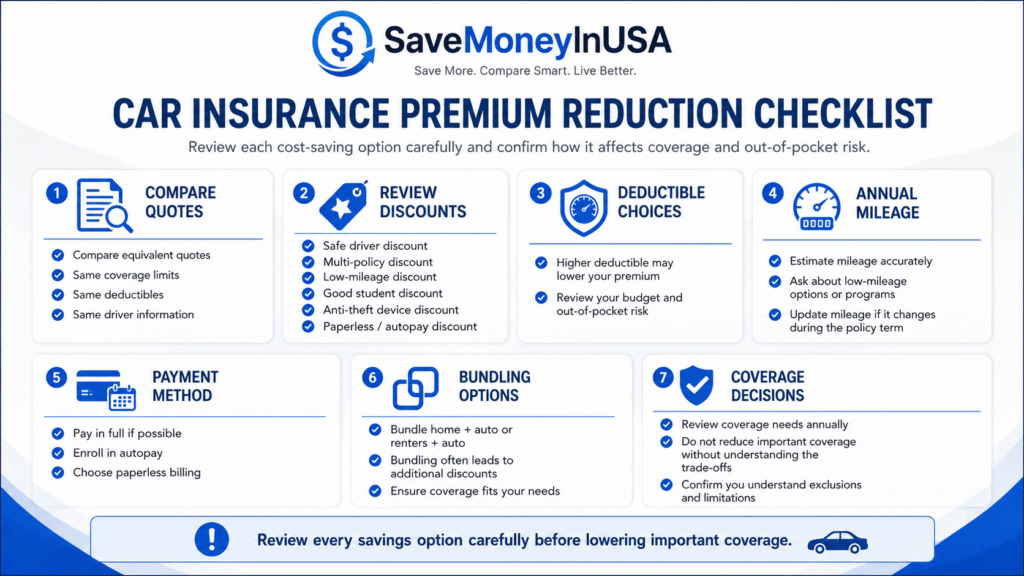
The following steps may produce relatively quick results because they can be reviewed when requesting a new quote or changing an existing policy. Savings are not guaranteed, and each change should be evaluated against its effect on coverage and out-of-pocket risk.
1. Compare equivalent quotes from several insurers
Comparing quotes is one of the most direct ways to find out whether another insurer offers a lower price for similar protection. Since insurers evaluate risk differently, your current company may not remain the most affordable option after a move, renewal increase, vehicle change, or change in driving history.
Use identical information for every quote, including:
- Drivers and vehicles
- Annual mileage and vehicle use
- Liability coverage limits
- Collision and comprehensive deductibles
- Uninsured or underinsured motorist coverage
- Rental reimbursement, roadside assistance, and other optional coverage
A quote that uses lower liability limits or removes optional coverage is not directly comparable to your current policy. Follow our guide on how to compare car insurance quotes before choosing the lowest displayed price.
2. Ask the insurer to review every available discount
Discounts vary considerably by insurer and state. Do not assume that every eligible discount has been applied automatically. Ask the company or agent to review your policy line by line.
Possible discounts may relate to:
- Multiple vehicles
- Bundling auto with homeowners or renters insurance
- Safe-driving history
- Good student status
- Low annual mileage
- Approved driver education or defensive-driving courses
- Vehicle safety or anti-theft equipment
- Automatic payments or paperless billing
- Paying the policy premium in full
- Employer, association, professional, or membership eligibility
Ask whether each discount is permanent, temporary, conditional, or dependent on continued participation in a program. A large introductory discount may not continue at the same level during future renewals.
3. Consider a higher deductible carefully
Choosing a higher collision or comprehensive deductible will often lower the premium for those coverages. However, the deductible is the amount you are responsible for paying after a covered loss before the insurer pays the remaining eligible amount.
Before increasing a deductible from $500 to $1,000 or another amount, ask yourself whether you could pay the higher amount immediately after an accident, theft, or weather-related loss.
A lower premium is not a good trade if the deductible would prevent you from repairing or replacing your vehicle. Compare the premium reduction with the additional financial risk rather than selecting the highest deductible automatically.
For a closer comparison, review our guides to how car insurance deductibles work and deductibles versus premiums.
4. Update your mileage and vehicle use
Your insurer may still be using an older estimate of how much you drive. If you now work from home, have a shorter commute, retired, changed jobs, or use another vehicle for most trips, ask whether your annual mileage and vehicle-use classification should be updated.
Provide an honest estimate. Underreporting mileage or describing a commuting vehicle as pleasure-only could create policy or claim problems. The goal is to make sure the insurer has accurate information, not to artificially lower the quote.
5. Review payment and billing options
Some policies include installment or service fees when the premium is paid monthly. Ask for the total six-month or annual cost under different payment schedules.
Paying the premium in full or using automatic payments may reduce fees or qualify for a discount with some insurers. However, do not use high-interest credit-card debt simply to obtain a small insurance discount. Compare the discount with the cost and effect on your cash flow.
See our guide on paying car insurance in full versus monthly before changing your payment schedule.
6. Check whether bundling is actually cheaper
Combining auto insurance with homeowners, renters, or another policy may qualify you for a multi-policy discount. Bundling can also simplify billing and policy management.
Nevertheless, a bundled package is not automatically the lowest-cost option. Compare the total cost of all policies together. One company may offer a large auto discount but charge more for homeowners or renters insurance.
Quick review: Ask your current insurer for a new discount review and updated mileage estimate. Then request several outside quotes using the same limits, deductibles, drivers, and vehicles. These steps may identify savings without immediately reducing coverage.
Longer-Term Ways to Reduce Car Insurance Costs
Some factors cannot be changed immediately, but they may affect your options over time. These strategies are most useful as part of an ongoing effort to maintain a lower-risk insurance profile.
Maintain a safe driving record
Accidents, moving violations, and serious offenses can affect eligibility and pricing for several years, depending on the insurer and state. Avoiding new incidents may gradually improve the range of quotes available to you as older violations or claims become less relevant under an insurer’s rating rules.
Drive defensively, avoid distracted driving, obey speed limits, and never drive while impaired. These habits matter more than any short-term discount because they also reduce the risk of injury, property damage, deductibles, and uninsured losses.
Review credit reports where credit-related insurance information is used
In states where permitted, insurers may use credit-related information as one factor in underwriting or pricing. The rules differ by state, and the insurance score used by an insurer is not necessarily the same as the consumer credit score displayed by a bank or credit-card company.
Review your credit reports for inaccurate accounts, balances, payment histories, or identity-related errors. Correcting inaccurate information is different from trying to manipulate an insurance score, and a correction may take time to appear in the information used by insurers.
Our guide on how credit-related information may affect car insurance explains this issue in greater detail.
Consider insurance cost before buying another vehicle
The purchase price is not the only cost of owning a vehicle. Repair costs, replacement parts, theft frequency, safety features, performance, vehicle value, and claim history for a particular model may affect insurance pricing.
Before buying or leasing a vehicle, request insurance estimates using the exact year, make, model, trim, and vehicle identification information when available. A vehicle with an affordable loan payment can still be expensive to insure.
Avoid unnecessary coverage gaps
Allowing a policy to lapse may create legal, financial, lender, registration, and future insurance problems. Some insurers may also treat a period without prior insurance differently when evaluating a new application.
When switching companies, activate the replacement policy before cancelling the existing policy. A quote, application, or payment screen does not always mean that coverage has been issued. Confirm the effective date and obtain proof of insurance first.
Should You Reduce Coverage to Save Money?
Reducing coverage can lower a premium, but it can also transfer substantially more financial risk to you. Do not remove coverage only because the monthly payment appears high.
Review liability limits before lowering them
Liability insurance helps pay eligible costs when you are legally responsible for injuring another person or damaging someone else’s property. State minimum limits may not be enough for a serious accident.
A lower limit may reduce the premium, but damages above the policy limit could become your personal responsibility. Consider your income, savings, assets, household needs, and potential legal exposure before reducing liability protection.
Evaluate collision and comprehensive separately
Collision generally covers eligible damage to your vehicle from a collision, while comprehensive generally covers certain non-collision losses such as theft, vandalism, fire, falling objects, weather, or animal-related damage, subject to the policy terms.
For an older vehicle, compare the annual cost of each coverage with the vehicle’s current value, deductible, and the maximum amount the insurer might pay after a total loss. Also consider whether you could replace the vehicle without insurance proceeds.
You do not necessarily have to remove both coverages at the same time. Depending on your vehicle and local risks, keeping comprehensive while reconsidering collision—or changing the deductible—may be worth discussing with an insurer or agent.
Check lender or lease requirements
If your vehicle is financed or leased, the lender or leasing company will generally require certain physical damage coverages. Removing required coverage may violate the contract and can lead to lender-placed coverage or other consequences.
Before making changes, review full coverage versus liability insurance and our guide to choosing appropriate car insurance coverage.
Coverage warning: A cheaper policy is not necessarily a better policy. Confirm that you understand every reduction in limits or coverage and that you could absorb the resulting out-of-pocket loss.
How to Compare Potential Savings Correctly
Do not compare quotes only by monthly payment. A policy may appear cheaper because it uses a longer payment schedule, requires a larger initial payment, includes lower coverage limits, charges installment fees, or applies temporary discounts.
Use a comparison table like the one below for every serious quote:
| Item to Compare | Current Policy | New Quote |
|---|---|---|
| Six-month or annual premium | Record total cost | Record total cost |
| Liability limits | Confirm limits | Use matching limits |
| Collision deductible | Confirm amount | Use matching amount |
| Comprehensive deductible | Confirm amount | Use matching amount |
| Optional coverage | List each coverage | Confirm same coverage |
| Discounts | Confirm eligibility | Confirm eligibility and duration |
| Down payment and fees | Record amounts | Record amounts |
| Effective date | Current coverage | Confirm before cancelling |
After identifying the lower-cost policies, compare claims reporting, payment flexibility, agent access, online tools, exclusions, endorsements, and customer-service options. A small difference in price may not justify a policy that does not fit your needs.
Common Mistakes That Can Increase Your Insurance Costs
Comparing only the monthly payment
A lower monthly bill may include a longer payment schedule, higher fees, a larger down payment, or less coverage. Compare the complete policy-term cost.
Using different coverage for each quote
A quote with lower limits and higher deductibles will naturally look cheaper. Standardize the coverage before comparing companies.
Increasing the deductible beyond your available savings
A deductible should be an amount you could reasonably pay after an unexpected loss. Do not assume that you will have time to save the money after an accident.
Removing coverage without checking the loan or lease
Lenders and leasing companies may require collision, comprehensive, and specific deductibles. Check the contract before changing the policy.
Failing to update household or vehicle information
Tell the insurer about changes involving drivers, addresses, vehicles, commuting, mileage, garaging, or vehicle use. Accurate information helps avoid incorrect pricing and possible claim disputes.
Cancelling before replacement coverage begins
Confirm that the replacement policy has been issued, verify the effective date and time, and obtain proof of insurance before cancelling your current policy.
When Should You Shop for New Car Insurance Quotes?
It is useful to review your policy around each renewal and after a meaningful change in your driving or household situation.
Consider requesting new quotes when:
- Your renewal premium increases significantly
- You move to a different ZIP code or state
- You add or remove a vehicle or driver
- You buy, finance, lease, or pay off a vehicle
- Your annual mileage or commuting pattern changes
- An accident or violation becomes older
- A young driver gains more experience or qualifies for a student discount
- You purchase a home, rent a new residence, or become eligible to bundle policies
- Your current insurer removes a discount or changes a driving-monitoring program
Do not switch automatically after receiving one low quote. Include several insurers when possible and review our comparison of cheap car insurance companies worth comparing.
Frequently Asked Questions About Lowering Car Insurance Premiums
What is the fastest way to lower a car insurance premium?
Requesting equivalent quotes, confirming available discounts, updating mileage, reviewing billing options, and evaluating deductibles may produce relatively quick results. The best method depends on your insurer and driver profile, and no specific amount of savings is guaranteed.
Will increasing my deductible lower my premium?
A higher collision or comprehensive deductible will often reduce the cost of those coverages. The exact difference varies. Choose a deductible you could afford after a claim rather than focusing only on the premium reduction.
Should I reduce liability limits to save money?
Reducing liability limits may lower the premium, but it also increases your personal exposure if damages exceed the policy limit. State minimum coverage may not be enough for a serious accident. Review your financial circumstances and risk before lowering limits.
Can I remove full coverage from an older car?
You may be able to reconsider collision or comprehensive coverage on an older vehicle, but “full coverage” is not a single standardized policy. Evaluate each coverage separately, including its premium, deductible, vehicle value, local risks, and your ability to replace the car. Financed or leased vehicles may be subject to lender requirements.
Does comparing car insurance quotes hurt my credit score?
Generally, requesting car insurance quotes does not create the type of hard credit inquiry associated with applying for a loan or credit card and normally does not lower a consumer credit score. Where state law permits, an insurer may still obtain credit-related information to help calculate a separate credit-based insurance score. State restrictions and insurer practices vary. For more information, review our guide on how credit-related information may affect car insurance rates.
Does paying car insurance in full save money?
Some insurers offer a paid-in-full discount or charge fewer installment fees. Compare the total cost under each payment option and make sure paying in full will not create cash-flow problems or expensive credit-card debt.
How often should I compare car insurance rates?
Reviewing your policy around each renewal is a practical approach. It may also be useful to compare after moving, changing vehicles or drivers, reducing mileage, paying off a loan, or experiencing a substantial premium increase.
Final Thoughts on Lowering Your Car Insurance Premium
Lowering your car insurance premium should begin with accurate information and equivalent comparisons. Ask your current insurer to review discounts, mileage, payment options, and deductibles, then compare several outside quotes using the same coverage.
Avoid reducing liability limits or removing collision and comprehensive coverage without considering the financial consequences. The goal is not simply to find the smallest monthly payment. It is to find a reasonable total cost for protection that fits your vehicle, legal obligations, finances, and risk tolerance.
Sources
- National Association of Insurance Commissioners — A Shopping Tool for Auto Insurance
- National Association of Insurance Commissioners — Auto Insurance Consumer Information
- California Department of Insurance — Shopping for Automobile Insurance
- California Department of Insurance — Automobile Insurance Guide
- Consumer Financial Protection Bureau — Insurance Claims and Consumer Reports
- Consumer Financial Protection Bureau — Consumer Reporting Companies
Insurance prices, discounts, underwriting rules, coverage requirements, and eligibility vary by insurer and state and may change over time. Confirm current policy terms with a licensed insurer or insurance professional before making a coverage decision.
About the Author
The SaveMoneyInUSA Editorial Team researches car insurance costs, coverage options, state requirements, and quote comparison considerations for drivers in the United States.
Learn more about our Editorial Team.
Disclaimer
SaveMoneyInUSA is an independent informational website and is not an insurance company, broker, or agent.
Some links may be affiliate links. We may receive compensation from partners at no additional cost to users.
Insurance rates, coverage options, and eligibility vary by provider and individual circumstances.
This content is provided for educational purposes only and should not be considered insurance, legal, or financial advice.