

Last Updated: August 2026

Getting car insurance for the first time can be expensive and confusing. A new driver may have little or no insurance history, limited driving experience, and no established record showing how safely they drive. Insurers may therefore charge more until they have enough information to evaluate the risk.
The best car insurance for a new driver is not automatically the company with the lowest advertised price. A suitable policy should combine an affordable premium, enough liability protection, manageable deductibles, useful discounts, and reliable claims service. Rates can vary widely by driver, vehicle, ZIP code, state, coverage level, and insurer, so comparing the same coverage with several companies is essential.
This guide explains which insurers may be worth comparing, what coverage a new driver may need, and how to reduce the cost without leaving major protection gaps.
Comparing quotes is generally free and normally does not lower your consumer credit score. Where permitted by state law, insurers may still use credit-related information to calculate a separate credit-based insurance score.
Quick Answer: What Is the Best Car Insurance for New Drivers?
There is no single car insurance company that is best for every new driver. GEICO may be worth comparing for eligible student and multi-vehicle discounts. State Farm may appeal to drivers who prefer local-agent support and may offer Steer Clear or another inexperienced-driver program where available. Progressive offers Snapshot, while Nationwide offers SmartRide and SmartMiles in participating states. Allstate may be relevant for households comparing agent service, bundling, and available driving-based programs. USAA is available only to eligible military members and qualifying family members.
The practical approach is to request several quotes using the same drivers, vehicles, liability limits, deductibles, and optional coverages. A lower quote may simply provide less protection if the policies are not equivalent. Follow our step-by-step guide to comparing car insurance quotes before selecting a policy.
Why Car Insurance Costs More for New Drivers
Insurers price policies according to expected risk. A driver with several years of claim-free experience gives an insurer more information than someone who was recently licensed or has never carried a policy. New drivers may therefore face higher premiums because the insurer has limited individual driving data and must rely more heavily on broader risk factors.
- Limited driving experience: A recently licensed driver has had less time to develop judgment in traffic, poor weather, nighttime driving, and emergency situations.
- No established insurance history: A first-time policyholder may not yet have a continuous coverage record.
- Age-related risk: Many new drivers are teenagers or young adults, although a new driver can be any age.
- Vehicle and location: Repair cost, theft frequency, annual mileage, ZIP code, and where the car is parked can affect the premium.
- Coverage choices: Higher limits, collision, comprehensive, rental reimbursement, and lower deductibles generally increase the price.
A higher starting premium does not necessarily last forever. Maintaining continuous coverage, avoiding tickets and at-fault accidents, and building a longer driving record may improve future pricing. However, insurers use different rating systems, so the size and timing of any reduction will vary.
Car Insurance Companies New Drivers Should Compare
The companies below are not ranked as universally cheapest. They are included because they offer features, discounts, agent support, or driving programs that may be relevant to new drivers. Availability and eligibility vary by state.
| Company | Why a New Driver May Compare It | Important Consideration |
|---|---|---|
| GEICO | Good student, multi-vehicle, multi-policy, and other discounts may be available. | Eligibility and final pricing vary by state, driver, vehicle, and coverage selection. |
| State Farm | Local-agent support and inexperienced-driver programs may appeal to younger or newly licensed drivers. | Steer Clear is not available in every state, and eligibility requirements vary. |
| Progressive | Snapshot may personalize pricing using driving behavior, and student-related discounts may be available. | Depending on the state and driving results, Snapshot may result in a discount or a higher renewal rate. |
| Nationwide | SmartRide may reward safer driving, while SmartMiles may suit eligible low-mileage drivers. | Program availability, eligibility, and discount calculations vary by state. |
| Allstate | May be worth comparing for agent access, family bundling, student discounts, and Drivewise where available. | Drivewise savings are not available in every state, including California and Alaska. |
| USAA | May be worth checking for eligible military members and qualifying family members. | USAA membership and auto insurance eligibility are restricted. |
GEICO
GEICO is worth comparing when a household may qualify for a good student, multi-vehicle, multi-policy, or other discount. Its online quote and policy tools may also suit drivers who prefer managing insurance digitally. A discount does not guarantee the lowest final premium, so compare the complete policy with other insurers.
State Farm
State Farm may be worth comparing for new drivers who value local-agent support. Its Steer Clear program combines training content with documented driving practice for eligible drivers, but program availability and qualification rules vary by state. Steer Clear is not available in several states, including California, where a different inexperienced-driver education discount may apply. Confirm the current age, licensing, driving-history, and state requirements with State Farm before assuming the driver qualifies.
Progressive
Progressive may be useful for drivers who want to try usage-based insurance through Snapshot. The program considers actual driving behavior, but drivers should understand what is measured and whether higher-risk driving could affect renewal pricing in their state. Progressive also advertises student-related discounts with eligibility rules that vary by location.
Nationwide
Nationwide offers SmartRide for eligible drivers who want feedback and possible savings based on safer driving. Its SmartMiles program may also be relevant to drivers who use a vehicle infrequently. These options are most useful when the driver is comfortable sharing driving or mileage data and the programs are offered in the state.
Allstate and USAA
Allstate may be worth including when a household wants to compare agent service, bundling, student discounts, and available driving-based programs. However, Drivewise savings are not available in California or Alaska. USAA should be considered separately because membership and auto insurance eligibility are generally limited to eligible military members, veterans who meet its requirements, and qualifying family members. Neither company should be selected without comparing the same limits, deductibles, and optional coverages offered by competing insurers.
Should a New Driver Stay on a Parent’s Policy?
For a teen or young adult who lives with a parent and regularly drives a household vehicle, being added to the family policy is often simpler and may cost less than buying a separate policy. The family may also retain multi-car, bundling, or loyalty discounts. However, the insurer must be told about all household drivers who regularly use the insured vehicles.
A separate policy may be necessary when the new driver owns a vehicle titled in their own name, lives at a different permanent address, or no longer meets the insurer’s household rules. The correct arrangement depends on vehicle ownership, residence, usage, state law, and the insurer’s underwriting requirements.
Decision point: Do not keep a regular household driver hidden from the insurer to avoid a premium increase. An undisclosed driver can create underwriting problems and may complicate a future claim.
What Coverage Does a New Driver Need?
A new driver must first meet the insurance requirements of the state where the vehicle is registered. State minimum liability limits are only a legal floor, not a guarantee that the policy will cover the full cost of a serious accident.
- Bodily injury liability: Helps pay for injuries the insured driver causes to other people, subject to policy limits.
- Property damage liability: Helps pay for damage the insured driver causes to another person’s vehicle or property.
- Uninsured or underinsured motorist coverage: May help when the at-fault driver has no insurance or insufficient limits, depending on state rules and policy terms.
- Collision coverage: Helps pay for damage to the insured vehicle after a covered collision, minus the deductible.
- Comprehensive coverage: Helps cover certain non-collision losses, such as theft, vandalism, falling objects, or weather damage, minus the deductible.
- Medical payments or personal injury protection: Availability and requirements depend on the state.
A financed or leased vehicle will usually require collision and comprehensive coverage under the loan or lease agreement. For an older vehicle owned outright, the driver can compare the annual cost of these coverages with the vehicle’s value and the amount they could afford to replace or repair.
Read our comparison of full coverage vs. liability insurance and review the minimum car insurance requirements by state before choosing limits.
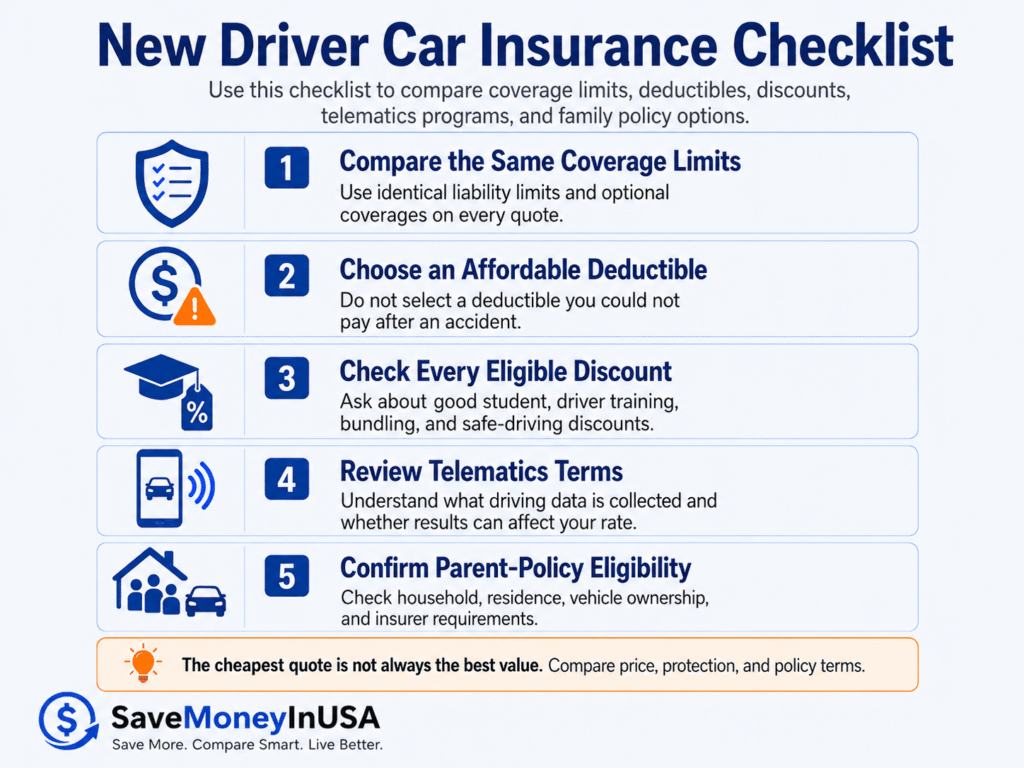
New Driver Coverage Decision Guide
| Situation | Coverage Direction to Consider | Main Risk to Review |
|---|---|---|
| Financed or leased newer car | Liability plus collision and comprehensive, subject to lender requirements | A high deductible may be difficult to pay after a claim |
| Older car owned outright | Compare liability-only with the cost of keeping physical damage coverage | Liability-only does not pay to repair the insured vehicle after an at-fault collision |
| Teen on a household policy | Ask about being added to the family policy and all available student or training discounts | All regular household drivers and vehicle use must be disclosed accurately |
| Low-mileage new driver | Compare traditional and mileage- or usage-based programs | Understand data collection and how driving behavior affects pricing |
| New driver with limited savings | Choose a deductible that could realistically be paid immediately | A very high deductible may lower the premium but make a claim unaffordable |
How New Drivers Can Lower Car Insurance Costs
1. Compare Identical Quotes
Use the same liability limits, deductibles, drivers, vehicle usage, annual mileage, and optional coverages on every quote. One insurer may be cheaper for a teen on a family policy, while another may be more competitive for an adult who was licensed later in life.
2. Ask About Every Relevant Discount
Potential discounts may include good student, driver training, distant student, multi-vehicle, multi-policy, paid-in-full, paperless billing, automatic payment, vehicle safety equipment, and usage-based insurance. Eligibility, savings, and availability vary, and discounts may not apply to every part of the premium.
3. Choose the Vehicle Before Buying It
Insurance should be checked before purchasing a vehicle. Repair cost, theft experience, safety technology, engine performance, and claim history can make two similarly priced vehicles very different to insure. Request quotes using the exact vehicle identification number when possible.
4. Select a Deductible You Can Actually Pay
Raising a collision or comprehensive deductible may reduce the premium, but it also increases the amount the policyholder must pay after a covered loss. A new driver should avoid choosing a deductible that would require new debt or prevent necessary repairs. See our guide to choosing a car insurance deductible.
5. Consider Telematics Carefully
Usage-based insurance may benefit some careful or low-mileage drivers, but programs do not all work the same way. Progressive states that Snapshot may produce a discount or, in some states, a higher renewal rate when the recorded driving indicates higher risk. Nationwide describes SmartRide as a discount program that does not raise the rate based on SmartRide results, although the earned discount could be zero. Before enrolling, review what is measured, how long monitoring lasts, whether phone activity is tracked, how household trips are classified, and whether participation can increase the premium or only affect the available discount.
6. Maintain Continuous Coverage and a Clean Record
Pay premiums on time, avoid coverage lapses, drive defensively, and correct policy information promptly. Tickets, at-fault accidents, and insurance gaps can reduce the number of affordable options. More ideas are available in our guide on how to lower your car insurance premium.
Does Credit History Affect a New Driver’s Rate?
In many states, insurers may use a credit-based insurance score as one factor in pricing or underwriting, subject to state law. This is not the same as the consumer credit score commonly shown by a bank or credit card account. Some states restrict or prohibit the use of credit information for auto insurance.
A young driver with little credit history may still be affected by other rating factors, including driving experience, vehicle, location, coverage, and whether the driver is added to a household policy. An adult who is newly licensed may have a longer credit history but still face a new-driver surcharge because of limited driving experience.
Learn more in How Credit Score Affects Car Insurance Rates in the USA.
Common Mistakes New Drivers Should Avoid
- Buying only the state minimum without reviewing assets and accident risk.
- Comparing monthly payments instead of the total six- or twelve-month premium.
- Choosing different limits on different quotes and assuming the cheapest quote is equivalent.
- Using an unrealistically low annual mileage estimate.
- Failing to disclose a regular household driver or the actual garaging address.
- Selecting a deductible that cannot be paid after a claim.
- Assuming a telematics program always lowers the rate.
- Allowing a policy to lapse while shopping for another insurer.
Frequently Asked Questions
Who is considered a new driver?
A new driver is generally someone with little driving or insurance history. The person may be a teenager, a young adult, an immigrant recently licensed in the United States, or an older adult who learned to drive later. Insurer definitions and rating periods vary.
Is it cheaper for a new driver to join a parent’s policy?
It often is, particularly when the driver lives in the household and uses a family vehicle. However, vehicle ownership, residence, household rules, and underwriting requirements determine whether the arrangement is permitted.
At what age does car insurance become cheaper?
There is no guaranteed age when the premium drops. Age may become less influential as a driver gains experience, but the rate also depends on accidents, tickets, claims, location, vehicle, coverage, credit-related factors where permitted, and the insurer’s rating model.
Should a new driver buy full coverage?
A financed or leased vehicle will generally require collision and comprehensive coverage. For a vehicle owned outright, compare the coverage cost with the car’s value, the deductible, and the driver’s ability to replace or repair the vehicle after a loss.
Can a defensive driving course lower the premium?
Some insurers and states offer discounts for approved courses, but not every course qualifies and the rules can differ by age and location. Confirm eligibility with the insurer before paying for a class.
How many car insurance quotes should a new driver compare?
Comparing at least three quotes is a practical starting point, but more may be useful when the premiums differ substantially. Include both large national insurers and reputable regional companies available in the state.
Final Thoughts
The best car insurance for a new driver is the policy that provides adequate protection at a sustainable total cost. Start by deciding on appropriate liability limits and deductibles, then request multiple quotes with identical information. Ask about student, training, household, bundling, and safe-driving discounts, but judge each insurer by the final premium, coverage, exclusions, and claims support—not by the number of advertised discounts.
Review the policy again when the driver gains experience, changes vehicles, moves, completes a training program, or becomes eligible for a new discount. A company that is competitive today may not remain the best option at the next renewal.
Sources
- National Association of Insurance Commissioners: Auto Insurance Consumer Resources
- NAIC: Protect Yourself When Insuring a Teen Driver
- NAIC: Credit-Based Insurance Scores and Auto Insurance Premiums
- Consumer Financial Protection Bureau: Auto Insurance When Financing a Vehicle
- GEICO: Car Insurance for Teens and New Drivers
- State Farm: Steer Clear Safe Driver Program
- Progressive: Snapshot Usage-Based Insurance
- Nationwide: SmartRide and SmartMiles Programs
- Allstate: Drivewise Availability and Program Information
- USAA: Membership Eligibility
About the Author
The SaveMoneyInUSA Editorial Team researches car insurance costs, coverage options, state requirements, and quote comparison considerations for drivers in the United States.
Learn more about our Editorial Team.
Disclaimer
SaveMoneyInUSA is an independent informational website and is not an insurance company, broker, or agent.
Some links may be affiliate links. We may receive compensation from partners at no additional cost to users.
Insurance rates, coverage options, discounts, program availability, and eligibility vary by provider, state, policy, and individual circumstances.
This content is provided for educational purposes only and should not be considered insurance, legal, or financial advice. Review policy documents and confirm current details with the insurer or a licensed insurance professional before making a coverage decision.