

Last Updated: August 2026
Finding cheap car insurance is not simply about choosing the company with the lowest advertised rate. The most affordable insurer for one driver may be expensive for another because rates depend on location, driving history, vehicle type, coverage limits, age, and other personal factors.
Quick answer: There is no single cheapest car insurance company for every driver. GEICO, State Farm, Progressive, and Allstate are major insurers worth including in a comparison, but the lowest price depends on your state, driving record, vehicle, coverage, deductibles, mileage, discounts, and other permitted rating factors. Compare at least three quotes using identical coverage and review the total policy cost—not only the monthly payment.
Before comparing companies, make sure you understand the protection you need. Our guide to choosing the right car insurance coverage explains the main coverage options and how they affect your policy.
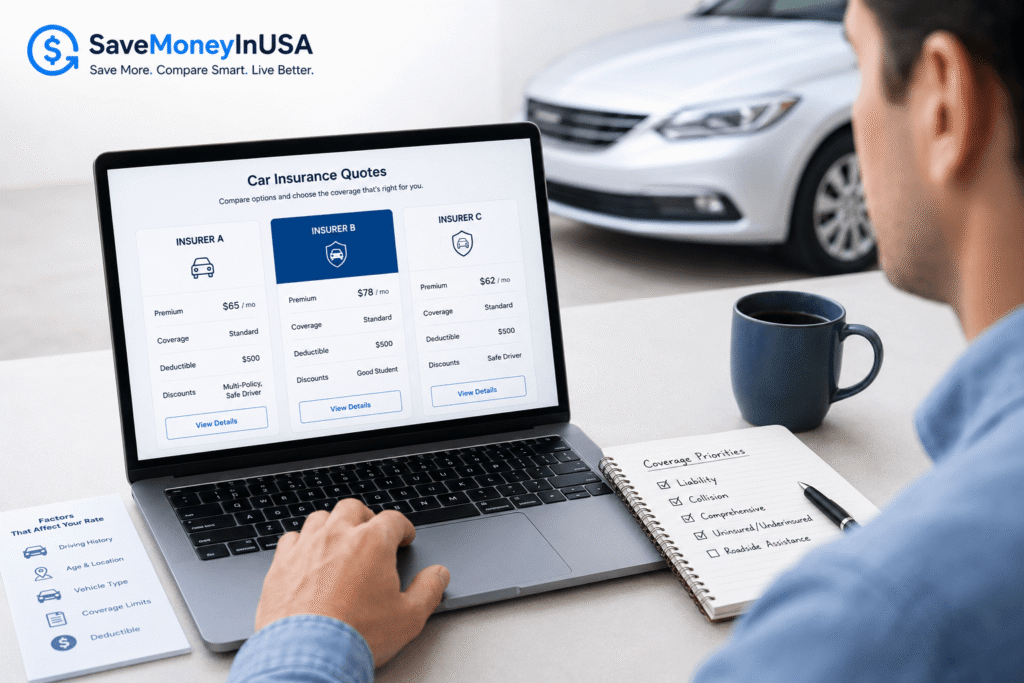
Because insurers use different pricing methods, comparing several quotes with matching coverage is usually more reliable than selecting a company based only on a national ranking.
What Makes a Car Insurance Company Cheap?
A cheap car insurance company is not necessarily the insurer with the lowest advertised price. A policy is only affordable when its premium, coverage limits, deductible, fees, discounts, and claims service provide reasonable overall value for the driver.
When evaluating whether an insurer is truly affordable, compare the following factors:
The total policy cost
Look beyond the monthly payment. Compare the full six-month or annual premium, installment fees, down payment requirements, and any other charges. A policy with a low monthly payment may cost more overall if it includes additional billing fees.
Coverage limits and deductibles
Two quotes are not directly comparable unless they include the same liability limits, deductibles, and optional coverages. A lower-priced policy may simply provide less protection or require you to pay more out of pocket after a covered claim.
Discounts you can actually use
Insurers may offer discounts for safe driving, multiple vehicles, bundling home and auto insurance, automatic payments, low mileage, good student status, or vehicle safety features. The most affordable company may be the one that offers discounts that match your actual situation.
Claims and customer service
Price matters, but an insurer should also provide clear policy information, accessible customer support, and a dependable claims process. Extremely low premiums may offer little value if the policy is difficult to manage or the company does not meet your service needs.
Rates for your driver profile
Insurance companies do not charge every driver the same way. One insurer may be competitive for a driver with a clean record, while another may offer better pricing for a young driver, a driver with poor credit, or someone who needs an SR-22 filing.
The best way to identify an affordable insurer is to request several quotes using the same driver information and identical coverage choices. Our guide on how to compare car insurance quotes explains how to make an accurate side-by-side comparison.
How We Selected Companies for This Comparison
The companies in this guide were selected as major insurers worth including in a quote comparison—not because one company is guaranteed to offer the lowest rate. We reviewed publicly available information about auto insurance availability, discount programs, policy-management options, agent access, and usage-based driving programs.
We did not rank these insurers using a single national average because published averages cannot predict an individual driver’s price. Inclusion in this guide is not an endorsement, and no company paid for its position in the comparison. Availability, eligibility, discounts, underwriting decisions, and final premiums vary by state and applicant.
Best Cheap Car Insurance Companies to Compare in 2026
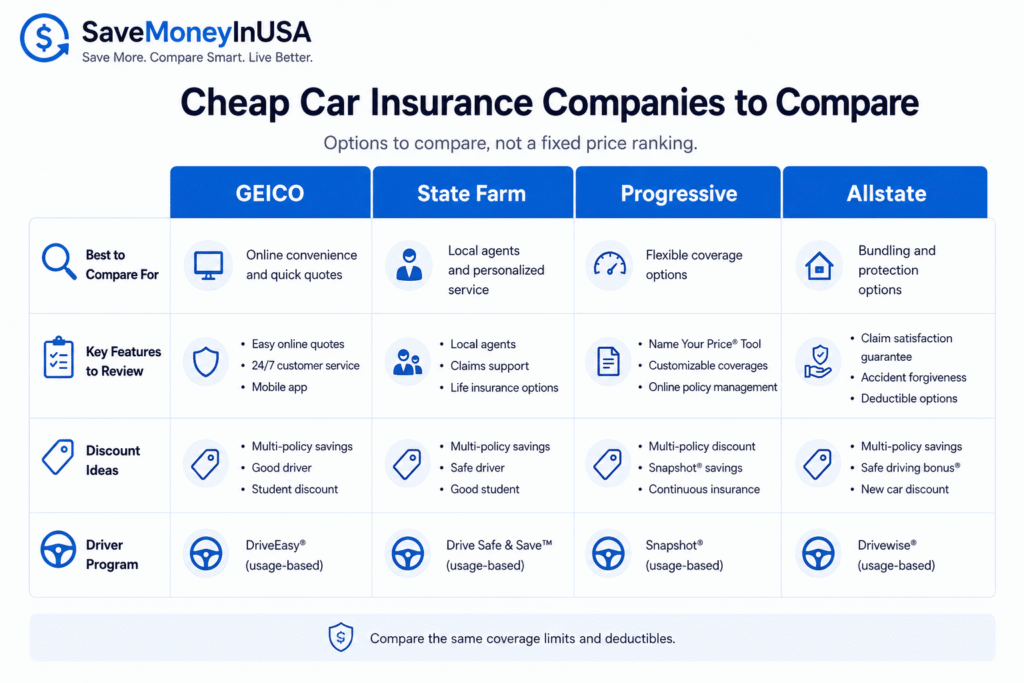
No single insurance company is consistently the cheapest for every driver. The companies below are major insurers worth including in a quote comparison because they offer broad auto insurance options, multiple discount programs, and different ways to purchase or manage a policy.
This is not a universal price ranking. Availability, discounts, underwriting rules, coverage options, and premiums can vary by state and driver profile. Always compare quotes using the same coverage limits and deductibles.
| Company | Worth Comparing If You Want | Features to Review |
|---|---|---|
| GEICO | An online-focused quote and policy-management experience | Driver, vehicle, student, membership, and safe-driving discount eligibility |
| State Farm | Access to local agents and several driver-based savings programs | Good student, multi-vehicle, safe-driver, and Drive Safe & Save availability |
| Progressive | Online comparison tools and usage-based pricing options | Snapshot, bundling, payment, multi-policy, and driver-related discounts |
| Allstate | Multiple coverage choices, agent access, and bundling opportunities | Drivewise, safe-driver, student, payment, vehicle, and multi-policy discounts |
These companies are options to compare, not a guaranteed ranking from cheapest to most expensive.
GEICO
GEICO may be worth comparing if you prefer getting a quote, reviewing policy options, and managing insurance online. The company lists several possible savings opportunities, including discounts connected to vehicle equipment, good students, certain memberships, federal employment, defensive driving, and its DriveEasy safe-driving program.
Discount eligibility and availability can vary by state. GEICO should therefore be treated as one quote to compare rather than automatically assumed to be the cheapest company for your situation.
State Farm
State Farm may be a useful option for drivers who want access to a local agent as well as online and mobile policy services. Its published auto insurance savings options include discounts for safe drivers, students, multiple household vehicles, and participation in eligible driving programs.
The Drive Safe & Save program uses driving information to determine potential savings, while the Steer Clear program may provide savings opportunities for eligible teen and young adult drivers. Program rules and discounts differ by state, so confirm which options are available where you live.
Progressive
Progressive may be worth comparing if you want online quote tools, several payment and policy discounts, or a usage-based insurance option. Its Snapshot program may personalize pricing using information about how and how much you drive.
Usage-based insurance is not automatically cheaper for every participant. Progressive states that Snapshot results can depend on driving behavior, and higher-risk driving may increase a rate in some circumstances. Review the program terms before enrolling rather than choosing it only because of an advertised savings figure.
Allstate
Allstate may be useful to compare if you want a combination of agent support, online policy tools, optional coverage choices, and bundling opportunities. Its listed auto insurance discounts may include savings for safe driving, students, automatic payments, vehicle safety equipment, multiple policies, and other qualifying factors.
Allstate also offers Drivewise, a usage-based program that may use driving behavior to help determine personalized pricing. As with other telematics programs, savings are not guaranteed, and the effect can depend on participation rules, driving results, and state availability.
Important: The presence of a discount does not mean that one insurer will produce the lowest final premium. A company offering fewer applicable discounts may still quote a lower total price, while another company may offer better coverage or service for a similar premium.
Why Car Insurance Quotes Can Vary So Much
Car insurance companies can produce very different quotes for the same driver because each insurer uses its own pricing methods, eligibility rules, discount structure, and assessment of risk. A company that offers a competitive price to one household may quote a much higher premium to another.
The difference between quotes may be influenced by several factors:
- Your state, ZIP code, and local claim patterns
- Your age, driving experience, and accident or violation history
- Your vehicle’s value, repair costs, safety features, and theft risk
- Your selected liability limits and optional coverages
- Your collision and comprehensive deductibles
- Your annual mileage and how the vehicle is used
- Discounts for bundling, safe driving, students, vehicles, or payment methods
- Credit-based insurance information where state law allows its use
Because these factors are weighted differently by each insurer, an advertised average rate cannot tell you which company will be cheapest for your own policy. The only reliable comparison is based on quotes prepared with the same driver details, vehicles, coverage limits, deductibles, and optional protections.
Compare equivalent policies, not just monthly prices
A quote may appear cheaper because it includes lower liability limits, removes optional coverage, uses a higher deductible, or applies a discount that may later change. Before choosing a policy, review the complete coverage summary and total policy cost rather than comparing only the monthly payment.
For additional ways to reduce costs without automatically reducing important protection, see our guide on how to lower car insurance premiums.
Practical comparison rule: Use the same coverage limits and deductibles for every quote. After identifying the lowest prices, compare exclusions, optional coverage, billing fees, claims support, and discount requirements before making a final decision.
How to Choose the Cheapest Car Insurance Company for You
The cheapest car insurance company for you is the insurer that offers the lowest reasonable total cost for the coverage and service you actually need. It should not be selected only because it shows the smallest monthly payment on the first quote screen.
1. Decide on your coverage before requesting quotes
Choose the liability limits, deductibles, and optional coverages you want before comparing companies. Otherwise, one quote may appear cheaper simply because it provides less protection.
If you are unsure where to begin, review our guide to choosing car insurance coverage before requesting quotes.
2. Request quotes from several insurers
Compare at least three insurers when possible, using the same driver details, vehicles, coverage limits, deductibles, and optional protections. Include both large national insurers and any reputable regional companies available in your state.
For a more accurate process, follow our guide on how to compare car insurance quotes.
3. Verify every discount included in the quote
Check whether the quoted price depends on bundling, automatic payments, paperless billing, safe-driving monitoring, low mileage, student eligibility, or another requirement. Confirm when each discount begins, whether it can change, and what you must do to keep it.
4. Compare the complete policy cost
Review the six-month or annual premium, down payment, installment fees, deductible amounts, and any optional coverage charges. A low monthly payment does not necessarily mean the lowest total cost.
5. Review service and claims considerations
Before choosing the lowest quote, consider how the policy can be managed, whether agent support is available, how claims are reported, and whether the company’s service options match your preferences. A small price difference may not be worthwhile if another insurer offers coverage or support that better fits your needs.
6. Check whether special circumstances affect your options
Drivers with poor credit, accidents, violations, a DUI, limited driving history, or an SR-22 requirement may receive very different results from the same group of companies. In these situations, compare insurers that are relevant to your driver profile rather than relying on a general list.
- For credit-related pricing concerns, see cheap car insurance for drivers with bad credit.
- For accidents, multiple violations, a coverage lapse, or another complex driving record, see car insurance options for high-risk drivers.
- After a DUI, review how to compare car insurance after a DUI.
Before buying: Confirm the policy term, coverage limits, deductibles, discounts, total premium, payment schedule, and effective date. Save a copy of the final quote so you can verify that the issued policy matches what you selected.
Is It Better to Switch Insurance Companies?
Switching car insurance companies may make sense when another insurer offers a better combination of price, coverage, discounts, and service. However, a lower quote does not automatically mean that changing companies is the right decision.
Before switching, compare the new quote with your current policy using the same liability limits, deductibles, optional coverages, drivers, and vehicles. Also check whether the new price depends on discounts or driving-monitoring programs that may change later.
When it may be worth comparing other insurers
- Your renewal premium increased significantly without a clear change in coverage.
- Your driving record, credit profile, address, annual mileage, or household situation changed.
- You added or removed a vehicle or driver.
- You are no longer receiving discounts available through your current insurer.
- You found another quote with comparable coverage and a lower total policy cost.
- You want different coverage options, agent support, online tools, or claims-service features.
When the cheapest quote may not justify switching
- The new policy has lower liability limits or removes useful optional coverage.
- The deductible is substantially higher.
- The quoted price depends on temporary or conditional discounts.
- You would lose valuable bundling or loyalty benefits on another policy.
- The savings are small after considering fees, payment requirements, and coverage differences.
- The new insurer’s service options do not meet your needs.
How to switch without creating a coverage gap
Arrange the new policy before cancelling the existing one. Confirm the exact effective date and time of the new coverage, then schedule the old policy to end only after the replacement policy has started.
Do not cancel your current insurance simply because you received a quote. A quote is not the same as an active policy. Wait until the new insurer confirms that coverage has been issued and you have received proof of insurance.
If your vehicle is financed or leased, verify that the replacement policy meets the lender’s coverage requirements. You may also need to provide updated insurance information to the lender.
Check cancellation and refund details
Ask your current insurer whether a cancellation fee applies and how any unused premium will be refunded. Also confirm whether cancelling another policy, such as homeowners or renters insurance, would affect a multi-policy discount.
Safe switching checklist: Confirm the new policy’s effective date, coverage limits, deductibles, discounts, total premium, payment schedule, lender requirements, and proof of insurance before cancelling your existing policy.
Frequently Asked Questions About Cheap Car Insurance Companies
Is the cheapest car insurance company always the best choice?
No. The lowest-priced quote may provide lower liability limits, higher deductibles, fewer optional coverages, or discounts that depend on specific requirements. Compare the complete policy, total premium, deductibles, exclusions, and service options before deciding.
Which car insurance company is cheapest for most drivers?
There is no single company that is cheapest for most drivers in every state and situation. Insurers evaluate location, driving history, vehicle information, coverage choices, mileage, discounts, and other permitted rating factors differently. The lowest-priced company for one driver may not be the lowest-priced option for another.
How many car insurance companies should I compare?
Comparing quotes from at least three insurers is a practical starting point. When possible, include both major national insurers and reputable regional companies available in your state. Use identical driver information, coverage limits, deductibles, and optional coverages for every quote.
How often should I compare car insurance quotes?
Review your options around each renewal period and whenever your circumstances change. It may be useful to request new quotes after moving, adding or removing a vehicle or driver, changing annual mileage, improving your driving record, or experiencing a significant premium increase.
Can raising my deductible lower my car insurance premium?
A higher collision or comprehensive deductible can reduce the premium for those coverages, but it also increases the amount you must pay after a covered claim. Choose a deductible you could reasonably afford from savings rather than selecting the highest amount only to reduce the monthly payment.
For a closer look at this tradeoff, see our guide to car insurance deductibles versus premiums.
Do car insurance discounts guarantee the lowest rate?
No. A company may advertise many discounts and still produce a higher final premium than another insurer. Compare the final policy price after all eligible discounts are applied, and confirm what you must do to keep each discount.
Can I switch car insurance companies before my policy expires?
Drivers can generally change insurers before the end of a policy term, but cancellation rules, fees, and refunds can vary. Activate the replacement policy and obtain proof of insurance before cancelling the current policy so that you do not create a coverage gap.
Final Thoughts on Comparing Cheap Car Insurance Companies
The best cheap car insurance company is not determined by a single national ranking. It is the insurer that offers a competitive total price for the coverage, deductibles, discounts, and service options that fit your individual needs.
Start by deciding what coverage you need, then request several equivalent quotes. Review the full policy cost and confirm all important details before purchasing or cancelling existing coverage.
Sources
- National Association of Insurance Commissioners — A Shopping Tool for Auto Insurance
- GEICO — Car Insurance Discounts
- GEICO — DriveEasy Safe-Driving Program
- State Farm — Auto Insurance Discounts
- Progressive — Snapshot Usage-Based Insurance Program
- Allstate — Car Insurance Discounts
- Allstate — Drivewise Safe-Driving Program
Insurance programs, discounts, availability, and eligibility requirements may vary by state and may change over time. Review the insurer’s current terms before purchasing or enrolling in a driving program.
About the Author
The SaveMoneyInUSA Editorial Team researches car insurance costs, coverage options, state requirements, and quote comparison considerations for drivers in the United States.
Learn more about our Editorial Team.
Disclaimer
SaveMoneyInUSA is an independent informational website and is not an insurance company, broker, or agent.
Some links may be affiliate links. We may receive compensation from partners at no additional cost to users.
Insurance rates, coverage options, and eligibility vary by provider and individual circumstances.
This content is provided for educational purposes only and should not be considered insurance, legal, or financial advice.