

Last Updated: August 2026
Finding cheap car insurance after a DUI can be challenging because a recent impaired-driving violation may change eligibility, pricing, payment requirements, and filing obligations. Some insurers may decline the application, while others may offer coverage at very different prices. The result depends on the state, driving record, conviction details, vehicle, coverage, and insurer.
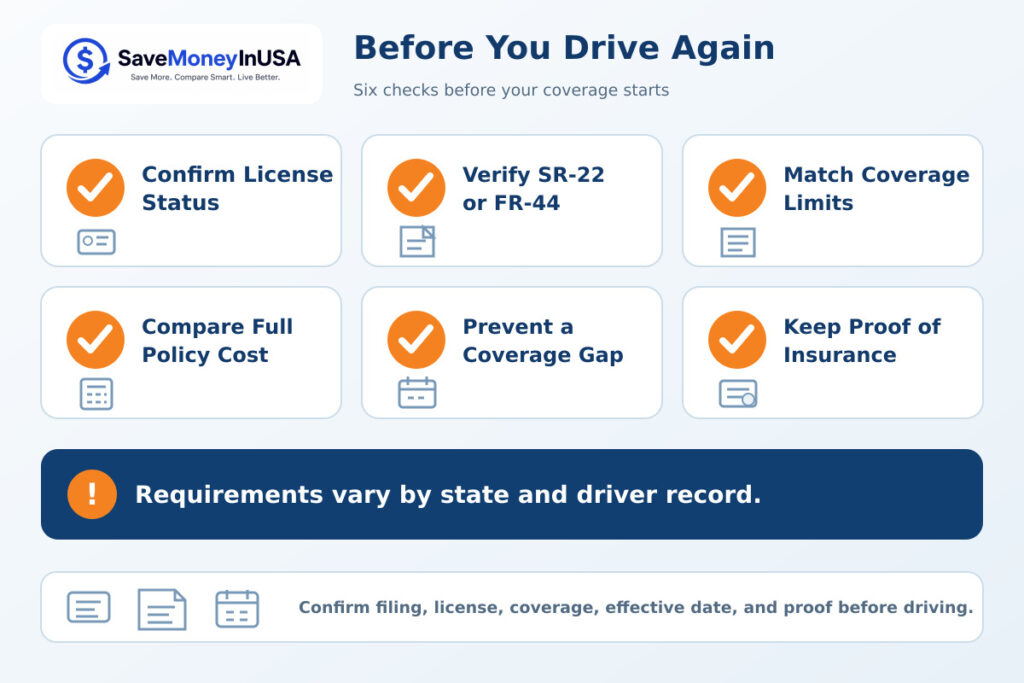
Quick answer: Do not assume one company is always cheapest after a DUI. Confirm your license and filing requirements, request several quotes with identical coverage, compare the full policy cost, and avoid any lapse. If an SR-22 or FR-44 is required, make sure the insurer can file it correctly before you drive.
Compare equivalent coverage and confirm any required filing before choosing a policy.
Why a DUI Can Change Your Car Insurance
A DUI or DWI is a serious driving event. An insurer reviewing a motor vehicle record may treat it as evidence of increased loss risk. The company may re-rate a current policy at renewal, remove a preferred-driver classification, change payment options, decline a new application, or require placement in a different underwriting program.
An arrest, administrative license action, and criminal conviction are not identical. Their insurance consequences depend on the record available to the insurer and state law. Do not describe the event inaccurately on an application. Answer the questions asked and verify uncertain details through the court, licensing agency, attorney, or insurer.
DUI laws also cover more than one universal blood alcohol concentration. NHTSA notes that the general per-se BAC limit is .08 in most states, while Utah uses .05; lower limits and separate rules may apply to drivers under 21 and commercial drivers. Drug-impaired driving laws also apply. This article discusses insurance shopping, not criminal-law advice.
What Determines the Price After a DUI?
- State law and the insurer’s approved rating plan
- Whether the event is an arrest, conviction, suspension, or refusal
- Time since the event and any earlier violations or claims
- Whether an SR-22, FR-44, or other proof filing is required
- Driver age, experience, location, mileage, and household drivers
- Vehicle, coverage limits, optional coverages, and deductibles
- Insurance history, coverage lapses, discounts, and payment plan
There is no reliable national percentage increase for every driver. A generic rate table cannot account for different state rules, insurers, records, or coverage. Use actual written quotes rather than multiplying an old premium by a claimed DUI percentage.
SR-22 and FR-44: What to Confirm
An SR-22 is commonly described as proof that a driver carries required liability insurance; it is not a separate insurance policy. Some states or situations use different forms or higher-limit proof, including FR-44. A DUI does not create one identical filing requirement nationwide.
For a dedicated filing and insurer-comparison guide, read Best SR-22 Insurance Companies in the USA.
| Question | Why It Matters | Where to Verify |
|---|---|---|
| Is a filing required? | Not every driver or state follows the same rule | State licensing agency or official notice |
| Which form is required? | SR-22 and FR-44 are not interchangeable | Official reinstatement instructions |
| What limits apply? | A filing may require specified liability limits | State notice and insurer |
| When must it start? | Driving before reinstatement can create further penalties | Licensing agency |
| How long must it remain? | A lapse may trigger notice and additional consequences | Written state requirement |
Ask the insurer whether it files electronically, how long processing normally takes, what confirmation you will receive, and what happens if the policy lapses. Keep the policy, filing confirmation, proof of insurance, and state notices together.
Decision Module 1: Keep the Current Insurer or Switch?
Do not cancel immediately after learning about a DUI-related change. First determine whether the existing policy remains active, when new pricing takes effect, and whether the current insurer can complete any required filing. Canceling too early can create a lapse.
| Situation | Action to Evaluate | Main Risk |
|---|---|---|
| Current policy remains active | Compare renewal cost with equivalent outside quotes | Switching before replacement coverage begins |
| Nonrenewal notice received | Shop early and confirm the exact final coverage date | Waiting until the final day |
| SR-22 or FR-44 required | Use an insurer that can make the correct filing | Buying a policy without completing reinstatement |
| Vehicle no longer owned | Ask about non-owner coverage when appropriate | Assuming no car means no insurance requirement |
For broader context on accidents, violations, coverage lapses, and other risk factors, review Best Car Insurance for High-Risk Drivers.
How to Compare Insurance Companies After a DUI
Company lists cannot identify the cheapest insurer for an individual driver. Instead, obtain quotes close together and keep the inputs equal. Use the same drivers, vehicle, address, annual mileage, liability limits, physical-damage coverage, deductibles, and optional benefits.
- Eligibility: Will the insurer accept the complete driving record?
- Filing: Can it complete the exact state-required proof?
- Total cost: What are the amount due today, full-term premium, and installment fees?
- Coverage: Are the liability limits, deductibles, and optional benefits equal?
- Conditions: Are telematics, automatic payment, or other requirements attached to the price?
- Continuity: Can the policy start before the existing coverage ends?
Follow the step-by-step quote comparison guide so that a lower price does not simply reflect weaker coverage.
What to Gather Before Requesting Quotes
Preparing accurate information reduces the chance that a preliminary price changes later. Have the driver’s license, vehicle identification number, current declarations page, estimated annual mileage, household-driver information, and desired coverage ready. Also keep the conviction date, state notice, suspension or reinstatement documents, and any SR-22, FR-44, DUI-program, or IID instructions available.
Ask whether the quote is final or still subject to review of the motor vehicle record. Confirm the effective date in writing and obtain an insurance identification card. If a filing is required, a policy card alone may not prove that the insurer submitted the filing or that the licensing agency restored driving privileges. Verify both steps separately before driving.
Decision Module 2: Minimum Coverage or More?
After a major premium increase, minimum liability coverage may seem like the only affordable option. It may satisfy the ordinary state minimum, but a reinstatement filing can impose different requirements. Minimum liability also does not repair your own vehicle after an at-fault collision.
- Confirm the state minimum and any separate filing requirement.
- Keep lender-required collision and comprehensive coverage on a financed or leased vehicle.
- Consider assets, income, passengers, mileage, and ability to pay after a serious accident.
- Compare savings from removing optional coverage with the loss you would retain.
Use Minimum Car Insurance Requirements by State as a starting point, then verify the current rule with your state.
Ways to Lower the Cost Without Weakening the Policy Blindly
Compare Equivalent Quotes
Pricing after a DUI can vary by insurer. Compare several options, but disclose the same facts and request identical coverage. A quote based on incomplete information may change after the motor vehicle record is reviewed.
Choose a Deductible You Can Pay
A higher collision or comprehensive deductible may lower the premium, but it increases the amount needed after a covered loss. Ask for more than one deductible option and compare the annual savings with the added out-of-pocket exposure.
Review Discounts and Telematics Terms
Ask about permitted discounts for multiple policies, vehicles, safety equipment, approved courses, automatic payment, or driving programs. A defensive-driving or DUI program required by a court or state does not automatically guarantee an insurance discount. For telematics, verify what data is collected and whether results can affect the premium in either direction.
Compare Monthly and Paid-in-Full Billing
Monthly billing may include installment fees, while paying in full may require too much cash at once. Compare the exact policy-term totals and protect emergency savings. Read Pay in Full Car Insurance: Is It Cheaper?.
Maintain Continuous Coverage and a Cleaner Record
Pay on time, follow license restrictions, avoid new violations, and do not allow a required filing to lapse. Re-shop before renewal or after a material record change, but do not assume the DUI disappears from insurance consideration on one universal schedule.
For additional ways to control premiums, see How to Save Money on Car Insurance in the USA. You can also browse the Car Insurance Guides Resource Center for related high-risk, SR-22, payment, coverage, and state-specific topics.
Car Insurance After a DUI in California
California requires special attention because insurance, court, DMV, DUI-program, and ignition-interlock steps can interact. The California Driver Handbook states that a DUI conviction results in suspension or revocation and requires completion of a DUI program, filing a California Insurance Proof Certificate (SR 22/SR 1P), payment of applicable fees, and potentially installation of an ignition interlock device.
California extended its statewide IID pilot program for specified DUI offenders through January 1, 2033. The exact restriction or installation period depends on the offense, prior record, court order, DMV action, and eligibility, so use the instructions issued for the individual case.
California DMV also states that DUI convictions remain on the driver record for ten years. That does not mean every insurer charges the same increase for ten years; it means drivers should not rely on a generic “three-to-five-year” promise. Follow the dates and conditions on the official DMV or court documents.
Do not drive merely because an insurance payment was accepted. Confirm that the policy is active, the required filing has been submitted, the license is valid or properly restricted, and any IID condition has been satisfied.
Common Mistakes After a DUI
- Canceling the current policy before replacement coverage becomes active
- Assuming every DUI requires the same SR-22 period
- Buying minimum coverage without checking filing or lender requirements
- Comparing premiums based on different limits and deductibles
- Relying on a company ranking instead of current individual quotes
- Providing incomplete or inaccurate application information
- Missing an installment and triggering a filing-related lapse notice
- Driving before reinstatement or restriction requirements are complete
Frequently Asked Questions
Which company is cheapest after a DUI?
No insurer is cheapest for every DUI driver. Availability and pricing depend on the state, full driving record, time since the event, filing needs, vehicle, coverage, and other approved factors. Compare current equivalent quotes.
Does every DUI require an SR-22?
No single national rule applies. Requirements depend on the state and case. Use the official reinstatement notice or licensing-agency instructions rather than assuming a filing is—or is not—required.
Can I get insurance after a DUI without owning a car?
A non-owner policy may be an option for someone who does not own a vehicle but needs liability coverage or a filing. It generally does not insure a vehicle you own or regularly use. Confirm eligibility and state requirements with the insurer.
How long will a DUI affect my insurance?
There is no universal period. State record-retention rules, insurer lookback practices, filing requirements, and later driving history all matter. California DMV states that a DUI conviction remains on the driver record for ten years.
Should I wait until renewal to compare quotes?
Start before renewal, nonrenewal, cancellation, or reinstatement deadlines. Early comparison gives time to verify records and filings while preventing a coverage gap.
Final Takeaway
Cheap car insurance after a DUI is not found through a universal company ranking. Confirm the exact state and license requirements, compare several written quotes using the same coverage, verify any SR-22 or FR-44 filing, and keep continuous insurance. The best policy is one that satisfies the legal requirements, protects you adequately, and remains affordable through the full term.
Sources
- National Highway Traffic Safety Administration — Drunk Driving
- California DMV — Alcohol and Drugs
- California DMV — Statewide Ignition Interlock Device Program
- California DMV — New Laws in 2026: Ignition Interlock Device Program Extension
- National Association of Insurance Commissioners — A Consumer’s Guide to Auto Insurance
- California Department of Insurance — Automobile Insurance Guide
About the Author
The SaveMoneyInUSA Editorial Team researches car insurance costs, coverage options, state requirements, discounts, and quote-comparison considerations for drivers in the United States.
Learn more about our Editorial Team.
Disclaimer
SaveMoneyInUSA is an independent informational website and is not an insurance company, broker, or agent.
Some links may be affiliate links. We may receive compensation from partners at no additional cost to users.
Insurance premiums, eligibility, SR-22 or FR-44 filing requirements, license restrictions, coverage options, and reinstatement procedures vary by insurer, state law, driving record, and individual circumstances.
This content is provided for educational purposes only and should not be considered insurance, legal, or financial advice.