

Last Updated: August 2026
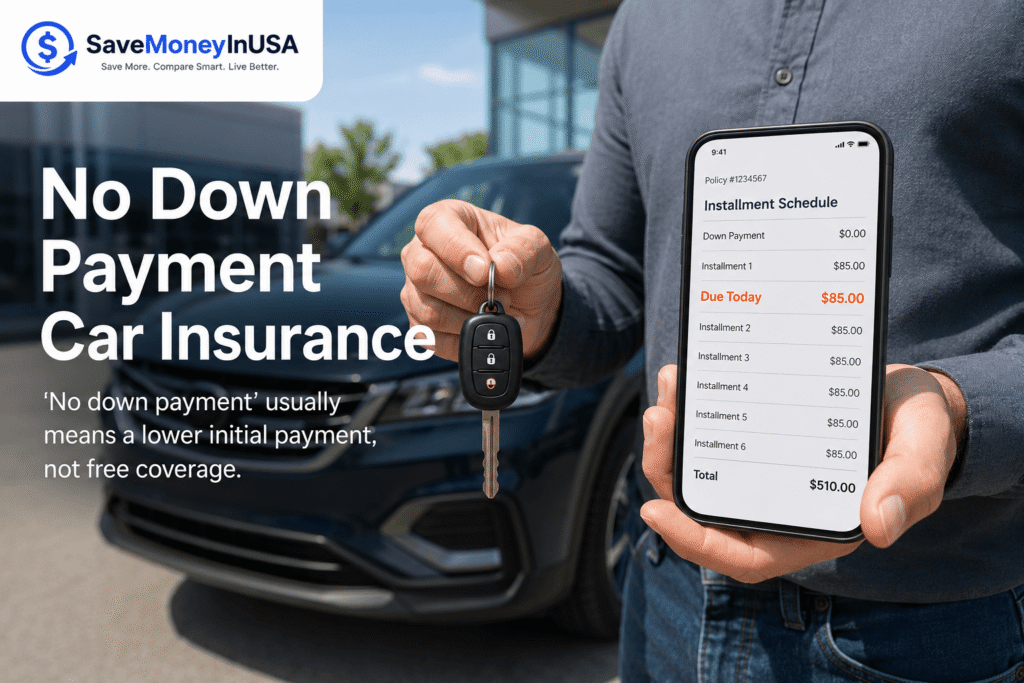
Drivers searching for no down payment car insurance usually want coverage that starts with little or no money upfront. The phrase sounds like an insurer will activate a policy before collecting any payment, but it does not necessarily mean that coverage begins without an initial payment.
Quick answer: True $0-upfront auto insurance is generally not a standard option. Most insurers require an initial payment before coverage begins. “No down payment” or “no deposit” usually describes a payment plan with a smaller first payment rather than free insurance. Compare the amount due today, total policy premium, installment fees, coverage, and future payment schedule before buying.
Compare the same coverage and review the full payment schedule before choosing an option.
What “No Down Payment” Car Insurance Really Means
Auto insurance premiums are commonly quoted for a policy term, often six or twelve months. An insurer may allow the premium to be divided into installments instead of requiring the entire term’s cost at once.
In advertising, “no down payment” may mean that there is no separate deposit added on top of the first installment. You may still have to pay the first monthly installment, taxes, fees, membership charges, or another required amount before the policy becomes effective.
| Phrase | What It May Mean | What to Verify |
|---|---|---|
| No down payment | No separate large deposit, but an initial installment may still be due | Exact amount required before coverage begins |
| No deposit | Often another marketing phrase for reduced upfront cost | First payment, fees, and cancellation terms |
| Low down payment | A smaller initial payment followed by installments | Total premium and every scheduled payment |
| Pay in full | The full policy-term premium is paid upfront | Any paid-in-full discount and refund rules |
Can You Get Car Insurance With $0 Due Today?
It may occasionally appear possible because of a special billing arrangement, delayed electronic withdrawal, employer or group benefit, premium-financing arrangement, or promotional wording. That does not mean the insurer is providing coverage without charging a premium.
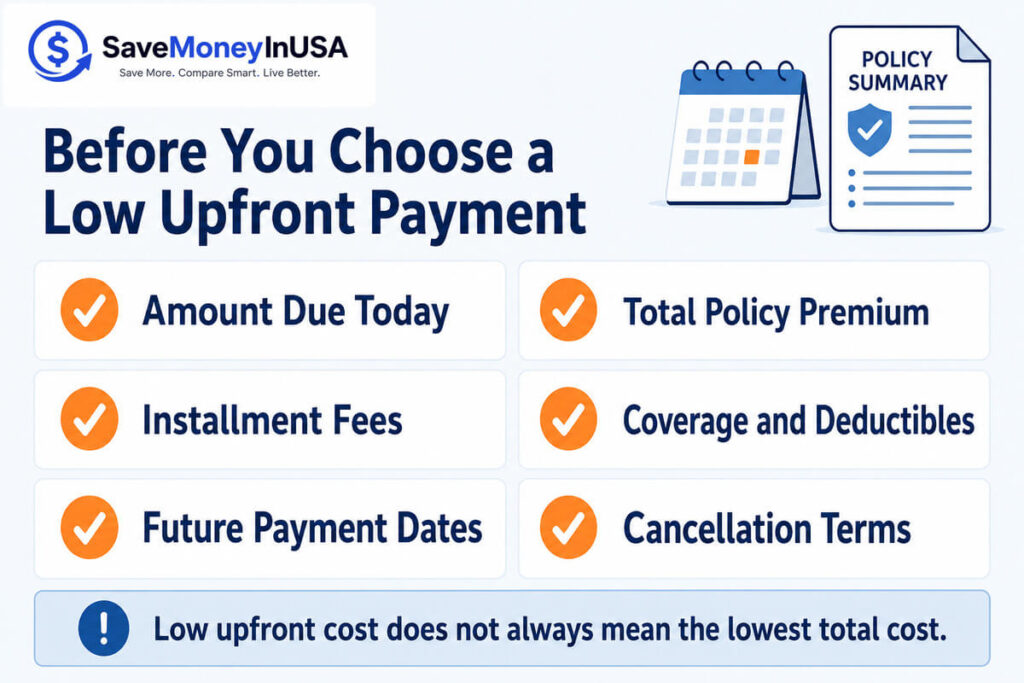
Before relying on a $0-due-today statement, obtain the written quote and ask:
- What exact amount must be paid before the policy becomes active?
- When will the first bank or card withdrawal occur?
- Is there an installment, policy, broker, membership, or financing fee?
- What is the total premium for the entire policy term?
- What happens if an automatic payment fails?
- Does the quote provide the coverage required by your state and lender?
Do not drive based only on a payment confirmation screen. Confirm that the policy is active and keep valid proof of insurance.
Why Insurers Usually Require an Initial Payment
The insurer begins accepting covered risk when the policy becomes effective. Requiring an initial payment confirms the billing arrangement and provides premium for the first part of the policy term.
The California Department of Insurance explains that although the full premium is due upfront when coverage is offered, many insurers provide payment plans that require a down payment and usually charge a service fee for each installment. The NAIC similarly advises that monthly payment options may include an extra fee.
Payment rules, available schedules, fees, and required initial amounts vary by insurer, state, policy, and applicant. There is no reliable universal amount that applies to every driver.
Compare the First Payment and the Total Policy Cost
The smallest first payment is not automatically the cheapest policy. A payment plan can improve short-term cash flow while producing a higher total cost because of installment fees or the loss of a paid-in-full discount.
Hypothetical Comparison
| Item | Option A | Option B |
|---|---|---|
| Amount due today | $75 | $200 |
| Remaining scheduled payments | Five payments of $225 | Five payments of $180 |
| Six-month total | $1,200 | $1,100 |
| Main trade-off | Lower initial payment | Lower total cost |
This is an illustration, not an actual insurance quote. It shows why the amount due today and total policy cost should be evaluated separately. Actual payments depend on the insurer, coverage, fees, discounts, state, and driver profile.
If you can pay the full term without weakening your emergency savings, compare the installment total with the paid-in-full price. Read Pay in Full Car Insurance: Is It Cheaper? for a detailed payment-method comparison.
For a broader cost-reduction plan, see How to Save Money on Car Insurance in the USA. You can also use the Car Insurance Guides Resource Center to find related coverage, payment, driver, financing, and state-specific topics.
What Determines the Amount Due at Policy Start?
The initial amount can reflect the policy premium, chosen billing schedule, permitted fees, coverage effective date, and the insurer’s approved payment rules. The underlying premium may depend on factors such as:
- State, ZIP code, and permitted rating territory
- Driving record and years of driving experience
- Vehicle, drivers, mileage, and vehicle use
- Liability limits and optional coverages
- Collision and comprehensive deductibles
- Insurance history and any coverage lapse
- Available discounts and payment method
Credit-based insurance information may also affect pricing where state law permits it. California private-passenger auto rating follows different state rules; do not assume that credit information affects a California quote. Learn more in How Credit Score Affects Car Insurance Rates.
How to Find a Lower Initial Payment
1. Compare Equivalent Quotes
Request quotes from several insurers using the same drivers, vehicles, liability limits, deductibles, and optional coverage. Record both the amount due today and the total term premium. Follow the step-by-step quote comparison guide to avoid comparing different protection levels.
2. Ask About Every Payment Schedule
Ask whether monthly, automatic-payment, quarterly, or paid-in-full options are available. Confirm every fee and whether changing the withdrawal date affects the initial amount.
3. Confirm Available Discounts
Possible discounts may involve multiple vehicles, multiple policies, vehicle equipment, paperless billing, automatic payment, safe-driving programs, low mileage, or other qualifications. Availability and savings vary.
4. Review the Deductible Carefully
A higher collision or comprehensive deductible may lower the premium, but it also increases the amount you may need after a covered claim. Do not select a deductible you could not pay. See Deductible vs Premium before changing it.
5. Avoid a Coverage Lapse
Arrange the new policy before canceling the old one. A lapse can create legal and financial problems and may affect future eligibility or pricing. Never cancel existing coverage based only on an unfinished quote.
No Down Payment Car Insurance in California
California drivers may find installment plans, but a legitimate insurer will generally require an approved payment arrangement. The state insurance department advises consumers to ask about installment plans and service fees and to compare several policies.
California premiums can vary based on approved factors, coverage, vehicle, driving record, mileage, driving experience, and location. Credit history should not be presented as a California private-passenger auto pricing factor.
Income-eligible California drivers seeking basic liability protection may also review the official California Low Cost Automobile Insurance Program. Eligibility, coverage, and program rules apply; it is not a $0-down insurance offer.
Red Flags and Misleading Offers
- The seller will not provide the insurer’s full legal name.
- The quote hides the total premium or payment schedule.
- The advertisement guarantees $0 upfront for every driver.
- You are pressured to pay before reviewing coverage and exclusions.
- The agent or company cannot be verified with the state insurance department.
- The offer promises a fixed price without collecting driver, vehicle, location, or coverage information.
Verify the company or producer’s license with your state insurance department. Keep the written quote, receipts, declarations page, payment schedule, and cancellation terms.
Who May Benefit From a Lower Initial Payment?
A smaller first payment may help a driver who needs continuous legal coverage but cannot comfortably pay an entire six- or twelve-month premium at once. It may also help when a renewal date falls before the next paycheck or when switching insurers requires overlapping payments for a short period.
However, payment flexibility should not be confused with affordability. If future installments will not fit the monthly budget, selecting the smallest amount due today only postpones the problem and increases the risk of cancellation.
When Paying More Upfront May Be Better
Paying more upfront may make sense when it eliminates installment fees, qualifies for a discount, simplifies budgeting, and still leaves adequate emergency savings. Compare the full-term cost rather than assuming that paid-in-full or monthly billing is always better.
Also review refund and cancellation rules. If you cancel before the end of the policy term, the amount returned can depend on earned premium, fees, state law, and policy terms.
Frequently Asked Questions
Is no-deposit car insurance the same as no down payment insurance?
The phrases are usually used for the same search intent: starting coverage with a low initial cost. Neither phrase guarantees that the policy begins without any payment.
Does the first monthly payment count as a down payment?
Advertising terminology varies. The important question is not the label but the exact amount due before coverage starts and whether it is part of the total premium.
Can a driver with a DUI or SR-22 get a payment plan?
Payment options depend on the insurer, state, policy, and driver profile. A DUI or SR-22 requirement does not create a universal payment rule. Compare eligible policies and confirm that any required filing is included.
Will comparing quotes affect my consumer credit score?
Requesting an insurance quote generally does not affect a consumer credit score. Where permitted, an insurer may use credit-based insurance information through a process that differs from applying for a loan. State rules vary.
What should I compare besides the first payment?
Compare the total premium, liability limits, collision and comprehensive coverage, deductibles, optional benefits, discounts, installment fees, cancellation terms, and every scheduled payment.
Final Takeaway
“No down payment car insurance” is usually a marketing description for a policy with a lower initial payment—not insurance that starts free. Focus on the written amount due today, total policy cost, fees, coverage, and future installments. A manageable first payment is useful only when the remaining policy is affordable and provides the protection you need.
Sources
- National Association of Insurance Commissioners — A Consumer’s Guide to Auto Insurance
- NAIC — A Shopping Tool for Auto Insurance
- California Department of Insurance — Auto Insurance Payment Plans
- California Department of Insurance — Automobile Insurance Guide
About the Author
The SaveMoneyInUSA Editorial Team researches car insurance costs, coverage options, state requirements, discounts, and quote-comparison considerations for drivers in the United States.
Learn more about our Editorial Team.
Disclaimer
SaveMoneyInUSA is an independent informational website and is not an insurance company, broker, or agent.
Some links may be affiliate links. We may receive compensation from partners at no additional cost to users.
Insurance premiums, initial payments, installment fees, payment schedules, refunds, coverage options, and eligibility vary by insurer, state law, policy, and individual circumstances.
This content is provided for educational purposes only and should not be considered insurance, legal, or financial advice.