

Last Updated: September 2026
International student car insurance applications usually go more smoothly when you prepare your driver, address, vehicle, and payment information before requesting quotes. You may not need to upload every document for an initial quote, but an insurer can ask for additional proof before issuing the policy or applying a discount.
The exact requirements depend on your state, license status, vehicle, and insurance company. If you have only a foreign driver’s license, first confirm both your state’s driving rules and the insurer’s eligibility rules. They are separate questions.
Compare matching coverage, deductibles, drivers, and vehicle details. Availability and eligibility vary by insurer and state.
International Student Car Insurance Document Checklist
Start with the items below. Some are commonly needed for a quote, while others may be requested only when you buy the policy, finance a vehicle, or apply for a discount.
| Category | Prepare | Why It Matters |
|---|---|---|
| Driver | U.S. or foreign license; IDP if applicable; date of birth; driving history | Identifies the driver and helps determine eligibility and price |
| Identity | Passport or other government ID if requested | May be used for identity verification |
| Address | Current U.S. residence, mailing address, and garaging address | Shows where you live and where the vehicle is usually kept |
| Vehicle | VIN; year, make, model; mileage; purchase or registration documents | Identifies and rates the exact vehicle |
| Loan or lease | Lienholder or leasing company details and contract requirements | Helps match the policy to required coverage and deductibles |
| Insurance history | Prior policy, coverage dates, claims, or foreign records if available | May help the insurer review prior coverage or experience |
| Discounts | Student ID, enrollment proof, grades, or course certificate if requested | Supports a discount for which you qualify |
| Payment | Accepted card or bank information and desired start date | Activates the policy and establishes billing |
Do not send sensitive documents to an unknown website or person. Before paying or uploading records, confirm that the company or agent is licensed through your state insurance department.
1. Driver’s License and Driving Information
Your license information is usually the most important starting point. A quote form may ask for the license number and issuing jurisdiction, the date you were first licensed, and recent accidents, claims, or violations.
- U.S. license: Prepare the license number, state, expiration date, and the approximate date you were first licensed.
- Foreign license: Keep the original valid license available. Acceptance varies by insurer, and some online forms cannot process a foreign license.
- International Driving Permit: If your state or situation requires one, keep it with the original foreign license. An IDP is a translation document, not a substitute for the underlying license.
- Pending U.S. license: Ask whether the insurer can issue a policy now and update the license information later.
State permission to drive does not guarantee that every insurer will accept the same license. Review our guide to car insurance with a foreign license, then check the motor vehicle agency for the state where you live.
2. Passport, Visa, and Student Records: What Is Actually Needed?
A passport, visa page, I-20, DS-2019, or school enrollment letter should not be described as universally required auto insurance documents. A basic quote normally focuses on driver, address, vehicle, coverage, and claims information. However, identity or student records may be requested in specific situations.
- Identity verification: An insurer or agent may request a passport or another government-issued ID.
- State licensing: Your DMV may have separate identity and residency requirements when you apply for a state driver’s license.
- Student discount: An insurer may ask for current enrollment, grades, or full-time student status.
- Vehicle transaction: A dealer, lender, or leasing company may ask for additional identity or immigration documents under its own procedures.
Ask why a document is needed before sending it. Provide only the information requested through a verified, secure channel.
3. U.S. Address and Garaging Address
Insurers need your current residence and the location where the vehicle is normally kept. This may be a dorm, apartment, host-family address, or other off-campus housing. Your mailing address can be different, but the garaging address must be accurate.
- Current residential address and ZIP code
- Garaging address if different
- Mailing address if different
- Move-in date or prior address if the insurer requests address history
Do not use a friend’s or relative’s address simply to obtain a lower quote. Incorrect garaging information can affect rating, underwriting, and a future claim. Notify the insurer when you move.
4. Vehicle Details, VIN, and Ownership Records
For an accurate quote, prepare the vehicle’s year, make, model, trim if known, current mileage, use, annual mileage, and VIN. The VIN helps the insurer identify the exact vehicle and its features.
- 17-character VIN
- Year, make, model, and trim
- Current mileage and estimated annual mileage
- Commute, school, business, or personal use
- Purchase date and ownership status
- Registration, title, bill of sale, dealer agreement, or temporary registration as applicable
- License plate number if already assigned
You can usually find the VIN on the dashboard near the windshield, the driver-side door label, registration, title, or purchase documents. Check every character before paying for the policy; an incorrect VIN can cause problems with proof of insurance, registration, or lender records.
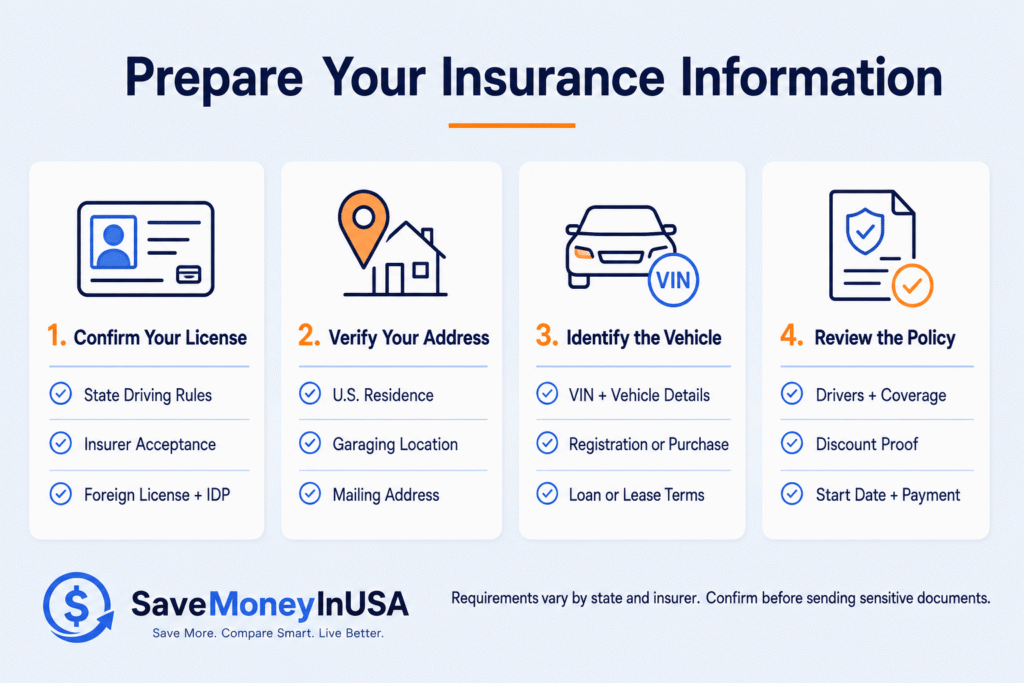
5. Finance or Lease Information
If the car is financed or leased, review the contract before choosing coverage. State minimum liability coverage may not satisfy the lender or leasing company. The contract commonly requires collision and comprehensive coverage, may limit deductible choices, and may require the lienholder or lessor to be listed on the policy.
- Lender or leasing company name and address
- Loan or lease account information if requested
- Required collision and comprehensive coverage
- Maximum permitted deductibles
- Instructions for sending proof of insurance
Read more about coverage for a financed car and the difference between full coverage and liability insurance. If required coverage lapses, a lender may purchase force-placed insurance to protect its interest.
6. Prior Insurance and Foreign Driving Records
Many foreign students have no U.S. auto insurance history. Answer “no prior U.S. insurance” accurately when that is true. If you have prior coverage, prepare the company name, policy number, coverage dates, and claims information.
You can also keep a foreign driving record, claims-free letter, or prior insurance statement available. An insurer may or may not consider it, so ask before paying for a translation or certified copy. Never imply that a foreign record guarantees a discount or approval.
If you regularly drive a vehicle you do not own, do not assume a standard owner policy is appropriate. Review whether non-owner insurance for international students fits your actual situation and confirm eligibility with the insurer.
7. Proof for Student and Other Discounts
Discounts vary by company and state. Ask each insurer which discounts are available and what proof is required. Possible supporting documents include:
- Current student ID or enrollment verification
- Transcript or grade report for a good-student discount
- Proof of full-time student status
- Approved driver-training or defensive-driving certificate
- Renters insurance policy information for a multi-policy discount
Do not assume a student discount is automatic or available at every age. Confirm the eligibility rules and whether the discount continues at renewal.
Documents for a Quote vs. Documents for Buying a Policy
| Preliminary Quote | Policy Purchase or Verification |
|---|---|
| Name, birth date, and contact information | Verified legal name and identity information if requested |
| Address and garaging location | Complete current address and any requested proof |
| License type and driving history | Exact license number and issuing jurisdiction |
| Vehicle year, make, and model | Exact VIN and ownership or purchase information |
| Estimated mileage and vehicle use | Confirmed use, drivers, and annual mileage |
| Desired coverage and deductibles | Final limits, deductibles, lender requirements, and effective date |
| Possible discounts | Supporting proof if required |
| Estimated payment choice | Accepted payment method and billing authorization |
A quoted premium can change when estimated information is replaced with verified information. Use accurate details from the beginning and review the final policy before paying.
What If an Online Quote Form Rejects Your Foreign License?
An online form failure does not necessarily mean you are ineligible for insurance. The form may not support a foreign license or a short U.S. address history.
- Check the driving and licensing rules of your state DMV.
- Confirm that your foreign license and any required IDP are valid for your situation.
- Contact the insurer or a licensed local agent and explain your license status.
- Ask what documents the insurer accepts and whether the policy can be updated after you receive a U.S. license.
- Compare other insurers using the same driver, vehicle, and coverage information.
For broader shopping guidance, see our guide to car insurance for international students in the USA. Newly arrived drivers can also review our new immigrant and foreign-driver insurance guide.
How to Compare Quotes Using the Same Information
- Use the same drivers and address. List everyone who must be disclosed and use the correct garaging location.
- Use the same vehicle information. Keep the VIN, mileage, use, and ownership status consistent.
- Match liability limits. Do not compare state-minimum limits with much higher limits as though they were the same product.
- Match deductibles and optional coverage. A higher deductible can lower the premium but increases your potential out-of-pocket cost.
- Confirm license acceptance. A price is not useful if the company cannot issue the policy for your license situation.
- Compare the total policy-term cost. Include initial payment, installments, fees, and discounts—not only the advertised monthly amount.
Use our step-by-step guide to compare car insurance quotes without changing important inputs between companies.
Common Document Mistakes to Avoid
- Using a mailing address instead of the true garaging address
- Entering one incorrect character in the VIN
- Leaving out a regular driver without asking the insurer how that person should be handled
- Assuming an IDP replaces the original foreign license
- Buying state-minimum liability coverage without checking a loan or lease contract
- Claiming a discount without the required proof
- Sending passport or immigration records through an unverified channel
- Comparing quotes with different coverage limits or deductibles
- Driving before the policy’s effective date and time
Frequently Asked Questions
Do all international students need a U.S. driver’s license to buy car insurance?
No single rule applies to every state or insurer. Some insurers may accept a valid foreign license, while others may require a U.S. license or a manual review. Confirm state driving rules and insurer eligibility separately.
Is an International Driving Permit enough by itself?
Generally, no. An IDP translates license information and should be carried with the valid foreign license. Whether it is required depends on the state and the driver’s circumstances.
Do I need an I-20 or student visa to get a quote?
Not usually for a basic quote. An insurer may request additional identity information, and student records may be needed for a discount. Requirements vary, so provide only what the verified insurer or agent requests.
Can I get insurance without prior U.S. coverage?
It may be possible, but eligibility and price vary. State that you have no prior U.S. insurance when that is accurate, ask whether foreign records are considered, and compare several insurers.
What are the most important items to prepare first?
Start with your license information, correct U.S. and garaging address, VIN and vehicle details, driving history, desired coverage, and payment method. Add lender and discount documents when they apply.
Final Checklist
- Confirm state driving and license rules
- Confirm the insurer accepts your license type
- Use your correct residential and garaging address
- Double-check the VIN and all regular drivers
- Review finance or lease coverage requirements
- Prepare proof only for discounts you actually claim
- Compare matching limits, deductibles, and policy dates
- Verify the insurer or agent before sending sensitive documents
- Confirm the exact policy effective date and time before driving
Sources
- USA.gov — Driving in the U.S. if You Are Not a Citizen
- USA.gov — State Motor Vehicle Services
- NAIC — Best Practices for Buying Auto Insurance
- NAIC — A Shopping Tool for Auto Insurance
- NAIC — State Insurance Departments
About the Author
The SaveMoneyInUSA Editorial Team researches car insurance costs, coverage options, state requirements, and quote comparison considerations for drivers in the United States.
Learn more about our Editorial Team.
Disclaimer
SaveMoneyInUSA is an independent informational website and is not an insurance company, broker, or agent.
Some links may be affiliate links. We may receive compensation from partners at no additional cost to users.
Insurance rates, coverage options, and eligibility vary by provider, state, and individual circumstances.
This content is provided for educational purposes only and should not be considered insurance, legal, or financial advice.