

Introduction
Many drivers search for cheap car insurance with no deposit because they need coverage immediately but want to avoid paying a large amount upfront.
The challenge is that true no-deposit car insurance rarely exists. Most insurance companies require some type of initial payment before coverage becomes active.
The good news is that there are still ways to reduce your first payment and find affordable monthly coverage.
In this guide, you’ll learn:
- What “no deposit insurance” really means
- Whether $0 down car insurance actually exists
- How to find low down payment insurance options
- Which companies may offer flexible payment plans
- How to reduce your first payment legally
- Common mistakes drivers should avoid
👉 Compare Car Insurance Quotes & Lower Your First Payment.
What Does “No Deposit Car Insurance” Really Mean?
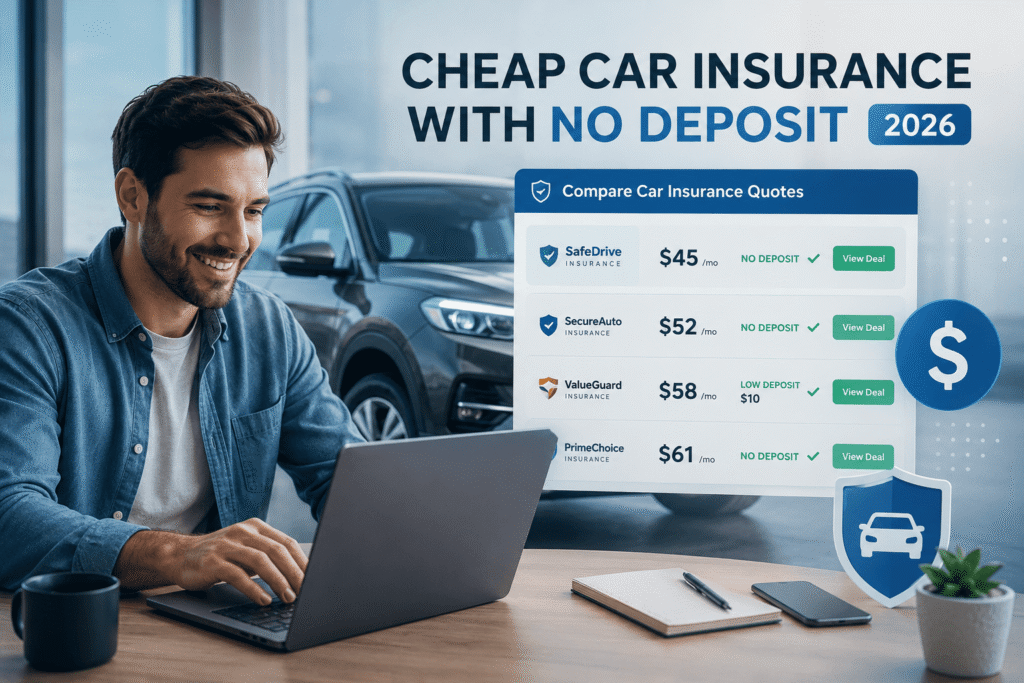
When drivers search for no deposit car insurance, they are usually looking for coverage that requires little or no money upfront.
However, insurance companies generally require at least the first month’s premium before coverage begins.
As a result, advertisements promoting “no deposit insurance” often refer to:
- Low down payment insurance
- Flexible monthly billing plans
- Reduced upfront costs
- Same-day coverage options
In reality, most insurers collect some payment before activating your policy.
Understanding this distinction can help you avoid misleading offers and focus on finding the most affordable overall coverage.
Why “No Deposit Insurance” Is Often Misleading
Insurance companies assume financial risk the moment a policy becomes active.
For this reason, insurers typically require:
- Initial premium payments
- Payment verification
- Policy activation fees (in some cases)
A company that truly offered $0 upfront coverage would be providing insurance before receiving any payment, which creates significant financial risk.
Because of this, most “no deposit” advertisements are actually marketing terms describing low upfront payment plans.
Consumers should carefully read policy details and understand exactly how much is required before coverage starts.
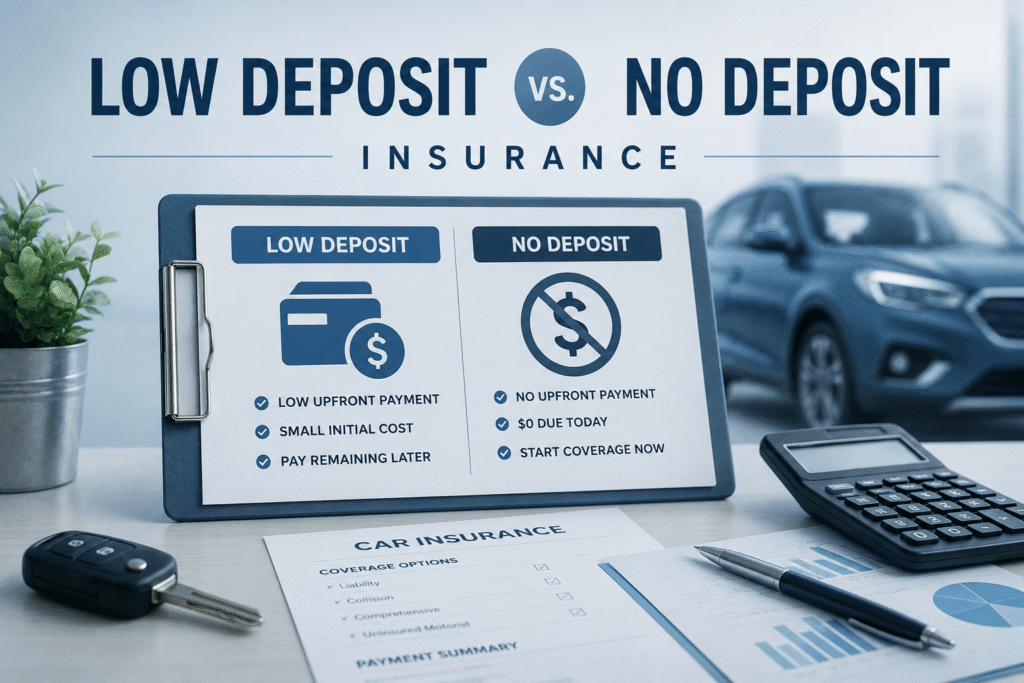
Low Deposit vs No Deposit Insurance
Many drivers confuse these two terms.
| Feature | Low Deposit Insurance | No Deposit Insurance |
|---|---|---|
| Exists in market | Common | Rare |
| Upfront payment | Small payment required | No payment required |
| Availability | Widely available | Extremely limited |
| Monthly payments | Usually available | Usually required |
| Realistic option | Yes | Usually not |
For most drivers, a low down payment policy is the practical alternative to true no-deposit insurance.
Can You Really Get Car Insurance With $0 Down?
In most cases, the answer is no.
Insurance companies generally require payment before assuming the risk of insuring a driver.
While some promotional offers may advertise:
- $20 down car insurance
- $30 down car insurance
- Same-day insurance with low upfront costs
these plans still require some payment before coverage becomes active.
Instead of searching for impossible $0 down coverage, drivers should focus on:
- Lowering initial costs
- Reducing monthly premiums
- Comparing multiple insurers
- Maximizing available discounts
Average First Payment by Driver Type
The amount required upfront varies significantly depending on your driving profile.
| Driver Type | Typical First Payment |
|---|---|
| Good Driver | $50-$150 |
| New Driver | $150-$300 |
| Young Driver | $150-$400 |
| Driver With Accident | $200-$500 |
| DUI Driver | $300-$800 |
| SR-22 Driver | $250-$600 |
Actual costs vary by state, insurer, vehicle, and coverage level.
Drivers with clean records generally qualify for the lowest initial payments.
Best Insurance Companies for Low Deposit Plans
Although true no-deposit insurance rarely exists, some insurers are known for flexible billing options.
Progressive
Progressive is often considered one of the better options for drivers seeking low upfront payments. Flexible billing plans and customizable coverage options can help reduce initial costs.
Progressive is particularly popular among higher-risk drivers and those with previous accidents.
GEICO
GEICO frequently offers competitive pricing for drivers with clean driving records. Many customers can choose monthly billing options that reduce the amount required upfront.
State Farm
State Farm may provide savings opportunities through bundling discounts. Drivers who combine auto and home insurance may qualify for lower overall costs.
Dairyland
Dairyland is commonly used by high-risk drivers, including those requiring SR-22 filings. Flexible payment plans may be available depending on state regulations.
National General
National General may offer payment flexibility for drivers who need affordable monthly coverage while maintaining required insurance limits.
👉 Compare Quotes From Multiple Insurers
Compare Low Down Payment Insurance Options
| Insurance Company | Low Upfront Payment Potential | Monthly Billing Available | Best For |
|---|---|---|---|
| Progressive | High | Yes | Budget-conscious drivers |
| GEICO | Medium-High | Yes | Clean driving records |
| State Farm | Medium | Yes | Bundle discounts |
| Dairyland | Medium | Yes | Higher-risk drivers |
| National General | Medium | Yes | Flexible payment needs |
Remember that the lowest first payment does not always result in the lowest overall policy cost.
Real-Life Example: Comparing Insurance Costs
Consider two drivers shopping for coverage.
Option A
- Initial Payment: $50
- Monthly Premium: $220
- Six-Month Total Cost: $1,150
Option B
- Initial Payment: $180
- Monthly Premium: $150
- Six-Month Total Cost: $930
Many drivers choose Option A because of the lower upfront payment.
However, Option B actually saves $220 over the policy term.
This example highlights why total policy cost matters more than focusing solely on the first payment.
No Deposit Car Insurance in California
California drivers frequently search for no deposit car insurance because insurance costs are often higher than the national average.
In areas such as:
- Los Angeles
- Orange County
- Riverside
- San Bernardino
- San Diego
premiums can vary significantly between insurers.
To reduce upfront costs, California drivers should:
- Compare multiple insurance companies
- Select monthly payment plans
- Maintain continuous coverage
- Improve driving records
- Take advantage of available discounts
Insurance rates in California are heavily influenced by:
- ZIP code
- Driving history
- Vehicle type
- Annual mileage
- Coverage limits
This makes comparison shopping especially important.
For more information, see our guide:
Minimum Car Insurance Requirements by State
Who Should Consider Low Down Payment Insurance?
Low down payment insurance may be appropriate for:
New Drivers
Drivers purchasing insurance for the first time often have limited cash available and may benefit from lower initial costs.
Drivers Facing Temporary Financial Challenges
A lower first payment can help maintain legal coverage while managing short-term cash flow.
Drivers Switching Insurance Companies
Some insurers offer promotional payment structures designed to reduce initial expenses.
Drivers Needing Same-Day Coverage
When insurance is needed immediately, a low upfront payment plan may provide a practical solution.
Who Should Avoid It?
Low down payment insurance is not always the best choice.
Drivers should be cautious if:
- Monthly premiums are significantly higher
- Installment fees apply
- Coverage levels are reduced
- The total policy cost increases substantially
In many cases, paying slightly more upfront results in lower overall insurance expenses.
Hidden Costs to Watch Out For
Some policies advertised as low deposit or no deposit insurance may include additional charges.
Installment Fees
Monthly billing plans often include administrative fees.
Higher Premiums
Lower upfront payments may result in higher monthly costs.
Policy Processing Fees
Certain insurers charge setup or policy issuance fees.
Late Payment Penalties
Missing a payment can result in:
- Reinstatement fees
- Coverage lapses
- Policy cancellation
Always review the complete payment schedule before purchasing coverage.
Common Mistakes Drivers Make
Many drivers focus only on the first payment and overlook important details.
Common mistakes include:
❌ Choosing the first quote received
❌ Comparing only upfront costs
❌ Ignoring installment fees
❌ Buying minimum coverage without understanding risks
❌ Allowing coverage to lapse
❌ Failing to compare multiple insurers
Avoiding these mistakes can save hundreds of dollars per policy term.
How to Lower Your First Insurance Payment
Compare Multiple Quotes
The most effective strategy is comparing several insurers before purchasing coverage.
For detailed tips, see:
How to Compare Car Insurance Quotes
Increase Your Deductible
A higher deductible may reduce premium costs.
Related guide:
How Deductibles Affect Car Insurance Premiums
Maintain Continuous Coverage
Coverage lapses often increase insurance costs.
Related guide:
What Is Force-Placed Insurance?
Bundle Policies
Combining auto and home insurance may qualify for additional discounts.
Improve Driving Habits
Safe drivers generally receive better rates and lower upfront payment requirements.
Frequently Asked Questions
Does No Deposit Car Insurance Really Exist?
In most cases, no. Most insurance companies require some payment before coverage begins.
Can I Get No Deposit Insurance After a DUI?
Drivers with DUI convictions can still obtain coverage, but insurers typically require larger upfront payments due to increased risk.
For more information:
Best Car Insurance After a DUI
Can I Get Low Down Payment Insurance With Bad Credit?
Some insurers may offer flexible payment plans, although monthly premiums may be higher.
Which Company Offers the Lowest First Payment?
There is no single insurer that consistently offers the lowest upfront payment. Costs vary based on location, driving history, vehicle, and coverage needs.
Is Monthly Billing Better Than Paying in Full?
Monthly billing reduces upfront costs but often increases total policy expenses due to installment fees.
Final Verdict
Cheap car insurance with no deposit is largely a marketing term rather than a true insurance product.
Most drivers will still need to make some form of initial payment before coverage begins.
The key is not finding a policy with absolutely zero upfront cost.
Instead, focus on:
- Comparing multiple quotes
- Evaluating total policy costs
- Reviewing installment fees
- Maintaining continuous coverage
- Choosing appropriate coverage limits
For most consumers, a low down payment policy combined with affordable monthly premiums offers the best balance between cost and coverage.
Drivers who compare multiple insurers and understand the full cost of a policy typically save more money than those who focus only on the first payment.
Sources
- Insurance Information Institute
- National Association of Insurance Commissioners
- California Department of Insurance
Ready to Compare Cheap Car Insurance?
Find affordable coverage, lower your first payment, and compare multiple insurers in minutes.
About the Author
SaveMoneyInUSA Editorial Team researches car insurance, personal finance, banking products, and money-saving strategies for consumers in the United States.
Learn more about our Editorial Team.
Disclaimer
SaveMoneyInUSA is an independent informational website and is not an insurance company, broker, or agent.
Some links may be affiliate links. We may receive compensation from partners at no additional cost to users.
Insurance rates, coverage options, and eligibility vary by provider and individual circumstances.
This content is provided for educational purposes only and should not be considered insurance, legal, or financial advice.