

Last Updated: September 2026

The best SR-22 insurance company is not the same for every driver. Progressive, GEICO, State Farm, Dairyland, The General, and Direct Auto are useful companies to compare because they publish information about SR-22 filings, serve drivers with different risk profiles, or provide agent support. However, availability, acceptance, filing methods, and prices vary by state and applicant.
An SR-22 is not a separate type of car insurance. It is a certificate an insurer files with the state to show that a driver has the required liability coverage. The company that offers the lowest standard premium may not accept your violation, provide the filing your state requires, or offer the right owner or non-owner policy. This guide shows what to compare before choosing.
Free to compare. No obligation to purchase.
Best SR-22 Insurance Companies to Compare in 2026
There is no reliable nationwide winner because insurers price the underlying violation, driver, vehicle, coverage, and location differently. The table below identifies practical starting points rather than declaring one company cheapest for everyone.
| Company | Why it may be worth comparing | What to confirm before buying |
|---|---|---|
| Progressive | Official SR-22 guidance, online and phone service, and information about non-owner SR-22 policies | Acceptance of your violation, state filing availability, and whether an owner or non-owner policy fits |
| GEICO | Official SR-22/FR-44 information and direct assistance for policyholders who need a filing | Eligibility, filing method, total premium, and whether the requested filing is available in your state |
| State Farm | Large local-agent network and official guidance about SR-22 requirements | Whether the local underwriting company will accept your record and complete the required filing |
| Dairyland | Focus on nonstandard auto insurance; official site says electronic filing is available in most states and it often does not charge a filing fee | State availability, policy fees, payment schedule, non-owner eligibility, and exact filing time |
| The General | Official SR-22 support and experience serving drivers who may have difficulty in the standard market | Coverage options, down payment, installment fees, state availability, and total term cost |
| Direct Auto | Official SR-22 guidance with phone and local-office support in its service area | Whether it operates in your state, filing timing, policy limits, fees, and renewal terms |
How We Evaluated SR-22 Insurance Companies
We included companies that publicly explain SR-22 or FR-44 filings, provide standard or nonstandard auto insurance, and offer a practical way to request help. We did not rank companies by an advertised national average because that figure may not predict the rate for a driver with a specific violation in a specific ZIP code.
- Filing support: Does the insurer confirm that it can file an SR-22 or help determine what form is required?
- Driver fit: Does it serve standard-risk, high-risk, or both types of applicants?
- Policy fit: Can it quote an owner policy, a non-owner policy, or the coverage required for a financed vehicle?
- Access: Can the driver get help online, by phone, through an agent, or at a local office?
- Comparison value: Does the company give the driver a meaningfully different underwriting or service option to compare?
Financial strength, complaint information, claims service, policy terms, and the complete six- or twelve-month cost should also be reviewed before purchase. A low initial payment alone does not establish that a policy is the best value.
What to Know About Each SR-22 Company
Progressive
Progressive states that an SR-22 proves a policy meets the applicable state coverage requirement. Its official guidance tells new customers to complete a quote and request the filing when purchasing a policy. Progressive also publishes information about non-owner SR-22 coverage for a driver who does not own a vehicle.
Progressive may be a useful first quote because it offers online, phone, and independent-agent access. That does not mean it will accept every violation or provide the lowest rate. Confirm that the policy start date and filing date satisfy the notice from your state.
GEICO
GEICO has a dedicated SR-22 information page and instructs current policyholders who need an SR-22 or FR-44 to contact the company. It can be worth comparing for drivers who prefer a direct online and phone-service model.
Do not assume an existing policy will automatically include the filing. Tell GEICO the exact form, state, case or reference number, and deadline shown on your notice. Ask whether the filing changes your policy, payment schedule, or renewal eligibility.
State Farm
State Farm publishes guidance explaining that an SR-22 is a certificate filed to confirm coverage, and its local-agent network may help drivers who want to discuss reinstatement paperwork in person. Agent access can be valuable when a driver has multiple vehicles, household drivers, or an out-of-state issue.
State Farm should be treated as a quote to check, not a guaranteed option. Ask the agent whether the underwriting company serving your state will accept your driving record and file the exact certificate required.
Dairyland
Dairyland focuses on drivers who may need nonstandard coverage. Its official site says it can issue an SR-22 promptly, send it electronically in most states, and often file it without a separate filing fee. Dairyland also explains that a non-owner policy may satisfy an SR-22 requirement in some situations.
Those published features make Dairyland a useful specialist quote. Still compare the entire policy cost, installment fees, coverage limits, exclusions, and cancellation terms. “No filing fee” does not mean the underlying insurance premium will be low.
The General
The General provides an official SR-22 product page and explains that the insurer generally files the certificate showing the required liability coverage. Its materials also describe the SR-26 notice used when the related coverage is canceled.
The General may be worth checking when a standard carrier declines the application or will not file the form. Compare the down payment and all scheduled payments rather than only the first-month amount, and verify that the limits meet both the state order and your coverage needs.
Direct Auto
Direct Auto publishes SR-22 guidance and offers phone and local-office support within its operating footprint. This can be useful for a driver who wants help reviewing documents or who cannot complete the process entirely online.
Direct Auto is not available everywhere. Confirm state availability before relying on it, then compare coverage, fees, payment terms, and the time required for the state to receive the filing.
Standard Insurer or High-Risk Specialist?
A large standard insurer may still offer coverage and file an SR-22, especially when the driver has one violation and an otherwise stable history. A nonstandard or high-risk specialist may accept situations that some standard carriers decline. Neither category is automatically cheaper.
| Comparison point | Standard-market insurer | High-risk or nonstandard specialist |
|---|---|---|
| Possible advantage | Broader products, established agent or digital service, and potential bundling | More focus on violations, suspensions, lapses, and financial-responsibility filings |
| Possible limitation | May decline or nonrenew certain driving records | May have higher total costs, more fees, or fewer optional features |
| Best use | Obtain at least one quote if eligible | Obtain at least one quote when standard options are limited or unavailable |
If a DUI or serious violation caused the requirement, also review our guides to car insurance for high-risk drivers and comparing car insurance after a DUI.
Owner vs. Non-Owner SR-22 Insurance
The correct policy depends on whether you own a vehicle and how you drive. The SR-22 is attached to qualifying insurance; it does not replace the policy.
- You own a car: You generally need a regular owner auto policy that lists the vehicle and includes the required filing.
- You finance or lease a car: The lender or lessor may require collision and comprehensive coverage in addition to state-required liability and the SR-22 filing.
- You do not own a car: A non-owner liability policy with an SR-22 filing may be available, depending on the state and insurer.
- You regularly drive a household vehicle: A non-owner policy may not be appropriate; the insurer may require you to be listed on that vehicle’s policy.
Non-owner coverage normally does not provide collision or comprehensive coverage for the vehicle you drive. If you own, finance, or lease a vehicle, review the difference between full coverage and liability insurance before selecting a policy.
Policy-Type Decision Check
- Do you own, finance, or lease any vehicle?
- Do you live with a vehicle owner or regularly drive the same car?
- Does your state notice require an owner’s, operator’s, or broad-form certificate?
- Will the policy cover your actual use of borrowed or rented vehicles?
- Are all household drivers and vehicles disclosed accurately?
Give the insurer complete information before requesting the filing. Buying the wrong policy can leave a coverage problem even if a certificate is submitted.
How to Compare SR-22 Quotes Correctly
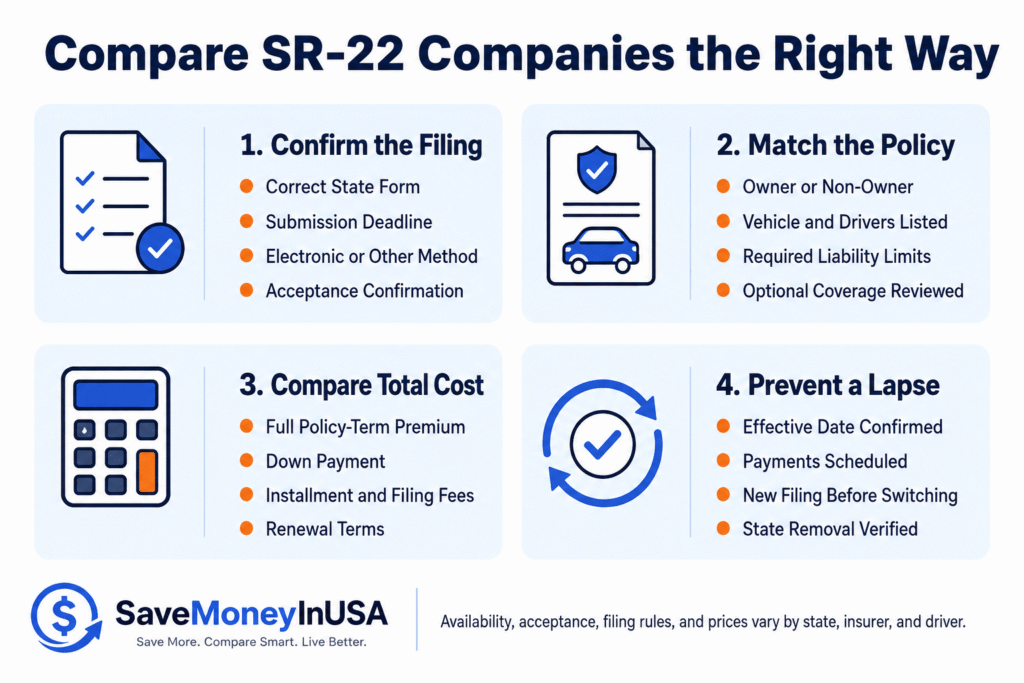
Request quotes using the same driver, vehicle, address, coverage limits, deductibles, and policy term. Then compare the following items line by line:
- Filing: Can the insurer submit the exact SR-22, FR-44, or other form required by the state?
- Timing: When will the filing be sent, and how can you confirm acceptance?
- Coverage: Are liability limits and optional coverages identical across quotes?
- Term cost: What is the complete six- or twelve-month premium?
- Payment cost: What are the down payment, installment charges, autopay rules, and late fees?
- Policy type: Is it an owner or non-owner policy, and does it match how you drive?
- Cancellation risk: What happens if a payment is late or the policy is canceled?
- Renewal: Is the quoted rate introductory, and when will the driving record be reviewed again?
Our car insurance quote comparison guide explains how to keep quote inputs consistent. Do not cancel an existing policy until the replacement coverage is active and the required filing has been handled.
Ask Every Insurer These Five Questions
- Will you accept my exact violation and license status?
- Can you file the required form with my state by the deadline?
- Is this the correct owner or non-owner policy for my situation?
- What is the total policy-term cost, including filing and installment fees?
- How will I confirm that the state accepted the filing?
Record the answers with the quote. This creates a useful comparison even when two companies present prices in different ways.
How the SR-22 Filing Process Works
- Read the notice: Identify the required form, state, deadline, case number, and reinstatement steps.
- Request matching quotes: Disclose the violation, suspension, vehicle ownership, household drivers, and required filing.
- Choose and activate coverage: Confirm the exact effective date and time before driving.
- The insurer files the certificate: Electronic or other accepted filing methods depend on the state and company.
- Complete other state requirements: An SR-22 does not replace reinstatement fees, court conditions, education programs, or other required steps.
- Verify status: Confirm with the appropriate state agency that all conditions have been satisfied before assuming driving privileges are restored.
Rules and filing periods vary. Use the notice issued for your case and the appropriate state agency rather than relying on a general national timeline. Our State Insurance Requirements Resource Center can help you locate related state guidance.
Why Continuous Coverage Matters
When a policy connected to an SR-22 is canceled or lapses, the insurer may notify the state through an SR-26 or another required process. The result may include a new suspension, additional fees, or a restarted filing period, depending on state law and the reason for the requirement.
- Schedule payments before the due date and monitor the account.
- Update the insurer promptly if you move, replace a vehicle, or change household drivers.
- Do not switch insurers without arranging the new policy and filing first.
- Do not remove the SR-22 merely because you believe the required period has ended; verify with the state.
If you move to another state, contact both the state that imposed the requirement and the insurer before changing the policy. Moving does not necessarily end an existing filing obligation.
How Much Does SR-22 Insurance Cost?
The filing fee and the insurance premium are separate. A company may charge a small filing fee—or no separate filing fee—while the underlying policy remains expensive because of the DUI, uninsured driving, suspension, accident, or other event that triggered the requirement.
Your state, ZIP code, age, driving record, vehicle, policy type, coverage limits, deductibles, credit-based insurance information where permitted, and prior coverage can all affect the quote. For a detailed cost discussion, see SR-22 insurance cost by state. This page focuses on choosing companies and comparing filings rather than repeating state-by-state estimates.
SR-22 vs. FR-44
An FR-44 is another financial-responsibility certificate used for certain violations in Florida and Virginia. It can require higher liability limits than an SR-22. Florida also uses SR-22 filings in some circumstances, so drivers should not assume that every Florida case requires the same form.
Give the insurer the exact notice instead of asking generally for “SR-22 insurance.” The wrong form or limits may not satisfy the order.
Common Mistakes When Choosing an SR-22 Company
- Choosing by company name alone: A familiar insurer may not be the best fit for your record or state.
- Comparing different coverage: A lower quote may use lower limits, higher deductibles, or fewer optional coverages.
- Looking only at the down payment: Add all installments and fees to compare the full term.
- Buying the wrong policy type: Non-owner coverage generally is not appropriate for a vehicle you own.
- Assuming filing equals reinstatement: Other state or court requirements may remain.
- Creating a coverage gap: Canceling too early can trigger reporting and further consequences.
Frequently Asked Questions
Which insurance company is best for SR-22?
No company is best for every SR-22 driver. Progressive, GEICO, State Farm, Dairyland, The General, and Direct Auto are reasonable companies to investigate, but the best fit depends on state availability, acceptance of the violation, filing support, coverage, total cost, and service.
Can any insurance company file an SR-22?
No. Not every insurer offers every filing in every state or accepts every driver. Confirm eligibility and filing capability before purchasing the policy.
Can I get an SR-22 without owning a car?
Possibly. Some insurers offer a non-owner liability policy with an SR-22 filing when the driver does not own a vehicle. State rules, household vehicle access, and insurer requirements still apply.
Does an SR-22 cover an accident?
No. The certificate itself does not pay claims. The underlying auto policy provides coverage according to its limits, terms, and exclusions.
How fast can an insurer file an SR-22?
Timing varies by insurer and state. Some companies advertise same-day electronic filing in many states, but drivers should ask for the expected filing time and confirm acceptance with the appropriate state agency.
Should I choose the company with no SR-22 filing fee?
Not based on that fact alone. The filing fee may be small compared with the policy premium, installment charges, and coverage differences. Compare the complete term cost and policy terms.
Final Takeaway
The best SR-22 insurance company is the one that accepts your actual record, files the correct certificate on time, provides the right owner or non-owner policy, and offers competitive total cost for the coverage you need. Progressive, GEICO, State Farm, Dairyland, The General, and Direct Auto provide useful starting points, but none is a universal winner.
Compare at least one standard insurer and one company experienced with high-risk drivers when possible. Keep the quote inputs identical, verify the filing and policy effective dates, and maintain continuous coverage for the full period required by your state.
Sources
- Progressive — What Is an SR-22?
- GEICO — SR-22 and Insurance
- State Farm — Suspended Driver’s License and SR-22
- Dairyland — What Is SR-22 Insurance?
- The General — SR-22 Insurance
- Direct Auto — Explaining SR-22
- California DMV — Insurance Requirements
- Florida Highway Safety and Motor Vehicles — DUI and FR-44 Requirements
- Virginia DMV — SR-22/SR-26 and FR-44/FR-46 Certifications
About the Author
The SaveMoneyInUSA Editorial Team researches car insurance costs, coverage options, state requirements, and quote comparison considerations for drivers in the United States.
Learn more about our Editorial Team.
Disclaimer
SaveMoneyInUSA is an independent informational website and is not an insurance company, broker, or agent.
Some links may be affiliate links. We may receive compensation from partners at no additional cost to users.
Insurance rates, coverage options, eligibility, filing availability, state requirements, discounts, and policy terms vary by insurer, driver, vehicle, location, violation, and time.
This content is provided for educational purposes only and should not be considered insurance, legal, or financial advice. Verify the current order with the state or court that issued it.