

Last Updated: September 2026

Non-owner car insurance may fit an international student who does not own a vehicle but occasionally borrows or rents one. It usually focuses on liability coverage for damage or injuries you cause to other people. It generally does not insure a vehicle you own, provide collision or comprehensive coverage for the car you are driving, or automatically solve every rental-car coverage gap.
The key question is not simply whether you lack a car. You must also consider how often you drive, whether you regularly use a household vehicle, whether the insurer accepts your license, and what protection already applies to the borrowed or rented car. This guide explains when a non-owner policy may fit and when another arrangement is more appropriate.
Availability, license acceptance, coverage, and eligibility vary by state and insurer. A quote is not active coverage.
What Is Non-Owner Car Insurance?
Non-owner car insurance is a personal auto policy designed for an eligible driver who does not own a vehicle. It commonly provides liability coverage when that driver uses a vehicle they do not own, subject to the policy’s terms, exclusions, and limits.
The vehicle owner’s policy may apply first after an accident. A non-owner policy may provide additional or excess liability protection in a covered situation. The order of coverage is not identical in every state or policy, so confirm it with the insurer instead of assuming which policy pays first.
Non-owner insurance is not a substitute for a standard auto policy when you own, finance, or lease a car. For a broader overview of other student driving situations, start with our international student car insurance guide.
Quick Fit Check
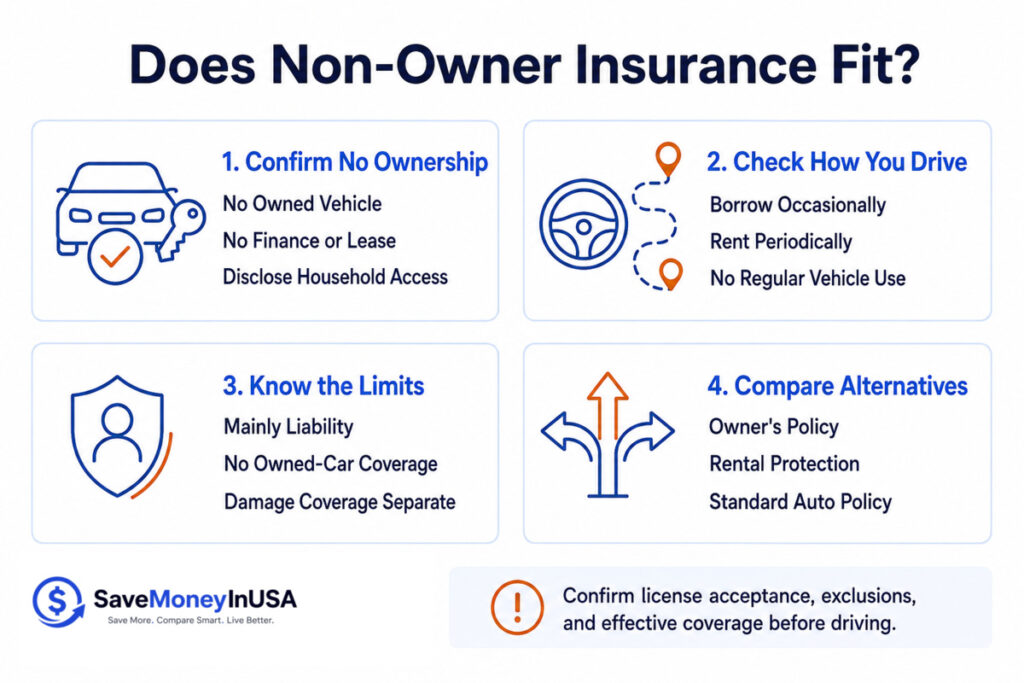
- May fit: you do not own a car and only borrow or rent vehicles occasionally.
- May fit: you need continuous liability coverage or an eligible non-owner SR-22 filing.
- Usually not the right fit: you own, finance, or lease a vehicle.
- May not fit: you regularly drive the same household or roommate’s vehicle.
- Not enough by itself: you need protection for physical damage to a borrowed or rented car.
What Does a Non-Owner Policy Cover?
A typical non-owner policy centers on bodily injury and property damage liability. Depending on the state and insurer, it may also offer uninsured or underinsured motorist coverage, medical payments coverage, or personal injury protection.
| Coverage question | Typical starting point | What to confirm |
|---|---|---|
| Injuries or property damage you cause | Liability may apply | Limits, exclusions, and whether other insurance applies first |
| Damage to the car you borrow | Usually not covered | Owner’s collision coverage and any applicable deductible |
| Damage to a rental car | Usually not covered by non-owner liability | Rental agreement, loss-damage waiver, and eligible card benefits |
| Your own injuries | Varies | Medical payments, PIP, or health coverage |
| Uninsured or underinsured driver | May be available or required | State rules, limits, and rejection options |
| Personal belongings | Usually not covered | Renters, homeowners, or travel insurance terms |
The National Association of Insurance Commissioners notes that a non-owner policy may provide benefits beyond rental-car coverage, but it also recommends checking liability protection and collision-damage options separately. Read the actual policy rather than relying only on a sales summary.
Can International Students Buy Non-Owner Insurance?
Some international students may qualify, but approval is not guaranteed. Insurers can differ in whether they accept a foreign driver’s license, require a U.S. license, offer non-owner policies in the state, or can verify limited U.S. driving and insurance history.
First confirm that you may legally drive under the rules of the state where you live and drive. An International Driving Permit generally serves as a translation or companion document and is not a standalone driver’s license. Insurance acceptance is a separate decision from state driving eligibility. See our guide to car insurance with a foreign license for the licensing questions.
When requesting a quote, provide your real license type, U.S. address, driving frequency, and vehicle access. The insurer may request license information, address details, prior driving or insurance records, and other identification. Requirements vary, so use our international student insurance document checklist without assuming every listed document is mandatory.
Borrowing a Car: Non-Owner Policy or Owner’s Policy?
If you occasionally borrow a friend’s car, ask how the owner’s insurance treats permissive drivers and how your non-owner coverage would coordinate with it. Permission to use the car does not guarantee that every driver, use, or claim is covered.
If you live with the owner or regularly use the same vehicle, the insurer may require you to be disclosed, listed, rated, or excluded where state law permits. In that situation, being properly added to the vehicle’s policy may be more appropriate than buying a separate non-owner policy.
Ask Before You Borrow
- Does the owner’s policy allow you to drive the vehicle?
- Must household or regular drivers be listed?
- Which policy applies first to a liability claim?
- What protects the borrowed vehicle from physical damage?
- Are delivery, rideshare, or other business uses excluded?
Non-Owner Insurance vs. Rental-Car Protection
Non-owner insurance and rental-company protection serve different purposes. A non-owner policy may provide liability coverage for eligible rental use, but it usually does not replace a collision or loss-damage waiver for damage to the rental vehicle.
Before renting, compare four separate areas: liability to other people, damage or theft involving the rental car, medical protection, and personal belongings. Also check whether an eligible credit card provides collision or theft benefits and whether those benefits are primary or secondary. Do not assume a card includes liability coverage.
How Much Does Non-Owner Car Insurance Cost?
There is no reliable single price for every international student or new driver. Non-owner insurance may cost less than a policy covering a specific vehicle because it generally does not include collision or comprehensive coverage for an owned car. Your actual quote can still vary substantially.
- State and location
- Age and driving experience
- License type and verifiable driving record
- Prior insurance history and coverage gaps
- Liability limits and optional coverages
- Violations, claims, and any required filing
- Insurer underwriting and available payment plans
Compare the total cost for the same policy term, not only the monthly payment. Review the amount due at purchase, installment fees, liability limits, optional coverages, and cancellation terms.
Non-Owner Insurance and SR-22 Filings
A driver who does not own a vehicle may sometimes use a non-owner policy for a required SR-22 or similar financial-responsibility filing. This depends on the state, insurer, license status, vehicle access, and reason for the filing. The SR-22 is generally proof filed by an insurer; it is not a separate coverage type.
Do not buy a non-owner policy if you actually own a vehicle or regularly use one without fully disclosing that fact. Confirm the exact filing form, deadline, limits, and continuous-coverage period with the relevant state agency and insurer. Our SR-22 cost guide explains how the filing and the underlying policy affect total cost.
How to Compare Non-Owner Insurance Quotes
- Confirm that non-owner coverage fits. Disclose whether you own a car, live with a vehicle owner, or regularly use a specific vehicle.
- Verify license acceptance. Ask whether the insurer accepts your current foreign or U.S. license.
- Use matching liability limits. Compare the same bodily injury and property damage limits on every quote.
- Check optional coverage. Ask about uninsured motorist, underinsured motorist, medical payments, or PIP where available.
- Review vehicle-use exclusions. Confirm rules for borrowed, household, rental, car-sharing, delivery, rideshare, and business use.
- Confirm how other insurance applies. Ask whether the policy is primary, excess, or unavailable in each driving situation.
- Compare the full term. Review the down payment, installments, fees, discounts, and total premium.
- Verify activation. Do not drive until you receive confirmation of the policy number, effective date and time, and proof of insurance.
Use the same information for every company. Our car insurance quote comparison guide provides a reusable process.
Common Non-Owner Insurance Mistakes
- Assuming the owner’s policy always covers you: driver, household, and use restrictions can matter.
- Expecting damage coverage for the borrowed car: non-owner liability normally does not provide collision or comprehensive protection for that vehicle.
- Using a non-owner policy for a car you own: an owned vehicle normally needs a standard policy.
- Hiding regular access to a vehicle: disclose household and recurring use accurately.
- Confusing an IDP with a license: an IDP does not independently authorize driving.
- Comparing only price: limits, exclusions, effective time, and policy coordination can matter more after a claim.
Frequently Asked Questions
Do international students always need non-owner car insurance?
No. It may be worth reviewing if you do not own a car but occasionally drive. It may be unnecessary or unsuitable if you never drive, already have appropriate coverage, own a car, or regularly use a household vehicle that should list you.
Can I buy non-owner insurance with a foreign license?
Possibly. Acceptance varies by insurer and state. First confirm that your license is valid for driving in the state, then ask the insurer whether it accepts that license for a non-owner policy.
Does non-owner insurance cover rental cars?
It may provide liability coverage for eligible rental use, depending on the policy. It usually does not cover physical damage to the rental vehicle, so review the rental company’s options and any eligible card benefits separately.
Does a non-owner policy cover my roommate’s car?
Do not assume it does. If you live with the owner or regularly use the car, the insurer may require another arrangement. Disclose the household and vehicle-access situation to both insurers.
Should I keep non-owner insurance after buying a car?
Usually not as your only policy. Before taking ownership, arrange a standard policy that correctly lists the vehicle, drivers, garaging address, and any lender. Avoid a gap when switching.
Final Takeaway
Non-owner car insurance can be a practical liability option for an eligible international student who does not own a vehicle and drives only occasionally. It is not designed for a car you own or regularly use, and it usually does not pay for physical damage to a borrowed or rented vehicle.
Confirm state driving rules, insurer acceptance, household access, rental-car gaps, limits, exclusions, and total cost before choosing a policy. If you are a new immigrant rather than a student, review our separate new immigrant car insurance guide.
Sources
- National Association of Insurance Commissioners — Auto Insurance Consumer Information
- National Association of Insurance Commissioners — Uber or Lyft? Protect Yourself When Ridesharing
- National Association of Insurance Commissioners — Auto Insurance Shopping Tool
- USA.gov — Driving in the U.S. if You Are Not a Citizen
About the Author
The SaveMoneyInUSA Editorial Team researches car insurance costs, coverage options, state requirements, and quote comparison considerations for drivers in the United States.
Learn more about our Editorial Team.
Disclaimer
SaveMoneyInUSA is an independent informational website and is not an insurance company, broker, or agent.
Some links may be affiliate links. We may receive compensation from partners at no additional cost to users.
Insurance rates, coverage options, eligibility, discounts, licensing requirements, and policy terms vary by insurer, state, driver, vehicle, and time.
This content is provided for educational purposes only and should not be considered insurance, legal, immigration, or financial advice.