

Last Updated: August 2026
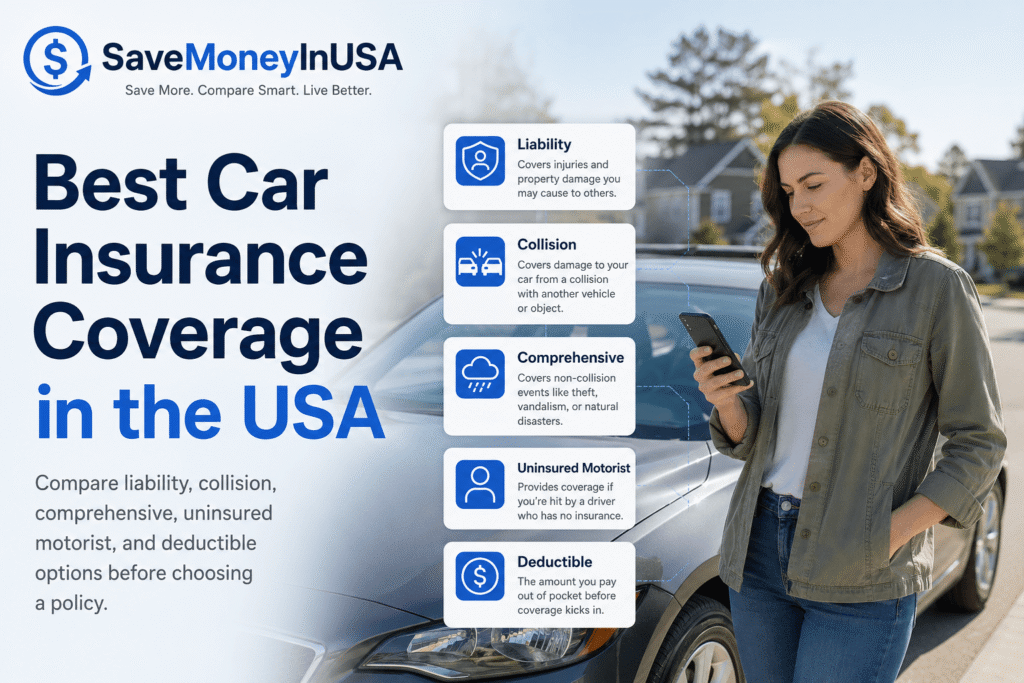
What is the best car insurance coverage in the USA? The answer is not simply “full coverage” or the cheapest state minimum. The right policy should protect your income, savings, vehicle, passengers, and legal obligations without making you pay for coverage that no longer provides enough value.
For many drivers, the biggest risk is not paying a slightly higher premium. It is discovering after a serious crash that their liability limits are too low, their own vehicle is not covered, or an uninsured driver leaves them with major expenses.
The practical goal is to build a balanced policy: adequate liability limits, protection for your vehicle when financially justified, uninsured/underinsured motorist coverage where available, and deductibles you could realistically pay after a claim.
This complete guide explains the major coverage types, what most drivers should consider, when full coverage may or may not make sense, how to choose limits and deductibles, and which optional protections may be worth adding.
Comparing the same coverage limits and deductibles across several insurers can help you find a better price without weakening your protection.
What Does Car Insurance Coverage Include?
A personal auto policy is usually made up of several separate coverages. Each one responds to a different type of loss, and state requirements vary. Before comparing prices, understand what each coverage is designed to do.
| Coverage | What It Generally Pays For | Who or What It Protects |
|---|---|---|
| Liability | Injuries and property damage you cause to others | Other people; also helps protect your assets |
| Collision | Damage to your vehicle from a crash or rollover, subject to a deductible | Your vehicle |
| Comprehensive | Theft, vandalism, fire, weather, falling objects, animal strikes, and other non-collision losses | Your vehicle |
| Uninsured/Underinsured Motorist | Covered losses caused by a driver with no insurance or insufficient limits | You and covered occupants, depending on state rules |
| PIP or Medical Payments | Certain medical expenses for you and passengers, subject to policy and state rules | You and covered occupants |
| Rental Reimbursement | A rental vehicle while your covered car is being repaired after a covered loss | Your transportation needs |
| Roadside Assistance | Towing, jump-starts, lockouts, or similar services | Your immediate roadside needs |
The National Association of Insurance Commissioners explains that collision generally covers damage to your vehicle from hitting another car or object, while comprehensive generally covers non-collision losses such as theft, fire, vandalism, weather, or animal damage.
When shopping, compare identical limits, deductibles, drivers, vehicles, and optional coverages. Otherwise, the cheapest quote may simply provide less protection. See our guide on how to compare car insurance quotes.
Liability Coverage: The Foundation of Your Policy
Liability insurance pays covered claims when you are legally responsible for injuring someone or damaging another person’s property. It normally has two main parts:
- Bodily injury liability: may pay covered medical costs, lost income, legal defense, settlements, or judgments arising from injuries you cause.
- Property damage liability: may pay for damage you cause to another vehicle, building, fence, or other property.
Liability coverage does not normally pay to repair your own car or cover your own injuries. State minimum limits are legal floors, not a personalized recommendation. A serious accident can exceed low minimum limits quickly, leaving you responsible for the remaining amount.
How to Read Split Liability Limits
A limit such as 100/300/100 generally means up to $100,000 of bodily injury liability per injured person, up to $300,000 total bodily injury liability per accident, and up to $100,000 of property damage liability per accident. This is an example of a commonly considered limit structure—not a universal answer for every driver.
Drivers with income, savings, a home, or other assets may have more to protect and may want to discuss higher limits with a licensed insurance professional. An umbrella policy may also require certain underlying auto liability limits.
Liability-Only vs Full Coverage
“Full coverage” is an informal term, not a standardized policy name. It usually refers to a policy that includes liability, collision, and comprehensive coverage. It does not mean that every possible loss is covered or that the policy has unlimited protection.
| Feature | Liability-Only | Common “Full Coverage” Package |
|---|---|---|
| Damage you cause to others | Yes, up to policy limits | Yes, up to policy limits |
| Damage to your own car from a collision | No | Generally yes, after deductible |
| Theft, vandalism, fire, weather, animal strike | No | Generally yes under comprehensive, after deductible |
| Usually costs less | Yes | No |
| Often required by a lender or lessor | Usually insufficient | Collision and comprehensive are commonly required |
Read our detailed comparison of full coverage vs liability insurance before removing physical damage protection from your vehicle.
What Coverage Do Most Drivers Really Need?
Most drivers should start by evaluating five layers of protection rather than choosing a package based only on the monthly price.
- Liability limits: choose limits that reflect the financial damage a serious crash could cause and the assets or income you need to protect.
- Collision and comprehensive: keep them when losing or repairing the vehicle would create a serious financial problem, or when a lender or lease requires them.
- Uninsured/underinsured motorist protection: consider limits that meaningfully protect you when the at-fault driver has no insurance or inadequate coverage.
- Medical protection: review PIP, medical payments, health insurance, deductibles, and state-specific rules to identify gaps.
- Affordable deductibles: choose amounts you could pay immediately without using high-interest debt.
A balanced policy for one household could look very different from another. A driver with a financed new SUV, long commute, limited savings, and teenage driver faces different risks than a driver with a low-value second vehicle and substantial emergency savings.
Coverage Recommendations by Driver Situation
| Situation | Coverage to Prioritize | Main Reason |
|---|---|---|
| New, financed, or leased vehicle | Required liability plus collision, comprehensive, and possibly GAP | Protects the vehicle and satisfies lender or lease requirements |
| Paid-off vehicle with meaningful value | Strong liability, UM/UIM, collision, and comprehensive | A total loss or major repair could still be financially painful |
| Older low-value vehicle | Strong liability and UM/UIM; evaluate whether collision/comprehensive still justify the premium | Physical damage coverage may pay relatively little after deductible |
| High-mileage commuter | Higher liability limits, UM/UIM, and physical damage coverage if vehicle value supports it | More time on the road generally means more exposure to accidents |
| New or inexperienced driver | Adequate liability, UM/UIM, manageable deductibles, and physical damage coverage when affordable | Limited driving experience can increase risk and repair costs may be unaffordable |
| Driver with savings or assets | Higher liability limits and possibly umbrella coverage | More income and assets may be exposed after a major claim |
| Rideshare or delivery driver | Personal policy plus any required rideshare or commercial endorsement | A standard personal policy may exclude or limit business use |
When Should You Keep Collision and Comprehensive?
Collision and comprehensive are not required by state liability laws, but lenders commonly require them on financed or leased vehicles. Even when your vehicle is paid off, dropping them should be a financial decision—not an automatic rule based only on the vehicle’s age.
Ask these questions:
- What is the vehicle’s current actual cash value?
- How much do collision and comprehensive add to the annual premium?
- What deductibles would apply?
- Could you replace the vehicle or pay for major repairs from savings?
- Would losing the vehicle affect your ability to work?
For example, if a vehicle is worth $5,000 and carries a $1,000 deductible, the maximum practical claim payment after a total loss may be substantially below the vehicle’s listed value once the deductible and valuation are applied. But if you depend on that car for work and cannot replace it, keeping coverage may still be reasonable.
Do not cancel collision or comprehensive without checking your loan or lease agreement. The NAIC notes that lenders may require these coverages for financed or leased vehicles.
How Much Liability Coverage Should You Buy?
There is no nationwide limit that is automatically right for every driver. Your decision should consider state minimums, household income, savings, property, future earnings, driving exposure, and the cost difference between limit options.
Use this decision process:
- Confirm your state’s current legal minimums through the state insurance department or motor vehicle agency.
- Request quotes at several limit levels, such as the state minimum, a middle option, and a higher option.
- Compare the premium increase against the additional protection.
- Choose limits based on the loss you could not comfortably absorb—not only the premium you prefer today.
Higher limits sometimes cost less than drivers expect. Comparing them directly is more useful than assuming stronger coverage is unaffordable.
Why Uninsured and Underinsured Motorist Coverage Matters
Uninsured motorist coverage may protect you when an at-fault driver has no insurance or in certain hit-and-run situations. Underinsured motorist coverage may help when the other driver has insurance but not enough to cover the loss. Availability, required offers, limits, stacking rules, and covered damages vary by state.
This protection can be especially important because your own liability coverage protects people you injure; it does not replace the inadequate liability coverage of the driver who injures you.
When comparing policies, review whether UM/UIM applies to bodily injury, property damage, or both, and whether the limits match your liability limits.
PIP, Medical Payments, and Health Insurance
Personal injury protection and medical payments coverage can help with certain medical expenses after a covered accident, regardless of fault in some situations. PIP may also cover other expenses depending on state law and policy terms. These coverages are required in some states, optional in others, and unavailable in certain forms elsewhere.
Do not assume health insurance makes auto medical coverage unnecessary. Consider your health plan deductible, copays, exclusions, passengers who may not share your health plan, and whether the auto coverage includes benefits that health insurance does not.
How to Choose the Right Deductible
A deductible is the amount you generally pay toward a covered collision or comprehensive claim before the insurer pays the remaining covered amount. A higher deductible usually reduces the premium, but it increases the cash you need after a loss.
| Deductible Choice | Potential Advantage | Potential Risk |
|---|---|---|
| Lower deductible | Less cash needed after a covered claim | Higher premium |
| Higher deductible | Lower premium | More out-of-pocket expense after a claim |
A deductible is not “affordable” merely because it lowers the monthly payment. Keep at least the deductible amount available in an emergency fund. For a deeper explanation, read Car Insurance Deductible Explained.
Optional Coverages That May Be Worth Considering
GAP Protection
GAP protection for a financed car is designed to cover some or all of the difference between what you owe on an auto loan and what the insurer pays if the vehicle is stolen or declared a total loss, subject to the contract. It may be useful when your loan balance is higher than the vehicle’s actual cash value. The Consumer Financial Protection Bureau notes that GAP is generally an optional product, so compare price, exclusions, refund terms, and whether similar protection is already included elsewhere.
Rental Reimbursement
This coverage may pay up to a daily and total limit for a rental vehicle after a covered claim. It can be valuable if you have no second vehicle and depend on transportation for work.
Roadside Assistance
Roadside coverage may include towing, battery jump-starts, lockout service, or flat-tire assistance. Compare it with benefits already provided by your vehicle manufacturer, credit card, auto club, or mobile provider.
New-Car Replacement or Better-Car Replacement
Some insurers offer enhanced replacement options for qualifying newer vehicles. Terms, age limits, mileage restrictions, and claim valuation methods vary significantly.
Rideshare or Business-Use Coverage
Personal auto insurance may exclude or restrict losses while driving for pay or making deliveries. Tell the insurer how the vehicle is used and ask whether a rideshare endorsement or commercial policy is required.
Common Car Insurance Coverage Mistakes
- Buying only the state minimum without checking the financial exposure.
- Assuming “full coverage” covers every loss. Exclusions, limits, deductibles, and optional coverages still apply.
- Choosing a deductible that cannot be paid after a claim.
- Dropping collision and comprehensive only because the car is old. Vehicle value and replacement ability matter more than age alone.
- Ignoring uninsured/underinsured motorist coverage.
- Comparing quotes with different limits or deductibles.
- Failing to disclose rideshare, delivery, household drivers, or changed mileage.
- Keeping optional extras that duplicate benefits you already have.
Coverage is only one part of the price. Discounts, rating factors, insurer underwriting, claims history, location, vehicle, and credit-based insurance scores where permitted can also affect premiums. See how credit score affects car insurance rates and how to lower your car insurance premium.
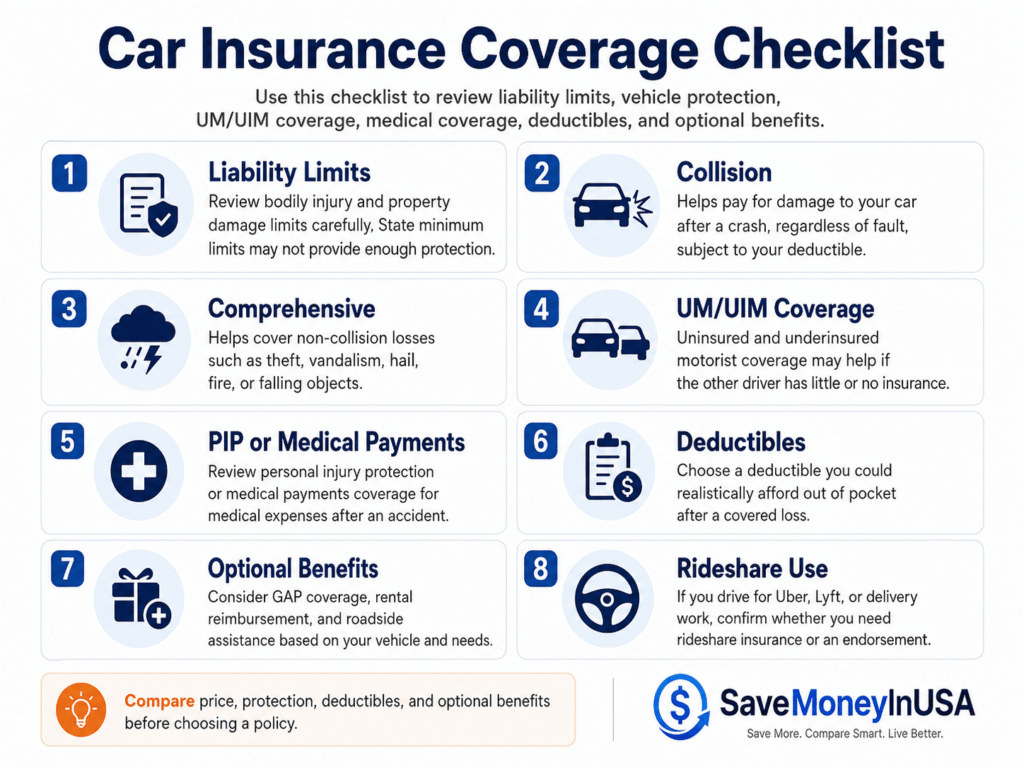
A Five-Minute Coverage Review Checklist
- Confirm every household driver and vehicle is listed correctly.
- Check your state’s current minimum requirements.
- Review bodily injury and property damage liability limits.
- Check UM/UIM limits and what losses they cover.
- Compare the vehicle’s value with collision and comprehensive premiums and deductibles.
- Confirm lender or lease requirements before removing coverage.
- Review PIP or medical payments coverage and health insurance gaps.
- Check rental, roadside, GAP, rideshare, and other optional protections.
- Ask for quotes using the same limits and deductibles from each insurer.
- Review the policy again after moving, changing vehicles, paying off a loan, adding a driver, or changing vehicle use.
Frequently Asked Questions
What is the best car insurance coverage for most drivers?
There is no single best package for everyone. Most drivers should consider adequate liability limits, uninsured/underinsured motorist protection where available, collision and comprehensive when the vehicle’s value or financing justifies them, medical protection appropriate to state rules, and deductibles they can afford.
Is 100/300/100 enough coverage?
100/300/100 is one example of higher split liability limits, but whether it is enough depends on your assets, income, driving exposure, state rules, and risk tolerance. Some drivers may need less, while others may benefit from higher limits or an umbrella policy.
Is full coverage required on a paid-off car?
State law generally does not require collision and comprehensive coverage on a paid-off vehicle, although liability and other state-required coverages still apply. Keeping physical damage coverage may still make financial sense if you cannot comfortably repair or replace the vehicle.
When should I drop collision coverage?
Consider the vehicle’s actual cash value, annual collision premium, deductible, replacement ability, and how essential the vehicle is. Do not use vehicle age alone, and do not remove coverage while a lender or lease requires it.
Does full coverage include rental reimbursement?
Not necessarily. Rental reimbursement is commonly optional and subject to daily and total limits. Confirm it separately on the declarations page.
Can I change my coverage during the policy term?
Insurers generally allow policy changes during the term, but the effective date, premium adjustment, underwriting requirements, and restrictions vary. Never remove required coverage without confirming state, lender, and lease obligations.
Final Takeaway: Build Coverage Around Risk, Not Price Alone
The best car insurance coverage in the USA is not automatically the cheapest policy or the policy with the most add-ons. It is the policy that protects the losses you cannot afford to absorb while avoiding coverage that provides little value for your situation.
Start with adequate liability limits, evaluate collision and comprehensive based on vehicle value and replacement ability, review uninsured/underinsured motorist and medical protection, and choose deductibles backed by real emergency savings. Then compare the same coverage package across multiple insurers.
Sources
- National Association of Insurance Commissioners — Auto Insurance
- NAIC — Best Practices When Buying Auto Insurance
- Insurance Information Institute — Auto Insurance Basics
- Consumer Financial Protection Bureau — GAP Insurance
About the Author
The SaveMoneyInUSA Editorial Team researches car insurance costs, coverage options, state requirements, and quote comparison considerations for drivers in the United States.
Learn more about our Editorial Team.
Disclaimer
SaveMoneyInUSA is an independent informational website and is not an insurance company, broker, or agent.
Some links may be affiliate links. We may receive compensation from partners at no additional cost to users.
Insurance requirements, rates, coverage options, exclusions, and eligibility vary by state, insurer, policy, and individual circumstances.
This content is provided for educational purposes only and should not be considered insurance, legal, or financial advice. Review your policy documents and consult a licensed insurance professional for advice about your situation.