

Last Updated: August 9, 2026
International students can often buy car insurance in the United States, but the best option depends on more than the company name. Your state, license status, vehicle ownership, financing agreement, driving frequency, U.S. insurance history, and available documents can all change which policy is practical.
Some students own a car and need a standard auto policy. Others regularly borrow a household vehicle, rent only occasionally, or do not own a car but may need non-owner liability coverage. This guide helps you match the insurance approach to your situation, prepare for quotes, compare coverage fairly, and avoid common first-time mistakes.
Comparing quotes does not require you to buy immediately, and the lowest price is not always the best match.
Can International Students Get Car Insurance in the USA?
In many cases, yes. International students are generally subject to the same state insurance and financial-responsibility rules as other drivers. The practical challenge is that insurers and state licensing agencies may handle foreign licenses, International Driving Permits, temporary addresses, and limited U.S. driving history differently.
The U.S. Department of Homeland Security advises F and M students to check with their designated school official and local Department of Motor Vehicles before applying for a U.S. driver’s license. Licensing requirements and the period during which a foreign license may be used vary by state. Insurance acceptance also varies by company, so a valid foreign license does not guarantee that every insurer will issue a policy.
Before driving, confirm three separate issues: whether your license is valid in the state, whether the vehicle is properly registered, and whether active insurance covers the vehicle and driver. Satisfying one requirement does not automatically satisfy the others.
What Does “Best” Car Insurance Mean for an International Student?
There is no single best insurer for every international student. A useful policy is one that accepts your real license and residency situation, meets state requirements, covers the way you use the vehicle, satisfies any lender or lease contract, and has a total cost you can maintain without a lapse.
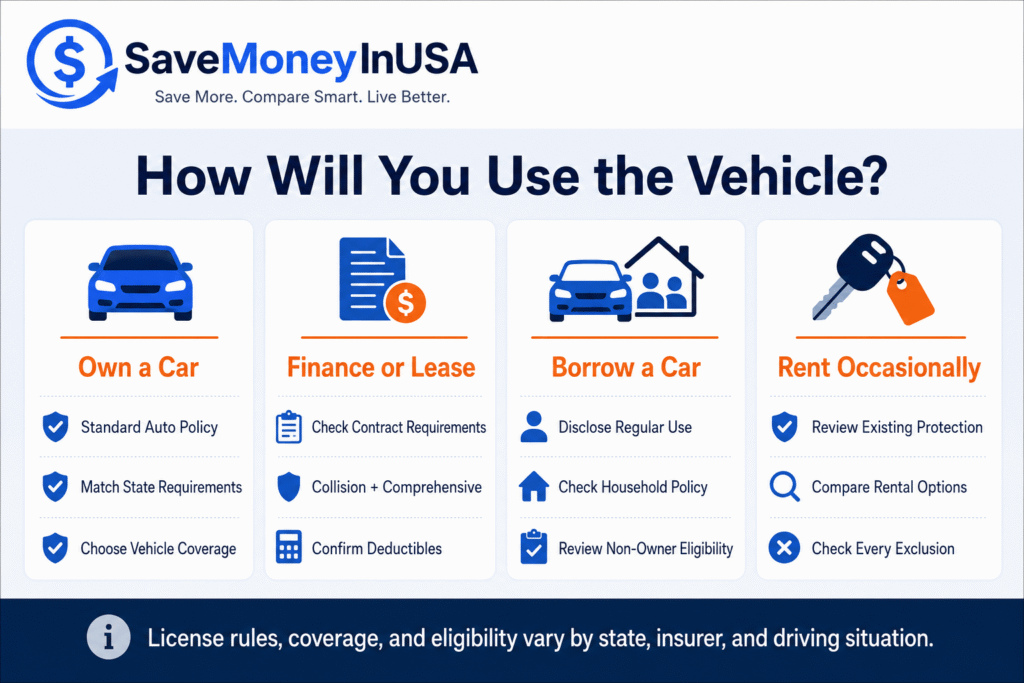
Quick Decision: Start With Your Driving Situation
- You own a car: compare standard auto policies that list you and the vehicle correctly.
- You finance or lease a car: compare liability plus the collision and comprehensive coverage required by the contract.
- You regularly drive a household car: ask whether you must be added to the owner’s policy.
- You borrow cars but do not own one: ask whether non-owner insurance fits your access and driving frequency.
- You rent only occasionally: compare the rental company’s protection with any coverage available through another policy or eligible credit card.
Tell the insurer exactly where the car is kept, who owns it, who drives it, and how often you use it. A policy built on the wrong situation may not protect you as expected.
Compare Insurance Options by Vehicle Situation
| Student situation | Option to review first | Main question |
|---|---|---|
| Owns a car outright | Standard personal auto policy | Which liability limits and vehicle coverages fit the car and budget? |
| Finances or leases a car | Policy meeting contract requirements | Are collision, comprehensive, deductibles, and lienholder details acceptable? |
| Lives with a vehicle owner | Household policy or listed-driver arrangement | Does the insurer require all licensed household members to be disclosed? |
| Does not own a car but borrows occasionally | Non-owner policy, if eligible | Does regular access to a specific car make non-owner coverage unsuitable? |
| Rents occasionally | Rental protection comparison | Which liability, collision-damage, medical, and personal-property protections already apply? |
A non-owner policy normally does not replace a standard policy for a car you own or regularly use. Read our detailed guide to non-owner car insurance for international students before choosing that option.
Foreign License, IDP, or U.S. Driver’s License?
Some insurers may quote an international student with a valid foreign driver’s license, while others may require a U.S. license or limit the available policy options. An International Driving Permit is generally a translation or companion document; it is not a standalone driver’s license and does not create insurance coverage.
If you expect to remain in the United States, ask your school official and state DMV when you should apply for a state license. A U.S. license can make online quote forms easier to complete, but obtaining one does not automatically produce a lower premium. Pricing still depends on the insurer and many other factors.
For licensing documents, IDP limitations, and state-level questions, see car insurance with a foreign license for international students.
Documents to Prepare Before Requesting Quotes
Not every insurer requests the same documents, but preparing accurate information reduces delays and makes quotes easier to compare.
- U.S. or foreign driver’s license information
- Passport or other accepted identification
- Current U.S. residential and garaging address
- Vehicle identification number, year, make, and model
- Registration, purchase, finance, or lease information
- Prior driving and insurance history, if requested and available
- Names and license details of household drivers
- Payment information accepted by the insurer
Do not enter invented information just to complete an online form. If a form does not accept your license type or address history, contact the insurer or a licensed agent. Use our full international student car insurance document checklist to prepare each category.
Which Car Insurance Coverages Should Students Review?
Start with the minimum insurance requirements in the state where the car is registered and driven. Liability coverage may help pay covered injury and property-damage claims you cause to other people, but it generally does not repair your own car after an at-fault collision.
- Bodily injury and property damage liability: addresses covered claims you cause to others, subject to limits.
- Collision: may pay for covered collision damage to your vehicle, subject to a deductible.
- Comprehensive: may cover losses such as theft, vandalism, fire, weather, or falling objects, subject to policy terms and a deductible.
- Uninsured/underinsured motorist: may help when an at-fault driver has no insurance or insufficient limits; requirements vary by state.
- Medical payments or PIP: availability and requirements vary by state and policy.
The National Association of Insurance Commissioners recommends reviewing coverage, limits, deductibles, exclusions, and total cost rather than comparing price alone. See the minimum car insurance requirements by state and our guide to full coverage versus liability insurance.
Financing or Leasing a Car as an International Student
State law may require liability insurance, while an auto loan or lease contract can require additional protection for the vehicle. The NAIC notes that lenders commonly require collision and comprehensive coverage until the loan is paid. The lender may also specify maximum deductibles and require the lienholder to appear on the policy.
Before agreeing to a car payment, request an insurance quote using the exact VIN and finance requirements. A vehicle that fits the purchase budget may still be expensive to insure. If required coverage lapses, the contract may allow the lender to add force-placed insurance that primarily protects the lender. Review full coverage requirements for financed cars before buying.
Why International Student Car Insurance May Cost More
Insurers do not use one “international student rate.” A higher quote may result from limited U.S. driving or insurance history, age, state and ZIP code, vehicle type, annual mileage, coverage limits, deductibles, previous claims, or other underwriting factors allowed in the state.
Do not assume your first quote represents the whole market. Companies may handle foreign licenses and limited U.S. history differently. Compare identical coverage and disclose available foreign driving experience honestly. Ask whether the insurer can review an official driving record from another country, but do not assume it will be accepted or produce a discount.
How to Compare International Student Car Insurance Quotes
- Confirm licensing and state requirements. Check the state DMV and insurance department.
- Define your vehicle situation. Own, finance, lease, borrow, or rent.
- Choose comparison limits and deductibles. Use the same values on every quote.
- Prepare consistent information. Use the same drivers, address, VIN, mileage, and use of the car.
- Ask about license acceptance. Confirm whether a foreign license, IDP, or U.S. license is required.
- Compare the full policy term. Review the amount due today, installment fees, discounts, and six- or twelve-month total.
- Review exclusions and effective time. A quote is not active coverage until the insurer confirms the policy.
Our step-by-step car insurance quote guide provides a reusable comparison checklist.
Discounts and Practical Ways to Lower the Cost
- Ask whether a good-student discount is available and which records qualify.
- Compare insurance before choosing the vehicle.
- Consider a deductible you could actually pay after a claim.
- Report realistic mileage and vehicle use.
- Ask about approved defensive-driving or telematics programs where appropriate.
- Avoid a coverage lapse when switching insurers.
- Re-shop at renewal after building additional U.S. driving and insurance history.
Discount names, eligibility, and savings vary. Never add a household member, change an address, or misstate mileage only to obtain a lower quote.
Common Mistakes International Students Should Avoid
- Buying a car before pricing insurance: the required coverage may change the total transportation budget.
- Assuming an IDP replaces a license: an IDP is not a standalone license.
- Using the wrong address: the garaging location must be accurate.
- Not disclosing household drivers: insurers may require licensed household members to be listed, rated, or excluded where permitted.
- Buying only by monthly payment: compare the amount due today, fees, and full policy cost.
- Confusing liability with vehicle protection: minimum liability usually does not repair your own car.
- Driving before the effective time: an application or quote does not prove active coverage.
Before You Drive: Five Confirmations
- Your license is valid for driving in that state.
- The vehicle registration and ownership information are correct.
- You are properly listed or covered for the way you use the vehicle.
- The policy meets state and lender or lease requirements.
- You have confirmed the policy number, effective date, effective time, and proof of insurance.
If any answer is unclear, contact the DMV, insurer, licensed agent, lender, or school official before driving.
Frequently Asked Questions
Can an international student buy car insurance without a U.S. driver’s license?
Some insurers may accept a valid foreign license, but acceptance varies by company and state. Confirm that the license is valid for driving in the state and ask the insurer directly what documentation it requires.
Is an International Driving Permit enough?
No. An International Driving Permit generally accompanies and translates a valid foreign license. It is not a standalone license, vehicle registration, or insurance policy.
Do international students need full coverage?
“Full coverage” is not a single standardized policy. A student who finances or leases a car will commonly need collision and comprehensive coverage in addition to required liability coverage. A student who owns an older car outright may have different needs.
Can an international student use a foreign auto insurance policy?
Do not assume a foreign policy satisfies U.S. state requirements or covers a vehicle registered in the United States. Confirm coverage with the insurer and the appropriate state agencies before driving.
Can an international student join someone else’s policy?
Possibly, if the insurer permits it and the ownership, household, garaging, and driving arrangements are accurately disclosed. Permission to drive a car does not automatically mean the driver’s regular use is properly covered.
Which company has the cheapest insurance for international students?
No company is consistently cheapest for every international student. Quotes vary by state, license type, vehicle, age, driving history, coverage, deductible, mileage, and insurer underwriting. Compare several quotes using identical information.
Final Takeaway
The best car insurance for an international student is the policy that matches the student’s actual driving situation and documentation—not a universal company ranking. Confirm state licensing rules, decide whether you own, finance, borrow, or rent a vehicle, and compare identical coverage across insurers that accept your license status.
Prepare accurate documents, compare the full policy cost, and verify the effective date and time before driving. Use the specialized foreign-license, document, and non-owner guides when you need more detail.
Sources
- U.S. Department of Homeland Security — Driving in the United States
- National Association of Insurance Commissioners — Best Practices for Buying Auto Insurance
- National Association of Insurance Commissioners — Auto Insurance Shopping Tool
- Consumer Financial Protection Bureau — Auto Insurance Options When Financing a Car
About the Author
The SaveMoneyInUSA Editorial Team researches car insurance costs, coverage options, state requirements, and quote comparison considerations for drivers in the United States.
Learn more about our Editorial Team.
Disclaimer: SaveMoneyInUSA is an independent informational website and may receive compensation through affiliate links. Insurance rates, coverage, eligibility, discounts, licensing requirements, and policy terms vary by insurer, state, driver, vehicle, and time. This content is for general educational purposes and is not insurance, legal, immigration, or financial advice. Verify current licensing and insurance requirements with the appropriate state agencies and consult a licensed insurance professional about your situation.