

Last Updated: August 2026
Minimum car insurance requirements vary widely across the United States. Each state determines which coverages drivers must carry, the minimum policy limits, and whether additional protection such as personal injury protection or uninsured motorist coverage is required.
In most states, the core requirement is liability insurance. Liability coverage helps pay for injuries and property damage you cause to other people, subject to the limits and conditions of the policy.
However, meeting the legal minimum does not necessarily mean you have enough financial protection. Medical bills, vehicle repairs, legal expenses, and damage to newer vehicles can quickly exceed a state’s minimum liability limits.
This guide compares the minimum car insurance requirements for all 50 states and Washington, D.C., explains how liability limits work, and identifies states with special PIP, uninsured motorist, no-fault, or financial responsibility rules.
Quick Answer: What Car Insurance Does Your State Require?
Most states require bodily injury and property damage liability insurance. Some states also require one or more of the following:
- Personal injury protection, or PIP: helps pay covered medical expenses and, depending on the state, lost income or other expenses for you and your passengers.
- Uninsured motorist coverage, or UM: helps protect you when an at-fault driver has no insurance.
- Underinsured motorist coverage, or UIM: may help when the at-fault driver has insurance but not enough to cover the loss.
- Medical payments coverage: helps pay covered medical expenses for you and your passengers, regardless of fault, subject to state and policy rules.
- Property protection or other state-specific coverage: required in certain no-fault insurance systems.
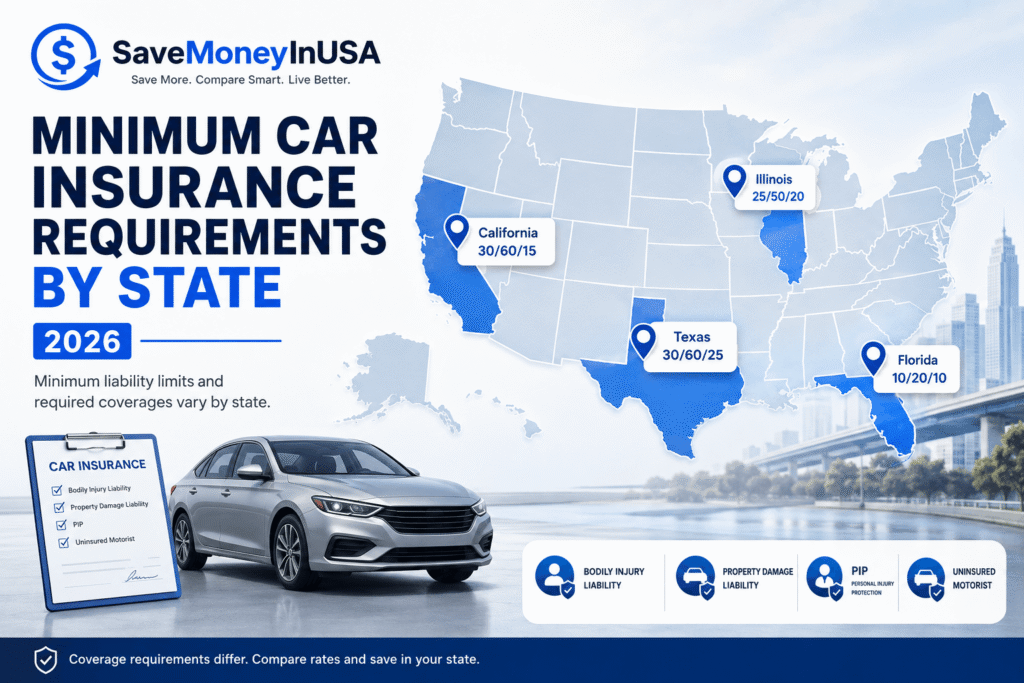
California, for example, requires at least 30/60/15 liability coverage for standard private passenger vehicles. Texas requires 30/60/25, while North Carolina now requires 50/100/50 plus applicable uninsured and underinsured motorist protection.
Florida is unusual because most private passenger vehicle owners generally must carry property damage liability and PIP, but bodily injury liability is not part of the basic registration requirement for every driver. New Hampshire also has special financial responsibility rules rather than a universal insurance mandate for every driver.
Because rules and policy forms can change, confirm the current requirement with your state insurance department, DMV, insurer, or licensed insurance professional before purchasing or reducing coverage.
Compare policies using your state’s current requirements and the same coverage limits, drivers, vehicles, and deductibles.
How to Read Liability Limits Such As 25/50/25
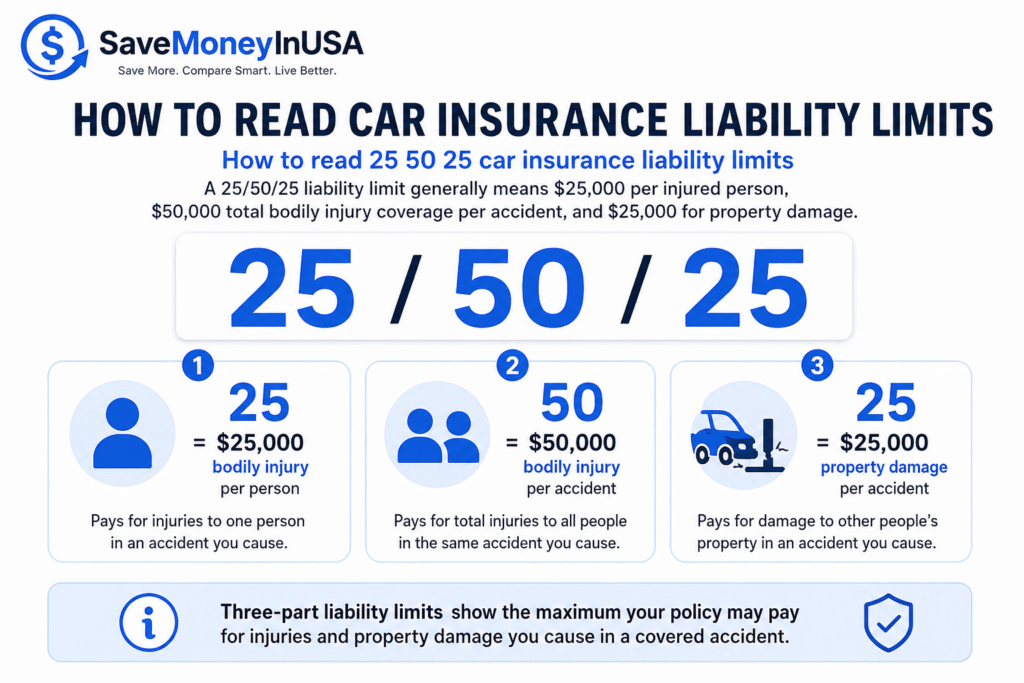
Most minimum liability requirements are written as three numbers. A limit of 25/50/25 generally means:
- $25,000 bodily injury liability per person: the maximum the policy generally pays for covered injuries to one person.
- $50,000 bodily injury liability per accident: the maximum the policy generally pays for covered injuries to all people in one accident.
- $25,000 property damage liability per accident: the maximum the policy generally pays for covered damage to other people’s vehicles or property.
These are separate limits. The $50,000 bodily injury limit does not increase the amount available for property damage.
For example, suppose you cause an accident that injures three people, with each person having $25,000 in covered injury costs. A 25/50 bodily injury policy may provide no more than $50,000 for all three people combined, even though each person’s individual loss is within the $25,000 per-person limit.
You may be personally responsible for damages that exceed your policy limits.
Minimum Car Insurance Requirements by State in 2026
The following table summarizes minimum private passenger vehicle requirements. The three-number liability format means bodily injury per person, bodily injury per accident, and property damage per accident.
Additional PIP, UM, UIM, medical payments, property protection, death-benefit, or policy-form requirements may apply. Some states allow alternative financial responsibility methods, combined single limits, written rejection of certain coverages, or special low-cost policies.
| State | Minimum Liability Limits | Other Required Coverage or Important Rule |
|---|---|---|
| Alabama | 25/50/25 | Liability insurance required. |
| Alaska | 50/100/25 | Special exceptions may apply in certain remote areas where vehicle registration is not required. |
| Arizona | 25/50/15 | Liability insurance required. |
| Arkansas | 25/50/25 | PIP is generally included or offered under state rules and may be rejected in writing in applicable situations. |
| California | 30/60/15 | UM/UIM must generally be offered but may be rejected in writing. Special low-cost policy rules may apply to qualifying drivers. |
| Colorado | 25/50/15 | Liability insurance required. |
| Connecticut | 25/50/25 | UM/UIM bodily injury coverage generally required at 25/50. |
| Delaware | 25/50/10 | PIP generally required, including at least 15/30 accident-related personal injury limits. |
| Florida | 10,000 property damage | $10,000 PIP generally required. Bodily injury liability may be required after certain accidents or violations. |
| Georgia | 25/50/25 | Liability insurance required. |
| Hawaii | 20/40/10 | $10,000 PIP generally required under the no-fault system. |
| Idaho | 25/50/15 | Liability insurance required. |
| Illinois | 25/50/20 | UM bodily injury coverage generally required at 25/50. |
| Indiana | 25/50/25 | Liability insurance required. |
| Iowa | 20/40/15 | Financial responsibility rules apply; insurance is the most common method of compliance. |
| Kansas | 25/50/25 | PIP and UM/UIM coverage generally required, subject to detailed statutory benefit amounts. |
| Kentucky | 25/50/25 | PIP generally required under the choice no-fault system; a $60,000 combined single limit may be available. |
| Louisiana | 15/30/25 | Liability insurance required. |
| Maine | 50/100/25 | UM/UIM generally required at 50/100, plus at least $2,000 in medical payments coverage. |
| Maryland | 30/60/15 | UM/UIM generally required at corresponding limits. PIP must generally be offered and may be waived in applicable situations. |
| Massachusetts | 25/50/30 | UM bodily injury coverage and $8,000 PIP generally required. |
| Michigan | 50/100/10 | PIP and property protection insurance required. Michigan property protection generally provides up to $1 million for covered property damage within the state. |
| Minnesota | 30/60/10 | $40,000 PIP and 25/50 UM/UIM generally required. |
| Mississippi | 25/50/25 | Liability insurance or another accepted financial responsibility method required. |
| Missouri | 25/50/25 | UM bodily injury coverage generally required at 25/50. |
| Montana | 25/50/20 | Liability insurance required. |
| Nebraska | 25/50/25 | UM/UIM bodily injury coverage generally required at 25/50. |
| Nevada | 25/50/20 | Liability insurance required. |
| New Hampshire | 25/50/25 when insurance is required | Insurance is not universally mandatory, but drivers must meet financial responsibility requirements after certain events. Policies generally include UM/UIM and medical payments coverage. |
| New Jersey | Standard policy: 35/70/25 | Standard-policy BI limits increased in 2026. A lower-protection Basic Policy may provide $5,000 property damage and $15,000 PIP, with bodily injury coverage limited or optional under that policy form. |
| New Mexico | 25/50/10 | Liability insurance required. |
| New York | 25/50/10 | $50,000 PIP and 25/50 UM generally required. Higher 50/100 limits apply for liability involving death. |
| North Carolina | 50/100/50 | UM/UIM coverage generally required at corresponding limits for policies issued or renewed under the current rules. |
| North Dakota | 25/50/25 | $30,000 basic no-fault/PIP benefits and 25/50 UM/UIM generally required. |
| Ohio | 25/50/25 | Liability insurance or another accepted financial responsibility method required. |
| Oklahoma | 25/50/25 | Liability insurance required. |
| Oregon | 25/50/20 | $15,000 PIP and 25/50 UM/UIM generally required. |
| Pennsylvania | 15/30/5 | At least $5,000 medical benefits generally required under the choice no-fault system. |
| Rhode Island | 25/50/25 | Liability insurance required. |
| South Carolina | 25/50/25 | UM generally required at 25/50/25. UIM must generally be offered. |
| South Dakota | 25/50/25 | UM/UIM bodily injury coverage generally required at 25/50. |
| Tennessee | 25/50/25 | Liability insurance or another accepted financial responsibility method required. |
| Texas | 30/60/25 | PIP and UM/UIM must generally be offered but may be rejected in writing. |
| Utah | 30/65/25 | At least $3,000 PIP generally required under the no-fault system. |
| Vermont | 25/50/10 | UM/UIM generally required at 50/100/10. |
| Virginia | 50/100/25 | UM/UIM generally required at corresponding limits. Virginia no longer allows vehicle owners to avoid insurance by paying the former uninsured motor vehicle fee. |
| Washington | 25/50/10 | Liability insurance or another accepted financial responsibility method required. |
| Washington, D.C. | 25/50/10 | UM generally required at 25/50, plus at least $5,000 uninsured motorist property damage coverage. |
| West Virginia | 25/50/25 | UM generally required at 25/50/25; UIM must generally be offered. |
| Wisconsin | 25/50/10 | UM bodily injury coverage generally required at 25/50. |
| Wyoming | 25/50/20 | Liability insurance or another accepted financial responsibility method required. |
Important: This table is a general educational summary for standard private passenger vehicles. Requirements can differ for commercial vehicles, taxis, rideshare use, high-risk filings, leased vehicles, motorcycles, nonresident vehicles, special low-cost programs, and drivers with prior violations. State laws and insurer policy forms can also change.
States With Important Special Rules
Some states cannot be fully explained by a three-number liability limit. The following examples deserve additional attention.
California: Minimum Limits Increased to 30/60/15
California’s standard minimum liability limits increased from 15/30/5 to 30/60/15 beginning January 1, 2025.
The current standard limits provide up to $30,000 for bodily injury or death to one person, $60,000 for bodily injury or death to more than one person in one accident, and $15,000 for property damage.
California insurers generally must offer uninsured and underinsured motorist coverage, but a policyholder may be able to reject it in writing. Qualifying low-income drivers may also have access to a separate low-cost insurance program with different limits and eligibility rules.
California drivers can review our detailed guide to California minimum car insurance requirements.
Florida: PIP and Property Damage Are the Basic Requirements
Florida generally requires owners of registered vehicles to carry at least $10,000 in PIP and $10,000 in property damage liability.
Bodily injury liability is not part of the basic requirement for every Florida driver, but it may become mandatory after certain accidents, convictions, or financial responsibility events.
Carrying no bodily injury liability can expose a driver to substantial personal financial risk after causing injuries.
Michigan: PIP and Property Protection Require Extra Attention
Michigan’s no-fault system includes bodily injury liability, PIP, and property protection insurance. PIP medical coverage choices can depend on Medicare, Medicaid, qualified health coverage, household members, and other eligibility conditions.
The commonly displayed 50/100/10 liability figures do not describe the entire minimum policy. Michigan drivers should review all PIP and property protection selections rather than comparing liability numbers alone.
New Hampshire: Insurance Is Not Universally Mandatory
New Hampshire does not require every driver to purchase an auto insurance policy before driving. However, drivers remain financially responsible for accidents and may be required to provide proof of insurance or other financial responsibility after certain crashes, convictions, or administrative actions.
Driving without insurance does not remove liability. A driver can still be personally responsible for injuries and property damage.
New Jersey: Standard and Basic Policies Are Different
New Jersey offers more than one policy structure. For standard policies issued or renewed from January 1, 2026, the statutory minimum bodily injury limits increased to $35,000 per person and $70,000 per accident, while the standard minimum property damage limit remains $25,000.
New Jersey also has a Basic Policy with much lower protection. The Basic Policy generally includes $5,000 in property damage liability and $15,000 in PIP, while bodily injury liability may be limited or optional depending on the policy form.
Drivers should not assume that the least expensive New Jersey policy provides the same liability protection as a Standard Policy.
North Carolina: Limits Increased to 50/100/50
For North Carolina policies issued or renewed on or after July 1, 2025, the minimum liability limits increased from 30/60/25 to 50/100/50.
Drivers using older comparison tables may therefore see outdated North Carolina requirements. Current quotes should reflect the newer limits and applicable UM/UIM requirements.
What Is the Difference Between Minimum Coverage and Liability-Only Insurance?
The phrases “minimum coverage” and “liability-only insurance” are often used interchangeably, but they do not always mean exactly the same thing.
A minimum-coverage policy contains the coverages necessary to satisfy a state’s legal requirements. In a state that only requires liability insurance, minimum coverage may effectively be liability-only insurance.
In a state that also requires PIP, UM, UIM, medical payments, or property protection insurance, a legal minimum-coverage policy includes more than liability insurance.
Minimum coverage generally does not include collision or comprehensive insurance for damage to your own vehicle unless another rule or contract requires it.
Learn more about the difference between full coverage and liability insurance before choosing a policy based only on its monthly price.
Why State Minimum Car Insurance May Not Be Enough
State minimums are legal thresholds, not personalized recommendations. They may not be sufficient to protect your savings, income, or other assets after a serious accident.
Minimum limits can be exceeded by:
- Emergency room treatment and hospitalization
- Long-term rehabilitation or lost income
- Injuries to several passengers in one accident
- Damage to a newer vehicle, luxury vehicle, or multiple vehicles
- Damage to buildings, utility equipment, traffic signals, or other property
- Legal defense expenses, settlements, or judgments
For example, a property damage limit of $10,000 may be inadequate if you total a vehicle worth substantially more than that amount. Similarly, a $25,000 bodily injury limit can be exhausted by one serious injury.
If covered damages exceed the policy limits, the insurer generally does not continue paying without limit. You may be personally responsible for the remaining amount.
How Much Liability Insurance Should You Consider?
There is no single liability limit that is appropriate for every driver. Consider the amount of financial harm you could cause, the assets and income you need to protect, and the price difference between available limits.
When comparing limits, ask insurers to show the price of:
- Your state’s minimum liability limits
- 50/100/50 liability limits
- 100/300/100 liability limits
- A higher combined single limit, where available
- An umbrella policy if your assets and liability exposure justify one
Do not assume that doubling the liability limits will double the premium. The cost difference may be smaller than expected because the base policy and first layer of coverage already account for substantial underwriting and claims expenses.
However, actual prices depend on the driver, insurer, state, vehicle, coverage history, and other underwriting factors. Compare real quotes rather than relying on a general average.
Does State Minimum Insurance Cover Your Own Car?
State-required liability insurance generally does not pay to repair or replace your own car after an accident you cause.
To protect your vehicle, you may need:
- Collision coverage for covered damage caused by a collision with another vehicle or object.
- Comprehensive coverage for covered non-collision events such as theft, vandalism, fire, hail, flooding, falling objects, or animal impact.
Collision and comprehensive insurance are generally not required by state law, but a lender or leasing company commonly requires them while it has a financial interest in the vehicle.
A minimum-coverage policy may therefore keep a paid-off vehicle legally insured while leaving the owner responsible for repairing or replacing it.
What Happens If You Drive Without Required Insurance?
Penalties vary by state and by the driver’s history. Possible consequences may include:
- Fines and administrative fees
- Suspension of vehicle registration
- Driver’s license suspension
- Vehicle impoundment
- Reinstatement fees
- SR-22 or other proof-of-financial-responsibility requirements
- Higher future insurance costs
- Personal responsibility for injuries and property damage
Even in a state with an alternative financial responsibility method, the driver must still meet that state’s legal conditions and remain able to pay for losses.
What Happens When You Move to Another State?
Car insurance requirements are generally based on where the vehicle is principally garaged and registered. If you permanently move, you may need to update your policy, driver’s license, vehicle registration, and insurance within the new state’s deadlines.
Do not keep an old address solely to obtain a lower premium. Incorrect garaging or residence information may create policy, rating, or claims problems.
Before moving:
- Tell the insurer your new address and move date.
- Confirm that the insurer sells policies in the new state.
- Obtain a policy that satisfies the new state’s requirements.
- Do not cancel the old policy before the new coverage becomes effective.
- Complete driver’s license and registration changes within the applicable deadlines.
How to Compare Minimum-Coverage Quotes Correctly
A quote can appear cheaper simply because it contains lower limits, fewer required protections, or different deductibles and optional benefits.
Use the same information for every quote:
- The same drivers and vehicles
- The same garaging address
- The same annual mileage and vehicle use
- The same bodily injury and property damage limits
- The same UM/UIM, PIP, and medical coverage selections
- The same collision and comprehensive deductibles, if included
- The same payment plan and policy term
Review the declarations page or coverage summary before accepting a policy. Our guide to comparing car insurance quotes explains how to identify differences that may be hidden behind the monthly price.
Common Mistakes to Avoid
Using an Outdated State Minimum Table
State limits change. California, North Carolina, Virginia, Massachusetts, Utah, and New Jersey are examples of states whose commonly repeated older limits may no longer be accurate for a current policy.
Assuming Minimum Coverage Is a Recommendation
The legal minimum is the lowest level that satisfies state requirements. It is not necessarily enough to protect your income, savings, home, or other assets.
Comparing Quotes With Different Limits
A lower quote may provide substantially less protection. Compare identical limits and required coverages before deciding which company is cheaper.
Forgetting Lender Requirements
A state may not require collision and comprehensive coverage, but a loan or lease agreement commonly does. State minimum coverage may not satisfy the contract.
Allowing Coverage to Lapse During a Move
Do not cancel an existing policy until the new policy is active. A lapse can create registration problems, penalties, or higher future premiums.
Frequently Asked Questions
Which state has the highest minimum liability limits?
Several states have comparatively high minimum limits. Alaska and Maine require 50/100/25, North Carolina requires 50/100/50, and Virginia requires 50/100/25. However, additional required coverages and special state systems can make direct comparisons more complicated.
Which state has the lowest minimum car insurance requirements?
Some states have relatively low property damage or bodily injury limits, but the lowest apparent three-number requirement does not always mean the least total coverage. Florida requires PIP and property damage liability, while Michigan and New Jersey have policy structures that cannot be judged from one split-limit number.
Is minimum car insurance the cheapest policy?
It is usually less expensive than a policy with higher liability limits, collision, and comprehensive coverage. However, rates vary significantly by insurer, and a minimum policy from one company may cost more than better coverage from another company.
Can I buy less insurance than my state requires?
An insurer generally cannot issue a standard policy below the state’s required limits. Some states allow approved alternative financial responsibility methods or special policy programs, but drivers must meet all eligibility and legal conditions.
Do I need full coverage to drive legally?
State law generally does not require collision and comprehensive coverage. However, a lender or leasing company commonly requires them. You must still carry all liability, PIP, UM/UIM, medical, or other coverages required by your state.
Does my insurance automatically adjust if state limits increase?
Insurers generally update new and renewing policies to comply with current law, but the timing may depend on the effective date and renewal cycle. Review your renewal documents instead of assuming an older declarations page reflects the current requirement.
Can I keep insurance from my old state after moving?
You generally need a policy written for the state where the vehicle is registered and principally garaged. Contact the insurer before moving and follow the new state’s registration and insurance deadlines.
Are motorcycles and commercial vehicles included in this table?
No. This table is a general summary for standard private passenger vehicles. Motorcycles, commercial vehicles, rideshare vehicles, taxis, heavy trucks, and business-use vehicles may have different limits or filing requirements.
Final Thoughts
Every driver should understand the minimum insurance required where the vehicle is registered, but legal compliance is only the starting point.
Minimum liability limits may be exhausted by one serious injury or the loss of a newer vehicle. PIP, uninsured motorist coverage, lender requirements, and state-specific policy rules can also make a minimum policy more complicated than a simple three-number limit.
Confirm the current requirements with an official state source, then compare the price of the legal minimum with higher liability limits and any protection needed for your own vehicle.
Use identical coverage selections when comparing insurers. The lowest monthly price is not a meaningful comparison if one quote provides substantially less protection.
Sources
- National Association of Insurance Commissioners: State Insurance Departments
- California Department of Insurance: Minimum Liability Limits Effective January 1, 2025
- Florida Department of Financial Services: Personal Automobile Insurance Overview
- Massachusetts Division of Insurance: Basics of Auto Insurance
- Michigan Department of Insurance and Financial Services: Auto Insurance FAQs
- North Carolina Department of Insurance: Automobile Insurance Changes Effective July 1, 2025
- New Jersey Department of Banking and Insurance: Standard Auto Insurance Policy
- New Jersey Department of Banking and Insurance: Basic Auto Insurance Policy
- Utah Insurance Department: Minimum Auto Liability Limits
- Virginia Department of Motor Vehicles: Insurance Requirements
State insurance laws, minimum limits, required coverage types, policy forms, and financial responsibility options can change. The information above is educational and may not reflect every exception or the most recent administrative interpretation. Confirm current requirements with your state insurance department, DMV, insurer, or licensed insurance professional before buying, canceling, or reducing coverage.
About the Author
The SaveMoneyInUSA Editorial Team researches car insurance costs, coverage options, state requirements, and quote comparison considerations for drivers in the United States.
Learn more about our Editorial Team.
Disclaimer
SaveMoneyInUSA is an independent informational website and is not an insurance company, broker, or agent. Some links may be affiliate links. We may receive compensation from partners at no additional cost to users. Insurance laws, rates, coverage requirements, policy limits, exclusions, and eligibility vary by state, insurer, policy, vehicle, and individual circumstances. This content is provided for educational purposes only and should not be considered insurance, legal, tax, or financial advice.