

Last Updated: August 2026
Drivers with an accident, DUI, multiple traffic violations, a coverage lapse, or another serious issue on their record often pay more for car insurance. Some may also have fewer insurance companies willing to offer coverage.
However, being classified as a high-risk driver does not mean every insurer will charge the same price. Insurance companies use different underwriting rules, rating systems, discounts, and eligibility standards. One company may offer a reasonable rate while another may decline the same driver or charge substantially more.
This guide explains which insurance companies may be worth comparing, how different types of driving records affect your options, what to do if standard insurers reject you, and how to gradually reduce your insurance costs.
Quick Answer: What Is the Best Car Insurance for High-Risk Drivers?
There is no single best car insurance company for every high-risk driver. The right option depends on why you are considered high-risk, where you live, whether you need an SR-22 or FR-44 filing, the vehicle you drive, your coverage limits, and each insurer’s underwriting rules.
A practical starting point is to compare both major standard insurers and companies that serve the nonstandard insurance market. Progressive, GEICO, State Farm, Dairyland, and National General may all be worth checking, but availability, eligibility, and pricing vary by state and driver.
When comparing policies, use the same drivers, vehicles, coverage limits, deductibles, and optional coverages on every quote. Otherwise, a lower price may simply reflect less protection.
Free to compare. No obligation to purchase.
Who Is Considered a High-Risk Driver?
“High-risk driver” is an insurance classification rather than one national legal definition. An insurer may consider a driver high-risk when the company believes that person has a greater-than-average likelihood of causing an accident, filing a claim, allowing coverage to lapse, or creating another financial risk.
Factors that may lead to a high-risk classification include:
- One or more at-fault accidents
- Multiple speeding tickets or moving violations
- A DUI or DWI conviction
- Reckless driving or excessive speeding
- A suspended or revoked driver’s license
- Driving without insurance
- A recent lapse in car insurance coverage
- An SR-22 or FR-44 financial responsibility requirement
- Multiple recent insurance claims
- Very limited driving experience
- A poor insurance-based credit score in states where its use is permitted
- A high-performance, heavily modified, or difficult-to-insure vehicle
Not every factor applies in every state. State laws can restrict which information insurers may use and how much weight they may give it.
If credit-based insurance information may be affecting your options, read our guide to car insurance for drivers with bad credit. State rules differ, and some states prohibit or restrict the use of credit information in auto insurance.
Why High-Risk Drivers Usually Pay More
Insurance companies generally use two related processes: underwriting and rating. Underwriting helps an insurer decide whether it is willing to accept a driver. Rating determines how much the insurer will charge for the risk it accepts.
An insurer may review your driving record, claims history, previous insurance coverage, location, driving experience, vehicle, annual mileage, selected coverage, and deductible. Where permitted, credit-based insurance information may also affect the decision.
A serious violation or pattern of claims can indicate a greater possibility of future losses. The insurer may respond by applying a surcharge, removing certain discounts, limiting available coverage, requiring a higher premium, or declining the application.
Because each company uses its own rating model, two insurers may evaluate the same driver very differently. This is why quote comparison is especially important after an accident, DUI, license suspension, or coverage lapse.
Best Car Insurance Companies for High-Risk Drivers to Compare
The companies below are not guaranteed to accept every high-risk driver or provide the lowest rate. They are starting points to include when comparing coverage. Product availability and filing services may vary by state.
| Company | Why It May Be Worth Comparing | Best Fit to Check | Important Limitation |
|---|---|---|---|
| Progressive | Offers coverage in many states and provides information about SR-22 and non-owner SR-22 filings. | Drivers who need an SR-22, have a serious violation, or want to compare direct online quotes. | Eligibility and rates depend on the state and individual driving record. |
| GEICO | Provides SR-22 and FR-44 filing assistance in applicable situations and offers direct quote access. | Drivers who need a financial responsibility filing or want to compare a large national insurer. | Some drivers with more serious or multiple violations may not qualify for the preferred rate tier. |
| State Farm | Offers access to local agents and recognizes high-risk or nonstandard insurance as an option for drivers with more complex records. | Drivers who prefer discussing coverage, discounts, and eligibility with a local agent. | Acceptance and product availability vary by state, record, and underwriting company. |
| Dairyland | Focuses on auto insurance options that include higher-risk drivers and offers SR-22 filing services where available. | Drivers who need nonstandard coverage, have been declined elsewhere, or need an SR-22. | May not be available in every state, and policy features can differ from standard-market policies. |
| National General | Offers personal auto coverage and may be worth including when comparing both standard and higher-risk options. | Drivers shopping through an agent or comparing alternatives after a rate increase. | Pricing and eligibility vary by location, vehicle, driving history, and underwriting program. |
Do not stop after receiving one acceptable quote. A company that works well for a driver with one speeding ticket may not be competitive for someone with a DUI, multiple accidents, or a recent lapse in coverage.
For a broader comparison of mainstream insurers, see our guide to the best cheap car insurance companies.
Best Insurance Options by High-Risk Situation
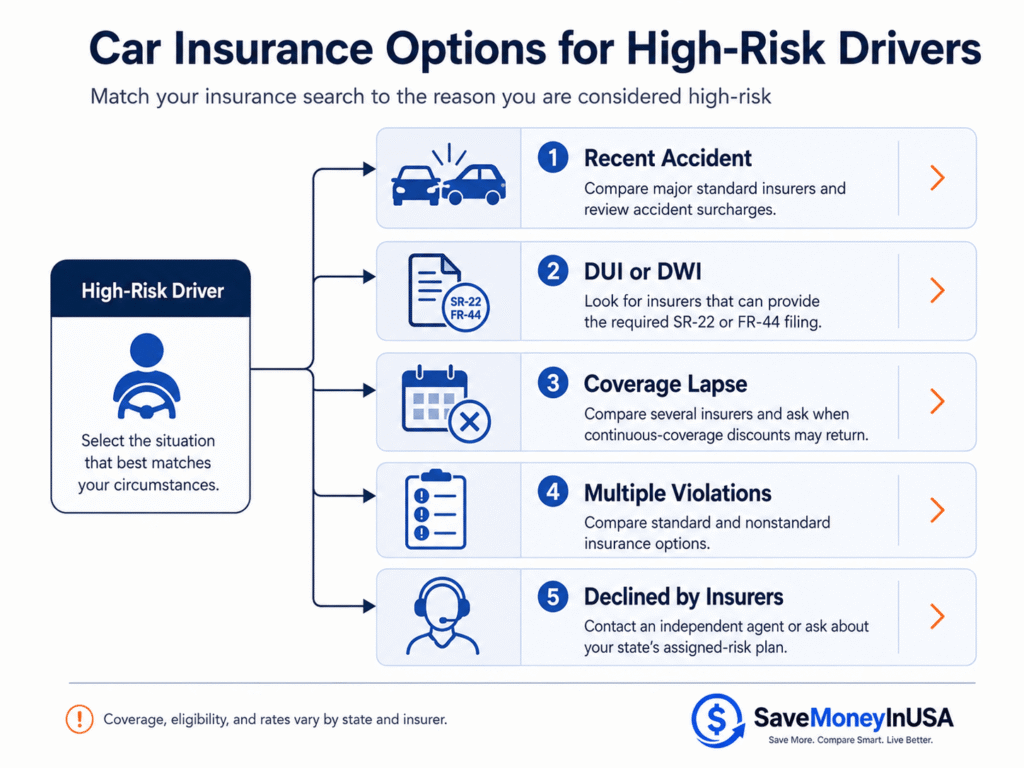
The reason for your high-risk status should influence which companies and policy types you compare.
| Driver Situation | Options to Compare | What to Check Carefully |
|---|---|---|
| One recent at-fault accident | Major standard insurers and current insurer | Accident surcharge, lost discounts, forgiveness eligibility, and renewal price |
| Multiple tickets or accidents | Standard and nonstandard insurers | Total six-month cost, down payment, installment fees, and renewal conditions |
| DUI or DWI | Insurers that can provide required SR-22 or FR-44 filings | Filing availability, liability limits, continuous-coverage rules, and total premium |
| Recent insurance lapse | Direct insurers and independent agents | Whether the lapse creates a surcharge and when continuous-coverage discounts may return |
| Suspended license | Insurers familiar with reinstatement and financial responsibility requirements | State eligibility rules, license status, SR-22 requirements, and named-driver restrictions |
| No car but SR-22 required | Non-owner car insurance providers | Whether the policy satisfies the state filing requirement and what vehicles are excluded |
| Declined by several insurers | Independent agent, nonstandard insurer, or state assigned-risk plan | Coverage limits, exclusions, fees, payment terms, and alternatives at renewal |
Car Insurance After an Accident
An at-fault accident can increase your premium because the insurer may consider it evidence of a higher future claim risk. The effect depends on the severity of the accident, claim amount, prior record, state rules, and company rating system.
Before renewing automatically, compare the new premium with quotes from several other insurers. Use the same liability limits, deductibles, drivers, vehicle usage, and optional coverages on every quote.
Also verify that the accident information is accurate. Insurance claim databases and motor vehicle records can contain information that insurers use in underwriting. If a report is incorrect, disputing the error may help prevent an inaccurate pricing decision.
Car Insurance After a DUI or DWI
A DUI or DWI is one of the most serious events for car insurance. In addition to fines, legal costs, license restrictions, and possible ignition-interlock requirements, a conviction may lead to much higher premiums or fewer available insurers.
Your state or court may require an SR-22 or, in certain states and situations, an FR-44. The insurance company files this certificate with the appropriate state authority to show that you maintain the required liability coverage.
The filing itself is not a separate insurance policy. The main cost increase usually comes from the violation and the insurer’s reassessment of your risk, although a filing fee or other state-specific charge may also apply.
Learn more in our guides to cheap car insurance after a DUI and the best SR-22 insurance companies to compare.
What Are SR-22 and FR-44 Filings?
An SR-22 is a certificate of financial responsibility filed by an insurance company to confirm that a driver carries the liability insurance required by the state. It may be required after a DUI, driving without insurance, repeated violations, a license suspension, or another serious incident.
An FR-44 serves a similar purpose but generally requires higher liability limits. It is associated with certain serious violations in Florida and Virginia.
Requirements differ by state. Do not cancel or allow the policy to lapse while the filing requirement remains active. The insurer may have to notify the state, which could lead to another suspension, a longer filing period, or additional reinstatement requirements.
For a closer look at filing fees, insurance premiums, and state-by-state differences, see our guide to SR-22 insurance costs by state.
If you do not own a vehicle but must maintain an SR-22, ask whether a non-owner car insurance policy can satisfy the requirement. A non-owner policy generally provides liability coverage when you occasionally drive vehicles you do not own, but it does not replace a vehicle owner’s policy and has important exclusions.
How to Compare High-Risk Car Insurance Quotes
High-risk drivers should compare more than the monthly payment. A quote with a low first payment may include higher later installments, reduced coverage, large deductibles, or additional fees.
Use this checklist when comparing quotes:
- Use identical driver information. Include all household members and regular drivers accurately.
- Use the same vehicle information. Confirm the VIN, annual mileage, commute, ownership, and vehicle use.
- Match liability limits. Do not compare a state-minimum quote with a quote that provides substantially higher protection.
- Match deductibles. A $1,000 deductible usually produces a different premium than a $250 or $500 deductible.
- Include the same optional coverage. Compare collision, comprehensive, uninsured motorist, rental reimbursement, roadside assistance, and other options consistently.
- Ask about the full policy cost. Review the down payment, installment fees, filing fee, six-month premium, and automatic-payment requirements.
- Confirm filing capability. When an SR-22 or FR-44 is required, verify that the insurer can file the correct form in the correct state.
- Check cancellation and renewal terms. Understand what happens after a missed payment and whether the quoted price is likely to change after final underwriting.
Our step-by-step car insurance quote comparison guide explains how to review quotes without accidentally comparing different levels of protection.
How to Lower High-Risk Car Insurance Costs
You may not be able to remove a recent accident or violation immediately, but you can improve other parts of your insurance profile.
1. Avoid Additional Violations and Claims
A clean period after an accident or violation can gradually improve your options. Avoid speeding, distracted driving, missed registration requirements, and any interruption in required coverage.
2. Maintain Continuous Insurance Coverage
A lapse can make an already difficult insurance situation more expensive. Set payment reminders or use automatic payments when appropriate, and contact the insurer before a payment problem leads to cancellation.
3. Compare Quotes at Renewal
Insurers may update rates and underwriting programs over time. Compare quotes before each renewal, especially after a violation becomes older, a claim closes, your credit information improves, or you move to a different location.
4. Review Your Deductible
A higher collision or comprehensive deductible may reduce the premium, but it also increases what you must pay after a covered claim. Choose an amount you could realistically pay from savings.
See our car insurance deductible guide before increasing the deductible solely to lower the monthly payment.
5. Ask About Available Discounts
Discounts vary, but possible options include automatic payment, paperless billing, multiple policies, multiple vehicles, approved defensive-driving courses, low mileage, vehicle safety equipment, and usage-based insurance.
Do not assume that completing a defensive-driving course automatically reduces the rate. Eligibility may depend on state law, age, violation history, whether the course was court ordered, and the insurer’s discount rules.
6. Review Credit and Claims Reports for Errors
Where permitted, insurers may use credit-based insurance information. They may also review claims-history reports. Check relevant consumer reports if you were unexpectedly declined or charged more, and dispute inaccurate information with the reporting company.
7. Reconsider the Vehicle You Insure
A high-performance, expensive, frequently stolen, or costly-to-repair vehicle can make coverage more expensive. Before replacing a vehicle, obtain insurance quotes for the models you are considering.
Should You Choose Minimum Coverage?
Minimum liability insurance may produce the lowest initial quote, but it may leave you with substantial financial exposure after a serious accident. State minimums may not be enough to cover major injuries, multiple injured people, or expensive property damage.
If you finance or lease a vehicle, the lender or leasing company will generally require collision and comprehensive coverage in addition to state-required liability coverage.
Compare the price of several liability limits rather than assuming the minimum is the only affordable option. In some cases, increasing liability limits costs less than expected.
Our guide to full coverage vs. liability insurance explains the major differences.
What to Do If Regular Insurers Reject You
A rejection from one or two companies does not mean insurance is unavailable. Try the following steps:
- Request quotes from several additional standard insurers.
- Contact an independent insurance agent who can compare multiple companies.
- Ask about nonstandard auto insurance designed for drivers with more complex records.
- Verify that the rejection was not caused by incorrect driving, claims, or consumer-report information.
- Contact your state insurance department for information about available-market assistance.
- If you cannot obtain coverage in the voluntary market, ask whether your state has an assigned-risk or automobile insurance plan.
An assigned-risk plan is generally a last-resort method of obtaining legally required coverage after insurers in the regular market have declined the driver. Coverage may be more expensive and choices may be limited, so continue comparing voluntary-market options at future renewals.
How Long Does High-Risk Status Last?
There is no single nationwide time limit. The answer depends on the state, type of violation, insurer, driving record, claims history, and whether a financial responsibility filing is required.
A routine ticket or accident may affect pricing for several years, while a DUI, reckless-driving conviction, license suspension, or repeated violations may be considered for a longer period. The time an event remains on a motor vehicle record is not necessarily the same as the time every insurer uses it for pricing.
Ask each insurer when a particular incident will stop affecting its rating. Continue maintaining coverage and compare again when the incident becomes older, because another insurer may reassess the record sooner or assign it less weight.
Common Mistakes High-Risk Drivers Should Avoid
- Accepting the first quote: Rate differences may be substantial for drivers with complex records.
- Comparing only monthly payments: Review total policy cost, fees, down payment, limits, and deductibles.
- Providing incomplete information: An insurer may revise or cancel a policy if important drivers, violations, or vehicle use are omitted.
- Allowing required coverage to lapse: A lapse may trigger state notification, license problems, additional penalties, and higher future rates.
- Buying insufficient coverage without reviewing the risk: A low premium can leave the driver responsible for losses above the policy limit.
- Assuming an SR-22 is insurance: It is a filing attached to an insurance policy, not a substitute for the policy itself.
- Canceling an old policy too early: Confirm that the replacement policy and any required filing are active before ending previous coverage.
Frequently Asked Questions
Can high-risk drivers get affordable car insurance?
Yes, but affordability depends on the driver, state, vehicle, coverage, and insurer. Comparing several standard and nonstandard insurers is usually the most effective way to find a more competitive rate.
Which company is cheapest for high-risk drivers?
No company is consistently cheapest for every high-risk driver. The lowest-priced option for a driver with one accident may be different from the best option for someone with a DUI, coverage lapse, or multiple violations.
Is high-risk insurance a separate type of coverage?
Not necessarily. “High-risk” or “nonstandard” generally describes the insurance market or underwriting category. The policy may still include familiar coverages such as liability, collision, comprehensive, and uninsured motorist coverage.
Do all high-risk drivers need an SR-22?
No. An SR-22 is required only when a state or court orders a financial responsibility filing. Many drivers with accidents, tickets, or higher premiums do not need one.
Can I get an SR-22 if I do not own a car?
Possibly. A non-owner policy with an SR-22 filing may satisfy the requirement for someone who does not own a vehicle. Confirm the rules with the state and insurer because eligibility and coverage differ.
Will taking a defensive-driving course lower my rate?
It may, but discounts are not automatic. Eligibility depends on the insurer, state, driver age, reason for taking the course, and whether the course is approved.
Will my insurance rate eventually go down?
It may decrease as violations and accidents become older, you maintain continuous coverage, and you avoid new incidents. General market rate increases or other rating factors can still affect the final premium.
Final Thoughts
High-risk car insurance can be expensive, but the first quote is not necessarily your only option. Compare several insurers, use identical coverage on each quote, verify that your driving and claims information is accurate, and make sure any required SR-22 or FR-44 filing is handled correctly.
Over time, continuous coverage and a safer driving record may improve your eligibility and rates. Review your policy at every renewal rather than assuming that the insurer that accepted you today will remain the best option in the future.
Sources
- National Association of Insurance Commissioners: Auto Insurance
- National Association of Insurance Commissioners: Understanding Auto Insurance Underwriting and Rating
- National Association of Insurance Commissioners: Best Practices for Buying Auto Insurance
- Consumer Financial Protection Bureau: Insurance Claims and Consumer Reports
- National Highway Traffic Safety Administration: Drunk Driving
- Virginia Department of Motor Vehicles: SR-22 and FR-44 Financial Responsibility Certification
- Florida Highway Safety and Motor Vehicles: DUI and FR-44 Requirements
- Progressive: Understanding SR-22 Filings
About the Author
The SaveMoneyInUSA Editorial Team researches car insurance costs, coverage options, state requirements, and quote comparison considerations for drivers in the United States.
Learn more about our Editorial Team.
Disclaimer
SaveMoneyInUSA is an independent informational website and is not an insurance company, broker, or agent.
Some links may be affiliate links. We may receive compensation from partners at no additional cost to users.
Insurance rates, coverage options, and eligibility vary by provider and individual circumstances.
This content is provided for educational purposes only and should not be considered insurance, legal, or financial advice.