

Last Updated: September 2026
Can international students get car insurance with a foreign license? In some cases, yes. A valid license from another country may be accepted by certain insurers, especially when a student is new to the United States. However, acceptance is not automatic, and a quote does not prove that the student is legally allowed to drive.
Two separate rules matter: the state must allow the student to drive with the license, and the insurance company must be willing to use that license when issuing the policy. The student may also need a U.S. address, vehicle information, and additional identity verification. Requirements vary by state and insurer.
This guide focuses on foreign-license eligibility. For the broader picture—including vehicle ownership, borrowing, renting, discounts, and coverage choices—read our car insurance guide for international students.
Compare the same coverage limits and deductibles, then confirm that the insurer accepts your license and documents before you buy.
The Short Answer: A Foreign License May Be Accepted
Some insurance companies may quote or issue a policy using a valid foreign driver’s license. Other companies may require a U.S. state license, accept foreign licenses only in limited situations, or ask the applicant to obtain a state license within a stated period.
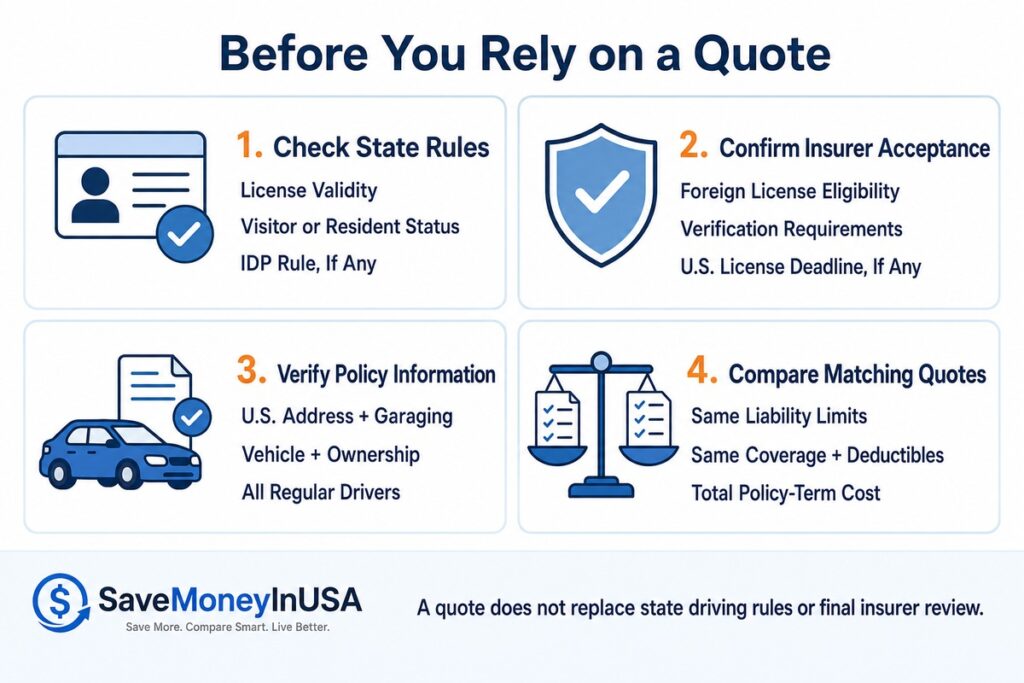
Before relying on a quote, confirm all three points:
- Driving eligibility: Does the state allow you to drive with your current foreign license and, if applicable, an International Driving Permit?
- Insurer acceptance: Will the company issue the policy with your current license, and must you update it later?
- Policy accuracy: Are your address, garaging location, vehicle use, regular drivers, and ownership details correct?
Do not assume that an online price means the application has been fully reviewed. Ask the insurer or licensed representative to confirm the license type shown on the application before paying.
State Driving Rules and Insurer Rules Are Different
This is the most important distinction in the article. A state government decides whether a person may legally drive. An insurance company separately decides whether it will accept an application and how it will underwrite and price the risk.
| Question | Who Decides? | What to Confirm |
|---|---|---|
| May I drive with my foreign license? | State licensing authority | Visitor or resident status, license validity, age, and any IDP rule |
| May I register the vehicle? | State motor vehicle agency | Identity, residency, ownership, insurance, and registration documents |
| Will my license be accepted for a policy? | Insurance company | Foreign-license eligibility, verification, and any deadline to obtain a U.S. license |
| What will the policy cost? | Insurance company | Driving history, location, vehicle, use, coverage, deductibles, and other lawful rating factors |
USAGov advises non-citizen drivers that requirements depend on the states they visit and that some states may require an IDP together with a license from the driver’s home country. Use the official state motor vehicle agency rather than relying on a general blog or school forum.
For example, California says an adult visitor with a valid license from another state or country may drive while the home-country license remains valid, but California residents must have a California driver’s license. This is only a state example—not a nationwide rule and not a promise that an insurer will accept the foreign license.
Foreign License vs. IDP vs. U.S. License
| Document | What It Does | What It Does Not Guarantee |
|---|---|---|
| Valid foreign driver’s license | Shows driving authorization issued by the home country | Legal driving in every state or acceptance by every insurer |
| International Driving Permit (IDP) | Translates identifying and license information for use with the original license | It does not replace an expired, suspended, or missing original license |
| U.S. state driver’s license | Provides a state-issued driving credential and begins a local motor-vehicle record | Lower premiums, policy approval, or a particular coverage option |
An IDP should generally be treated as a supporting translation, not a stand-alone license. Whether it is required depends on the state and situation. A student should obtain any needed IDP from an authorized organization in the country that issued the original license before traveling; the United States does not issue an IDP for a foreign license.
Do not buy a document advertised online as an “international driver’s license” without checking whether it is officially recognized. It may have no legal value.
How the Vehicle Situation Changes the Insurance Answer
License eligibility is only one part of the application. The appropriate insurance starting point also depends on who owns the vehicle and how the student uses it.
| Driving Situation | Insurance Starting Point | Important Check |
|---|---|---|
| Own a car | Personal auto policy | Make sure ownership, registration, garaging address, and regular drivers are accurate |
| Finance or lease a car | Personal auto policy plus contract-required protection | Confirm collision, comprehensive, deductibles, and lender or lessor requirements |
| Regularly borrow a household or roommate’s car | Existing vehicle policy may need to list the student | Disclose regular use; do not assume permissive-use coverage is enough |
| Rent occasionally | Rental agreement, rental protection options, and any applicable personal or card benefits | Read exclusions, liability protection, and damage-waiver terms |
If the student finances or leases a vehicle, review our guide to coverage requirements for financed cars. A lender’s contract can require collision and comprehensive even when those coverages are not part of the state’s minimum insurance law.
Information to Prepare Before Requesting Quotes
Prepare the information that most applications use, but do not assume that every company requires the same identity or immigration documents.
Common Quote Information
- Full legal name and date of birth
- U.S. residential address and the vehicle’s actual garaging location
- Valid foreign license details and a U.S. license number if one has been issued
- Vehicle year, make, model, VIN, ownership, and financing or lease information
- Estimated mileage, vehicle use, and all regular drivers
- Prior insurance and driving history, if available
- Requested liability limits, optional coverages, and deductibles
Documents That May Be Requested
A company or state agency may request an IDP, proof of address, vehicle purchase or registration records, or additional identity documents. A passport, visa, I-20, DS-2019, I-94, student ID, or Social Security information may be relevant in a particular process, but none should be presented as a universal requirement for every insurance quote.
Use our separate international student insurance document checklist to organize the information without mixing DMV requirements with insurer requirements.
Why a Foreign-License Quote May Cost More
A student may have years of safe driving abroad but little or no driving record that a U.S. insurer can readily verify. Companies may handle foreign experience differently. Some may request supporting history; others may rate the applicant more like a newly licensed driver.
The license is not the only pricing factor. The National Association of Insurance Commissioners explains that insurers use underwriting to decide whether to accept a risk and rating to determine its price. Depending on state law and company practices, relevant factors may include:
- Driving experience and available driving record
- Age, location, garaging address, and annual mileage
- Vehicle type, ownership, use, and safety or repair characteristics
- Prior insurance and claims history
- Selected limits, optional coverages, and deductibles
- Other rating factors allowed in the state
Getting a U.S. license can create a local record and may expand the companies willing to review the application, but it does not guarantee a lower premium. For additional cost-control ideas, see how to lower a car insurance premium.
Choose Coverage Before Comparing Prices
The state’s minimum insurance or financial-responsibility rules apply regardless of citizenship or student status. However, the legal minimum may not be enough to protect the student’s finances or vehicle after a serious loss.
Start by checking the minimum car insurance requirements for the state. Then decide whether the vehicle needs collision and comprehensive, whether higher liability limits are affordable, and which deductible could be paid after a claim.
Our full coverage vs. liability guide explains the tradeoff. “Full coverage” is an informal phrase, not a standardized policy that covers every loss.
How to Compare Quotes With a Foreign License
- Verify state driving rules. Check the current motor vehicle agency guidance for the state where you live and drive.
- Choose one coverage package. Set the same liability limits, optional coverages, and deductibles for every quote.
- Use accurate license information. Identify the credential as a foreign license. Do not select a U.S. state merely to force an online form to continue.
- Ask whether the quote is conditional. Confirm whether documents must be reviewed before the policy can be issued.
- Confirm any U.S.-license deadline. Ask whether the company requires an updated license later and how the policy should be updated.
- Compare the complete term cost. Review the down payment, installments, fees, discounts, and total six- or twelve-month cost—not only the first payment.
- Save the application and policy records. Check the declarations page for the correct drivers, vehicle, address, limits, and deductibles.
Insurance acceptance and pricing can vary substantially between companies. Comparing matching coverage is more useful than comparing a minimum-coverage quote with a broader policy.
Should International Students Get a U.S. License?
A student should apply for a state license when required by state law. Even when immediate conversion is not required, a U.S. license may be practical for someone who will live and drive in the country for an extended period.
A state license can make it easier to maintain a local driving record, update insurance, and handle vehicle or identity transactions. The application documents and deadlines vary by state and by the student’s circumstances, so use the official state licensing agency instructions.
After receiving a U.S. license, contact the insurer promptly. Do not assume the company will automatically discover and replace the foreign-license information.
Common Mistakes to Avoid
- Confusing insurance with driving permission: A policy does not make an otherwise invalid license legal.
- Treating an IDP as a stand-alone license: It normally supports the original valid license rather than replacing it.
- Buying a car before checking insurance: Obtain realistic quotes using the vehicle or VIN before completing the purchase.
- Using the wrong address: Give the actual residence and garaging location, even when the mailing address is different.
- Leaving out regular drivers: Disclose household members or roommates who regularly use the vehicle when the insurer asks.
- Canceling coverage during a school break: A registered, financed, leased, stored, or occasionally used vehicle may still create insurance obligations or financial risk.
Frequently Asked Questions
Can I get car insurance with only a foreign license?
Some insurers may accept a valid foreign license, but others may require a U.S. license or additional verification. You must also be legally permitted to drive under the rules of the state where you live and drive.
Is an International Driving Permit enough?
Generally, no. An IDP is used with the valid original license and does not replace it. State and insurer requirements still apply.
Do I need a Social Security number to get a quote?
Requirements vary. Some companies may be able to quote without an SSN, while others may request one or use another identity-verification process. Ask how the company handles applicants who have not been issued an SSN rather than entering inaccurate information.
Do international students need full coverage?
Not automatically. State law typically focuses on liability or financial responsibility, while a lender or lessor may require collision and comprehensive. Owners of paid-off cars should decide based on the vehicle’s value, replacement ability, and risk tolerance.
Will a U.S. license make my insurance cheaper?
Not necessarily. It may improve access to insurers and create a local record, but the premium still depends on the company, state rules, driver, vehicle, location, coverage, and other rating factors.
Final Thoughts
International students may be able to get car insurance with a foreign license, but the correct sequence matters: verify state driving rules, confirm insurer acceptance, provide accurate vehicle and address information, and compare the same coverage across companies.
Do not treat an IDP, an online quote, or an insurance card as proof that every legal and underwriting requirement has been satisfied. Confirm both the driving rule and the policy requirement before relying on the coverage.
Sources
- USAGov — Driving in the U.S. if You Are Not a Citizen
- National Association of Insurance Commissioners — Auto Insurance
- California DMV — Requirements for a California Driver’s License
About the Author
The SaveMoneyInUSA Editorial Team researches car insurance costs, coverage options, state requirements, and quote comparison considerations for drivers in the United States.
Learn more about our Editorial Team.
Disclaimer
SaveMoneyInUSA is an independent informational website and is not an insurance company, broker, or agent.
Some links may be affiliate links. We may receive compensation from partners at no additional cost to users.
Insurance rates, coverage options, eligibility, licensing rules, and document requirements vary by state, provider, and individual circumstances.
This content is provided for educational purposes only and should not be considered insurance, legal, immigration, or financial advice.